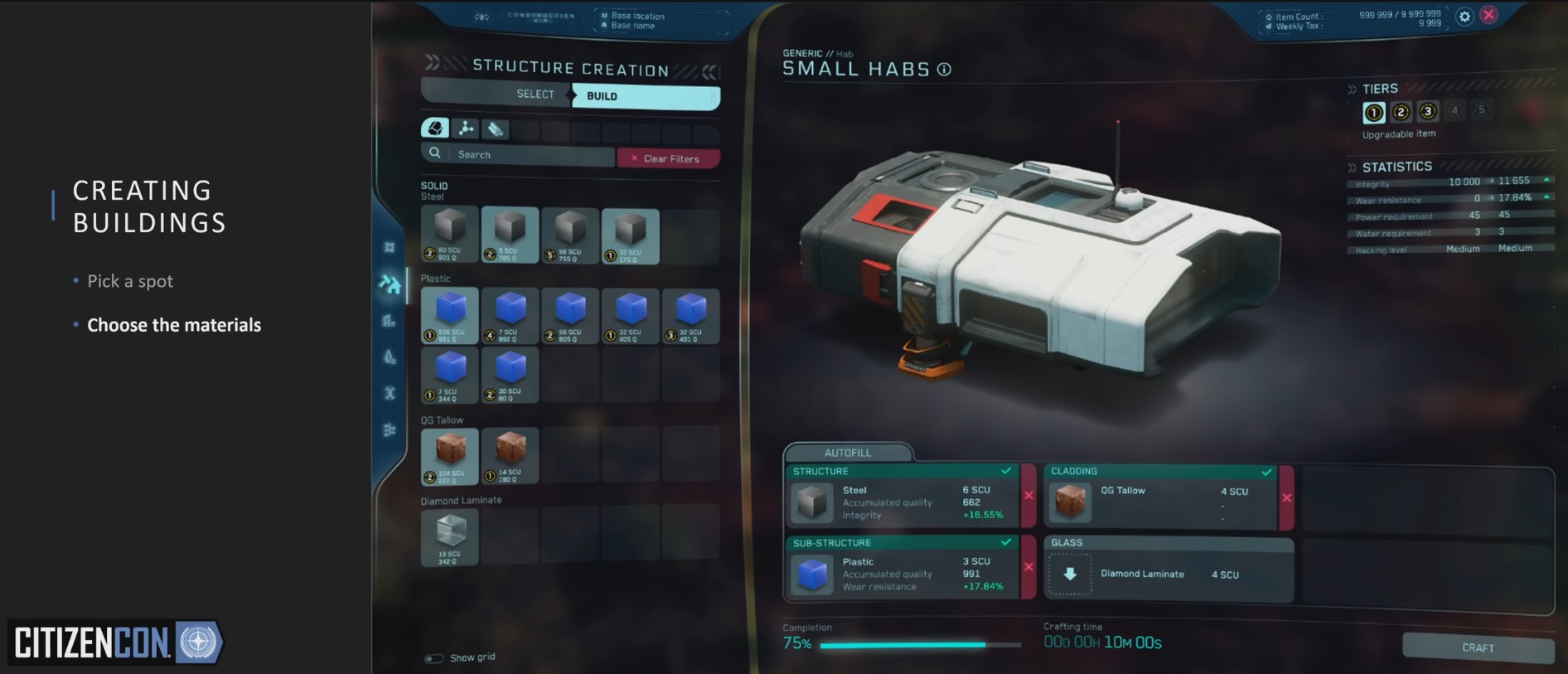
Let me set a scene for you. You’re in a chat about a game you like. Someone brings up a new crafting system. You think: finally, a feature that could be both deep and accessible. You offer a reasonable suggestion for base building: let players spend in-game money to speed things up a little. Simple. Logical. Fair.
Then the pushback starts.
“That breaks immersion.” “In real life, building a base takes time.” “It doesn’t feel earned.”
And you sit there thinking: we’re talking about a game with faster-than-light spaceships.
What a Sandbox Game Actually Promises
A sandbox game, at its core, is a promise. It says: here is a world, and here is your freedom. The term comes from the physical sandbox; a place with no rules, no right answer, no single way to play. You build, destroy, explore, and create on your own terms. Games like Minecraft, Grand Theft Auto, and Star Citizen built their identities on this promise.
Part of that promise, and this is the part people sometimes forget: two players can approach the same objective completely differently. One player storms a base head-on. Another scouts it for an hour and finds a backdoor. A third recruits friends and overwhelms it with numbers. No path is wrong. That is the sandbox.
When a game removes options from its players, it is betraying the idea of a sandbox. Every time a developer or a community argues to restrict how players can engage with a system, they are quietly chipping away at the very thing that makes the genre great.
Waiting Is Not Gameplay
This needs to be said plainly. A countdown timer is not gameplay.
Sid Meier, one of the most celebrated game designers in history, built his career around the idea that every moment in a game should present the player with an interesting decision. A ticking clock that asks nothing of you, requires nothing from you, and teaches you nothing. It’s a wall.
I was in a Star Citizen chat when this came up. I was honestly surprised at the reaction at me suggesting the ability to expedite base building. Did I say make it instantaneous? No. I suggested giving players a baby base… didn’t get a chance to finish my sentence. I said expedite the first base and leave the others alone. No. Make it expensive. No. I tried to clarify that giving the option for players that legitimately don’t have the time to wait… NO! For a player to get a base in Star Citizen, they had to acquire the land, and the resources. The hard work is done. Chris Roberts (co-founder of Cloud Imperium Games) has to get unnecessary time gaits right or people will not play the game. And let me be very clear here: enough people for the game to thrive. Games have these features to thrive.
Chris already knows this. CIG made a conscious, deliberate decision to compress space travel into something that takes minutes instead of the months it would take in reality. Why? Because we understand that fun takes priority over strict simulation. The moment you accept that, the argument against expediting a base construction timer starts to look a lot shakier.
The expedite system already exists in Star Citizen. Ships can be expedited. The infrastructure is there. The philosophy is already baked in. Extending it to base crafting is not a radical new idea. It’s a logical, consistent application of something players already accept.
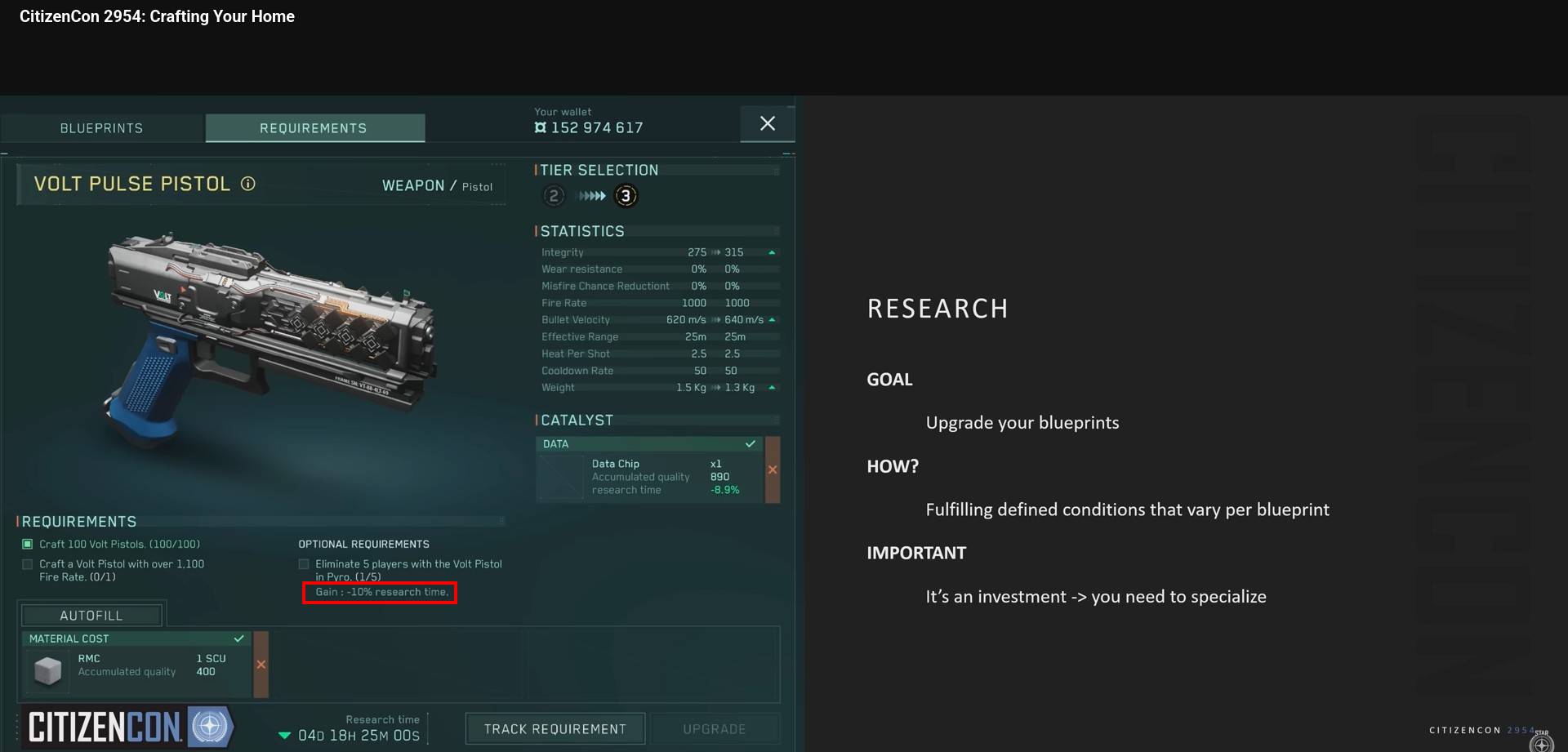
It’s not like they aren’t building expedite into crafting. Please note: the timer on this gun is subject to change (4 days).
Let’s Be Fair to the Other Side
I want to be honest here, because the immersion argument is not entirely without merit.
There are players for whom the slow build is the point. The anticipation, the waiting, the moment when something finally completes… that emotional arc matters to them. It is a legitimate playstyle, and it deserves respect. Some of the most beloved game moments in history come from patience paying off.
But, and this is the part that gets lost, an option does not force anyone to do anything. If you want to wait, wait. Nobody is taking your slow build from you. The expedite button only threatens your experience if you have decided, somewhere deep down, that other people must play the same way you do. That’s wanting control.
The real question is not “should expediting exist?” The real question is: why does someone else’s shortcut bother you at all?
The Real World Already Answered This
The people against expediting on realism grounds had, without realizing it, made the case for it.
In real life? The rich throw money at problems to make them go away faster. Premium service, expedited shipping, fast-track applications, priority construction, etc. It’s one of the oldest and most universal human dynamics in existence. If we are invoking real-world logic, then paying in-game currency to speed up your base construction is not a fantasy. It’s one of the most realistic things in the game. It should be a valid playstyle.
Consider who is playing these games right now. Star Citizen started selling ships in 2012. The person who backed it years ago is now, at least, in their early thirties. Maybe married. Maybe has kids. Maybe works fifty hours a week and gets two evenings of gaming time if they are lucky. The player base did not stay young. It grew up. A game company that refuses to acknowledge that is ignoring real constraints in their community.
The Irony: Chris Roberts Already Did This
Here is where the argument against expediting gets truly difficult to defend. Not just philosophically. Historically.
Cast your mind back to 2012. Star Citizen launches on Kickstarter with a goal of $500,000. It hits that in a week. Then it keeps going. Then it blows past $2 million. Then $6 million. Then stretch goals start appearing. More star systems, more ships, orchestral scores, celebrity voice acting, capital ships, procedural generation. And with each new milestone, Chris Roberts said something that every backer understood intuitively: more money means we can do more, faster.
Chris put it plainly himself. The stretch goals existed, in his own words, to make things CIG had imagined but didn’t think they could afford possible. Hiring additional artists to build more ships at once, funding systems that would have otherwise taken longer or never existed at all. The crowdfunding side, he explained, helped determine how ambitious they could be upfront. That is expediting.
The entire Kickstarter campaign was, at its core, backers paying to speed things up. Not to change what the game was, but to compress the timeline, to unlock content sooner, to resource the vision more fully than would otherwise have been possible. The community did not call that immersion-breaking. They called it backing a dream.
Star Citizen has raised almost a billion dollars from its community since that first campaign. The game is still in development more than a decade later. The honest truth is: without that staggering level of funding, it would be nowhere near where it is today. The money didn’t make development instant. It made it possible at a scale that would otherwise have been unimaginable. The funding expedited the vision, even if it could not expedite every challenge that came with it.
I hope Chris thinks about this very carefully when he’s adding timers to a sandbox.
Diversity of Play Is Not a Weakness
Developers, the good ones, have said this for years. Options are not a sign that a game lacks vision. Options are the vision. The best sandbox titles in history succeeded not because they forced players into a single experience, but because they gave players the tools to build their own.
Skyrim has console commands on PC. ARK: Survival Evolved lets server administrators dial up harvest rates, turn off timers, and reshape the experience entirely. RuneScape lets players buy materials on the Grand Exchange instead of grinding, trading gold for time. Warframe lets you rush crafting timers with in-game currency based on real-money currency. They are features. Intentional, player-respecting features.
The games that survive decades are the ones that understand their players’ change. Life changes. Time changes. Priorities change. A game that grows with its community instead of demanding the community bend to it… that is a game worth playing for another decade.
Why This Actually Matters
Many gamers play games to escape the frustrations of real life. To explore worlds they will never visit. To do things that physics, circumstance and bank accounts will never allow. To be powerful, creative, free… even if it’s just for an hour on a Tuesday night after the kids are in bed.
The immersion argument assumes that realism is the highest goal of a game. For most people, most of the time, the highest goal is joy. Connection. A sense of progress in a world that sometimes feels like it offers none. That is not a trivial thing. That is deeply, profoundly human.
When we argue to take options away from each other in a game built on freedom, we are making someone else’s Tuesday night a little smaller. And for what?
Give people the option. Let them choose. That is what the sandbox was always for.
Please Note: I have no opinion on having a personal base (for myself). IMO, I cannot make an informed decision on whether I want one until more game mechanics are in the game. Right now, a penthouse in Terra sounds mighty nice…