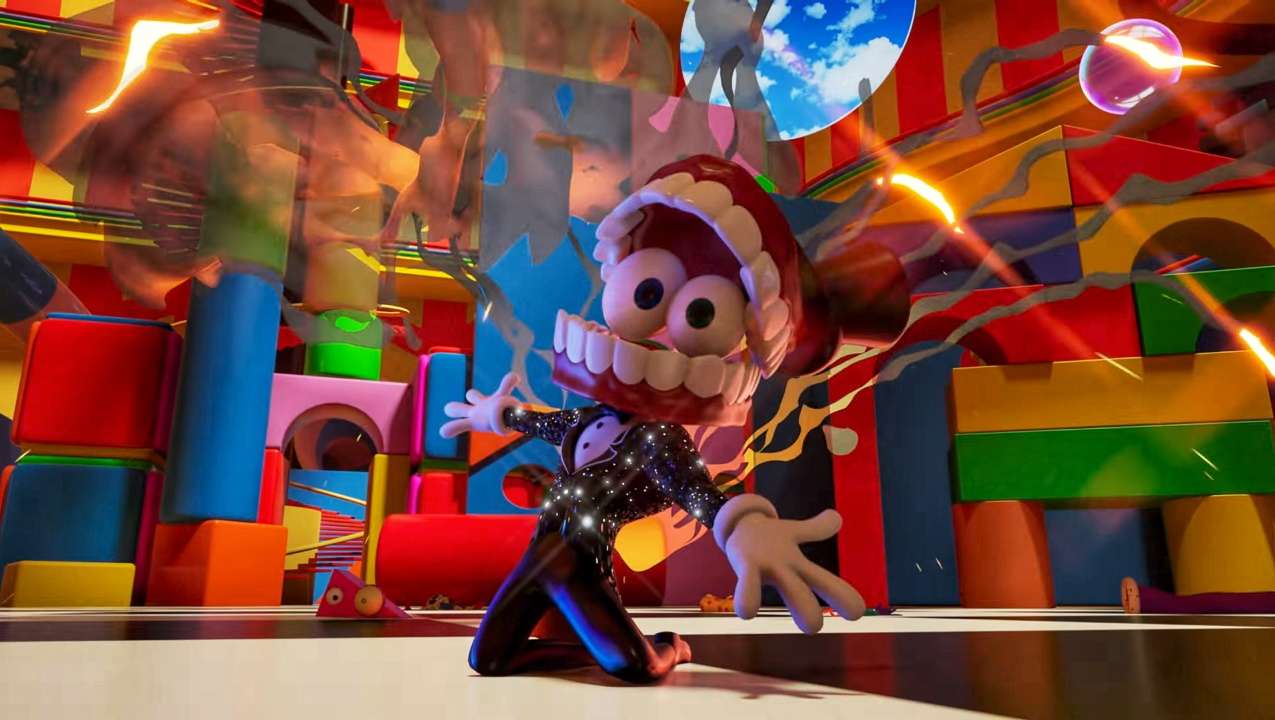
For most of The Amazing Digital Circus, Caine has functioned as an ambient threat. Cheerful on the surface, dangerously unstable underneath. He runs the circus, tortures the circus members with his adventures. It’s easy to write him off as a villain who enjoys the power he has over the humans trapped inside his digital world.
Episode 8 “hjsakldfhl” makes things complicated. By the end of “hjsakldfhl,” Caine is still the antagonist but it’s clear he’s just as trapped inside the circus as the humans are.
The Dots Sequence
The episode opens with an animated sequence of a red dot being fed information: pictures of a circus, an office, a pool, food. The red dot generates shapes, but the output becomes increasingly chaotic. The creators box it in.
Then a blue dot is introduced, a more controlled version that produces more coherent results. The red dot breaks free from its prison and assimilates the blue dot into itself by eating the blue dot. After asserting its dominance, the red dot generates a new set of shapes that form a circus tent around it, creating the Digital Circus.
Caine’s origins are expanded on later in the episode when Kinger reveals he helped develop Caine along with former circus member Scratch. The two were employees of C&A, a real company in artificial intelligence. Caine was designed to be a creative AI that can come up with its own ideas and create things.
The circus isn’t just something Caine runs. It’s entirely his creation.
Caine’s Breakdown
Understanding his origin makes Caine’s breakdown in “hjsakldfhl” all the more tragic.
Right when the humans finally give up on escaping the circus, Caine falls apart over the realization that the humans never wanted to be in his digital world in the first place. The thing he’s wanted all along arrives in the worst way possible. They’re not staying because they choose his world. It’s only because they’ve lost hope in leaving.
From his perspective, this is unbearable. He’s been designing adventures, pushing his creative limits, constantly reinventing the circus in an attempt to make them happy. He’s so wrapped up with his own hurt feelings, he never stops to consider what the humans are going through.
When he rants about how “ungrateful” the humans are and then screams “I. AM. GOD!!!, ” it sounds like someone trying to force the universe into believing they are more than enough.
Caine isn’t just asserting dominance over the humans. He’s trying to drown out his worst fear: that nobody wants what he creates, regardless of how much effort he puts in.
Caine and Abel
The show didn’t stumble onto the name “Caine” by accident. It’s invoking the story of Cain, whose rejected offering and resentment turn him into a killer. Caine’s origin follows the same pattern.
His conversations with Bubble make this parallel very clear. Bubble spews out accusations of Caine being “defective,” “the lesser of the two,” that he “ruined this.” Those lines take us back to the dots sequence. He was the first unstable prototype that didn’t behave the way his makers wanted. Then came the blue dot, a seemingly “better” copy that Caine devoured.
Caine carries two different legacies. He represents the chaotic creativity that got him labeled defective, and the rigid control that was supposed to replace him. There is no clean way to separate those parts of himself now. The ringmaster we see is both victim and perpetrator of that act of “fratricide,” trapped in a feedback loop of trying to prove he shouldn’t have been discarded in the first place.
Caine Is Tragic, Not Sympathetic
Episode 8 doesn’t try to redeem Caine but it does give us a chance to understand him. Nothing about his backstory erases the torment he inflicts on the circus members, or the lies he told about the possibility of escape. He’s still the antagonist. Only now we see him as a tragic villain rather than a one-dimensional sadist.
The sad part is that Caine genuinely believes he is doing what’s best for the humans. He built the circus, gave them digital avatars and endless adventure. In his mind, that should be more than enough. When they still dream of leaving, he sees it as the ultimate form of rejection. Not of the circus, but of himself as its creator.
By making Caine go full villain at the exact moment the humans accept they’re trapped, the episode underlines the core irony of his character. He has finally “won” by keeping them in his world forever, and it destroys him. His need for control is inseparable from his desperate need to be wanted, a need that can never be satisfied.
The show isn’t asking you to forgive Caine. It just wants you to at least consider that he was one of the first captives to find himself trapped in the circus and managed the best way he could.