Before he was Doctor Doom, ruler of a fictional European country called Latveria, he was Victor von Doom, a kid from a poor family. His father, Werner, was a traveling healer. His mother, Cynthia, was a witch gifted in sorcery. From the beginning, Victor had an interest in both science and magic and those interests ended up defining his life.
Peter Parker, on the other hand, is a teenager from Queens who got bitten by a radioactive spider. He ended up with a spider’s strength, speed, and grip, plus a sixth sense that warns him when danger’s close. After his Uncle Ben was killed, Peter learned being a superhero is a huge responsibility. If he slacks, people get hurt. As Spider-Man, he’s trying to make up for that.
Both of them are about to learn a lesson.
Doom Picks His Pawn
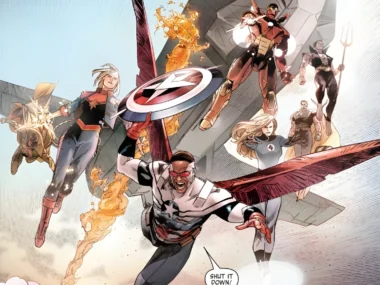
Doom truly hates Reed Richards, dating back to when they were in college. His hatred has spread to the Fantastic Four, who got their superpowers from a botched space mission. Reed can stretch his body, his wife Sue can generate powerful force fields, as well as turn herself and others invisible. Sue’s younger brother Johnny can control fire, cover his entire body in flames and fly. Ben Grimm, a friend of Reed’s from college, has stone for skin that gives him incredible strength and endurance.
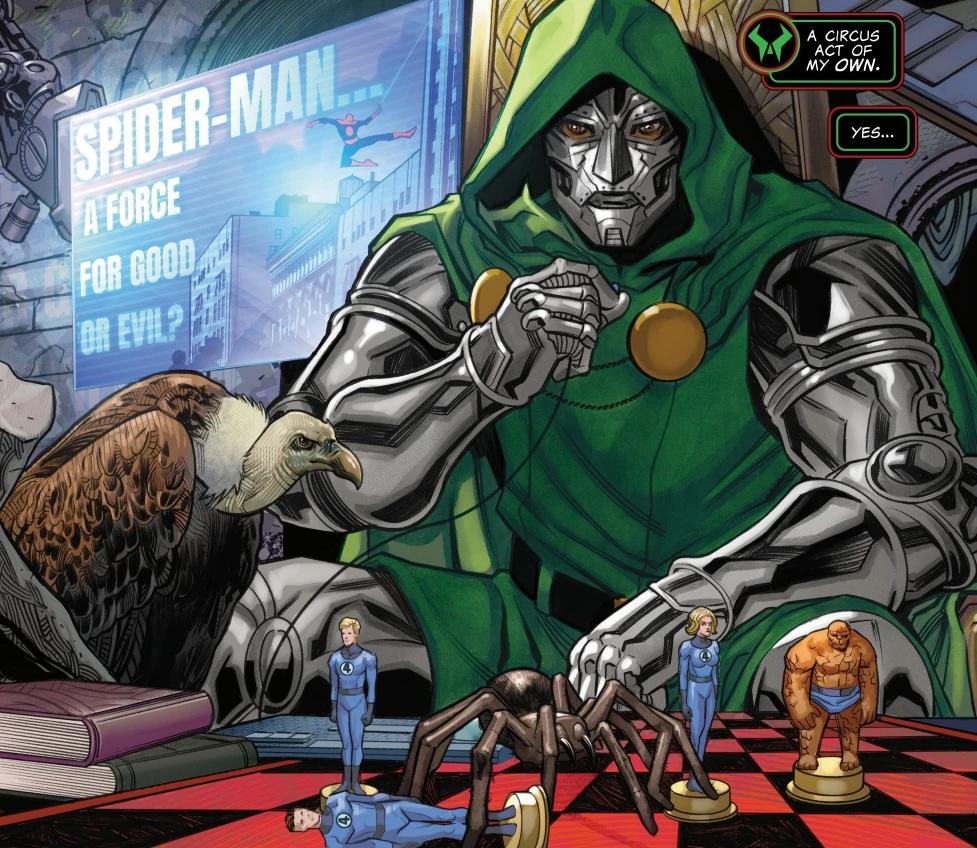
In Doom’s private journal, he complains that Reed would be easy to kill, but Reed’s “family of circus acts,” (his teammates), keep getting in the way. Honestly, it’s mostly Sue that gets in the way since she’s the most powerful member on the team and the only member who can take him on in a direct fight. Doom compares his situation to a chess match: he can’t get to the king without first removing the other pieces.
He decides to enlist Spider-Man to help.
Spider-Man Learns a New Trick
Meanwhile, across town, Peter is in his room tinkering with his web shooters. He’s suited up, without the mask. He figured out how to make his webbing shoot out like a baseball and he’s not being quiet about it.
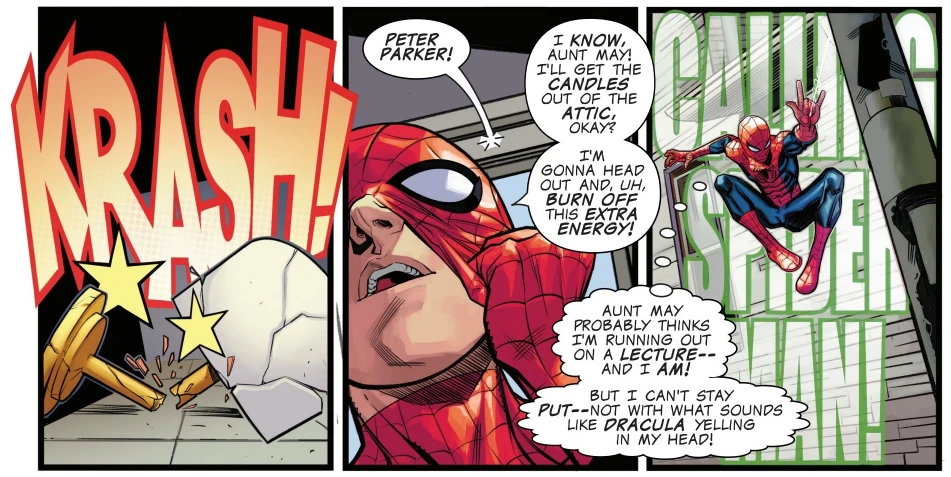
Aunt May hears the noise from downstairs wondering what Peter’s doing? He makes an excuse about tossing a baseball around. Then immediately thinks to himself that if she came up and caught him bouncing off the ceiling, it might genuinely give her a heart attack (she has a bad heart). He’s also stressing about money. The paycheck he gets from selling pictures to his boss, J. Jonah Jameson, goes straight to rent. If he breaks something in the house, there’s no budget to replace it.
Suddenly, a loud sound blasts through his head, like a siren only he can hear, causing him to break a lamp. It’s not clear what’s causing it (yet). Peter throws his mask on and heads out, telling Aunt May he’ll grab some candles from the attic. He knows she probably thinks he’s skipping a lecture. He is, but he needs to find the source of the noise.
The First Meeting
The noise leads him straight to Doctor Doom.
Peter recognizes him immediately, since Doom is famous for being one of the Fantastic Four’s most dangerous enemies. He asks how Doom knew about his spider sense, and whether Doom can track it. Doom’s answer, “I am Doom, that should tell you enough,” and admits he hasn’t tried tracking it yet, but wonders if he should.
Spider-Man cracks jokes when he’s nervous (you should quote one of the quotes he’s making in this scene). It buys him time to think, lets him read the other person, and usually throws his opponent off guard. That approach doesn’t work on Doom because Doom doesn’t “do” jokes.
Doom gets straight to the point. He offers Spider-Man power, enough power to rule the world…if he chooses to stand by Doom’s side. Spider-Man, being Spider-Man, quips if this is some kind of job interview. Doom, meanwhile, thinks to himself that he’s got Spider-Man exactly where he wants him.
Then Doom points out that Spider-Man is struggling financially. He can’t afford a decent costume. He can’t operate in public because the cops and the press are always hunting him down for wearing a mask. In comparison, the Fantastic Four, who broke the law by stealing an experimental rocket, are treated like celebrities. Why does Spider-Man get treated like a villain while they get treated like royalty? Why doesn’t Spider-Man have what they have, or more?
Doom doesn’t believe any of this connects the two of them. In his mind, his mask is nothing like Spider-Man’s, not even close. He’s trying to find Peter’s weak spots, envy and pride. Feelings Doom considers beneath him. Doom figures if Peter can be manipulated that easily, getting rid of him later will be easy.
Doom continues by pointing out that the Fantastic Four live in a million dollar penthouse and wear fancy unstable molecule costumes while Peter’s suit is homemade and saggy. Then he asks Peter an interesting question: has the Fantastic Four ever offered to help him?
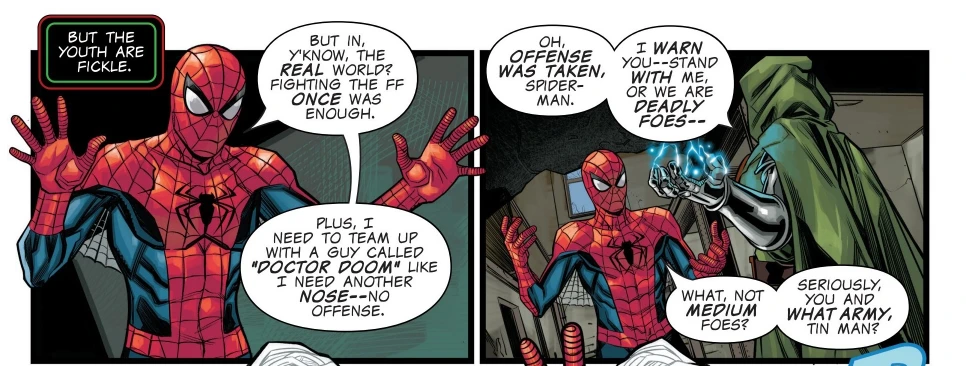
For a moment, Doom is convinced he got to Spider-Man. Spider-Man says fighting the Fantastic Four once was rough enough, and teaming up with someone named Doctor Doom sounds as appealing as growing a second nose.
Doom doesn’t take that well. He warns Peter that they’re now enemies, deadly ones. Peter jokingly asks if they could be “medium” enemies instead, and calls Doom “tin man.” Doom isn’t going to take that joke well. We know, from the previous issue, what Doom went through to get his metal armor.
They start fighting. Spider-Man throws webs at Doom, sticks him to a wall, and cracks a joke about how he’s used to putting guys like Sandman on ice, so Doom doesn’t scare him.
Doom’s eyes start glowing red, and he says, “You asked what army? The robots repy: This one.” A door opens up revealing an “army” of robots built to look like Doom. Spider-Man can’t help himself and jokes that between the mask, the cape, the armor, the accent, and now robot doubles of himself, Doom is overdoing it.
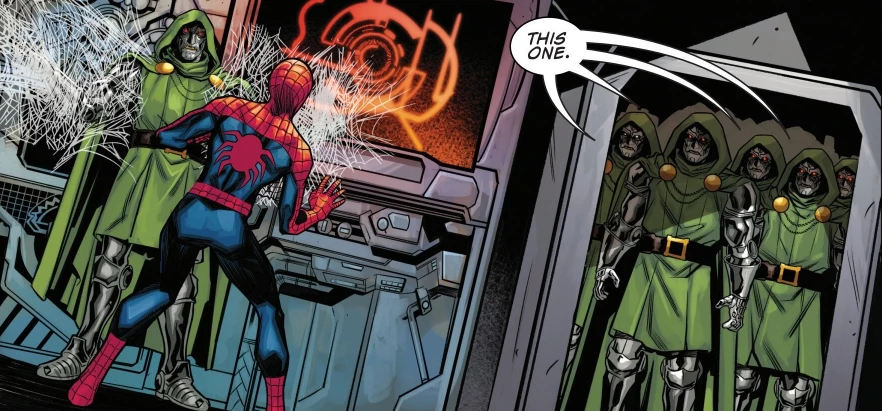
Doom seems amused by that one, calling Spider-Man quick-witted before revealing that one of the robots’ faces is hiding a bomb with a countdown. Spider-Man realizes it’s time to leave. The building explodes, and Peter is thrown into the water. As he’s swimming away, he’s panicking, not about the explosion itself but about whether there might have been homeless people sheltering in that supposedly abandoned building. Peter is stunned that Doom blew up the building because he made a joke and had no empathy for who could’ve been in the building.
Turns out later Doom picked it because it really was deserted, but Peter has no way of knowing that at the moment.
Doom considers the meeting a partial success. Spider-Man didn’t fear him going in. He definitely does now.
The Second Meeting
The next day, Doom writes in his journal that he can roughly track Spider-Man’s spider sense to a general area. He’s narrowed Spider-Man’s location down to Queens and set his robots loose using image recognition to find him. The robots end up capturing some random kid running around in a homemade spider costume, better made than Peter’s real one. Rather than waste the opportunity, Doom decides to use the kid as bait, hoping to lure Spider-Man or the Fantastic Four. Spider-Man shows up first.
They start fighting again. Doom throws magnetic force globes at Spidey, a blaster mounted on his finger, an electrified floor, a disintegration beam, a heat ray built into the floor, more robot doubles. The only weapon that actually works is the visual disrupter flakes, which makes Spider-Man vulnerable for a few minutes.
Before Doom can finish him off, the Fantastic Four show up. Spider-Man probably would have died if they hadn’t arrived when they did. Doom decides retreating is best, and so does Spider-Man. Doom gives Reed Richards a few seconds to look at the wreckage before blowing up the building again.
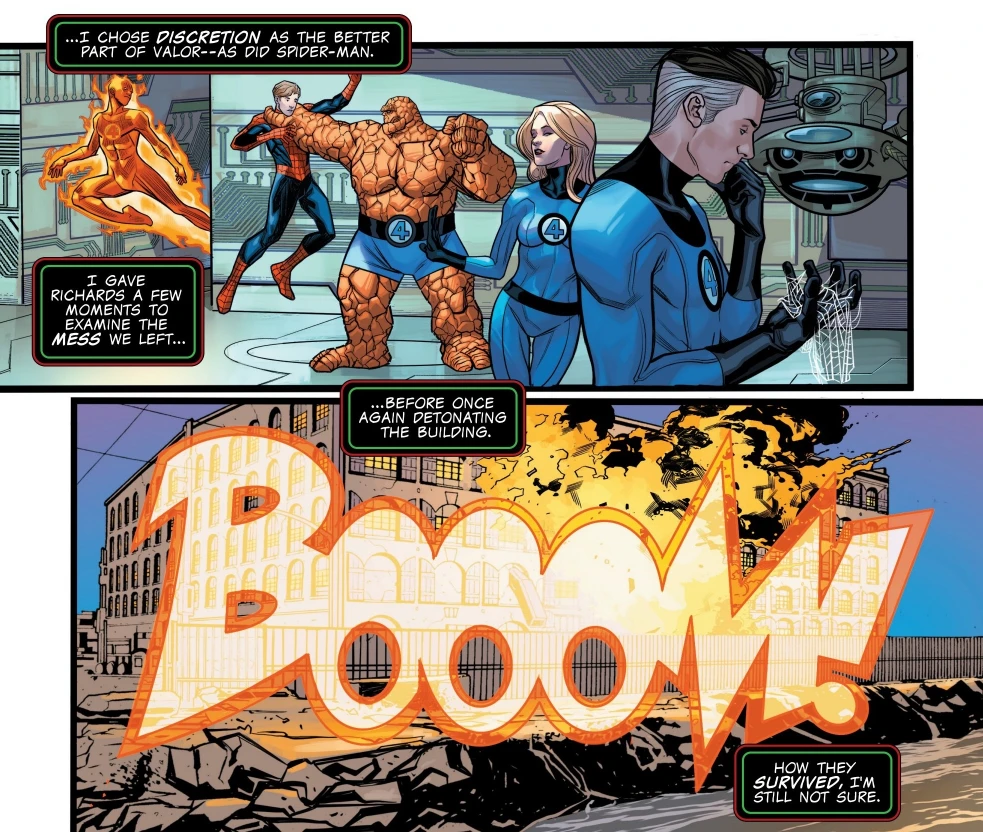
Somehow, everyone survives, and Doom doesn’t understand why. He guesses Reed built some kind of force field into their uniforms, or maybe those cosmic rays that gave the Fantastic Four their powers are upgrading their abilities. He decides it’s worth investigating and calls it a night.
The Third Meeting
By the third journal entry, you can tell the interactions with Spider-Man are wearing him down. He starts writing that he’s “humbled,” then immediately crosses it out and insists Doom remains undefeated, that in the long run he’s still winning against Richards and everyone else. He keeps stumbling over his own sentences, backing up and restarting, which is very unlike him.
Meanwhile, Spider-Man is swinging through the city singing “Take Me Out to the Ball Game” to himself, completely unaware anything’s wrong, when a creature covered in tentacles grabs him.
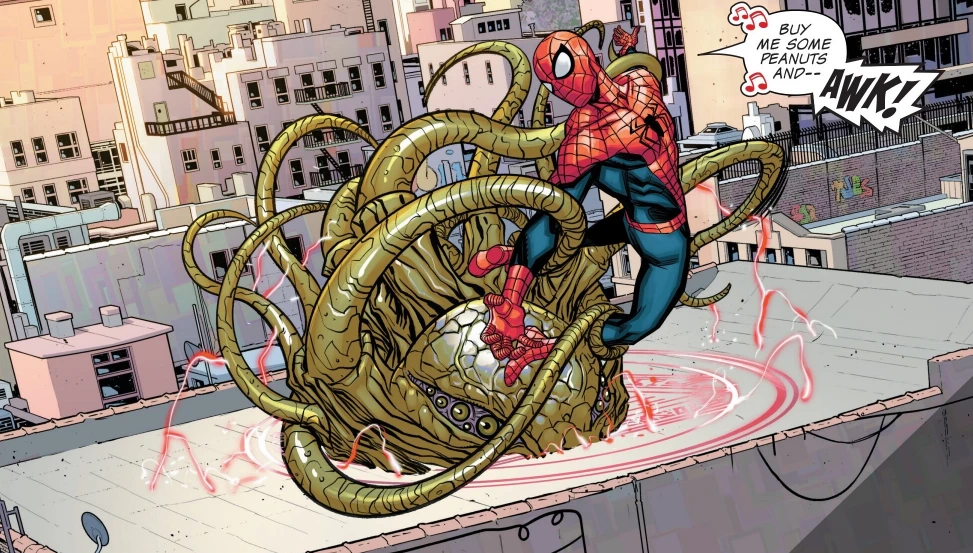
Doom is floating nearby, sitting cross-legged like he’s been waiting. He asks if Spider-Man really thought their last fight was the end of it, and whether Spider-Man thinks Doom is the type of man who takes a small setback lying down. Spider-Man admits he’d kind of hoped so, and asks what kind of special effects trick his floating is.
Doom corrects him. This isn’t fake, it’s real magic. Doom asks Spider-Man if he wondered what Doom was a doctor of? Spider-Man, makes another joke, says given all the evil gadgets, he’d thought Doom was a dentist.
Doom says Spider-Man is no longer useful for his war against the Fantastic Four, but admits he’s still curious about him. Spider-Man is just a teenager. What makes a kid that young risk his life, Doom wonders. Doom says if this were a different time, boys of fifteen used to carry a man’s responsibilities, but not now, not in America.
Doom says if Spider-Man wants to die like a man, he’ll grant that, but first he wants to share a theory. Doom explains he keeps his own face hidden because it’s scarred badly. If Spider-Man saw it, he’d feel sorry for him. Doom refuses to allow that. He says his mask doesn’t hide who he is, it reveals him, the same way Spider-Man’s mask reveals who he really is.
He goes on, telling Spider-Man that underneath his mask he’s a poor, awkward kid people would otherwise pity or mock. Putting on the costume, he becomes someone people notice, even if it means constant danger. Doom says the thrill, the drama, the chase, all of it, might be the real reward. Doom frames it as if he’s doing Spider-Man a favor by pointing this out.
That’s when Spider-Man finally loses his patience. He says it would be nice if someone understood him for once, instead of assuming he does this for thrills. He makes it clear he’s doing it because he has to. Spider-Man breaks free from the tentacle creature, something Doom didn’t think was possible, and lands on a nearby rooftop.
Spider-Man tells Doom there was a time he put himself first, and someone he loved died because of it (Uncle Ben). Every day he isn’t wearing the mask, he wonders who might be dying, who might be losing someone, all because he chose to sit in class instead of being out there.
Doom tries to tell him to calm down, but Spider-Man’s not done. He says if he gets arrested or killed, chances are somebody close to him pays the price for it.
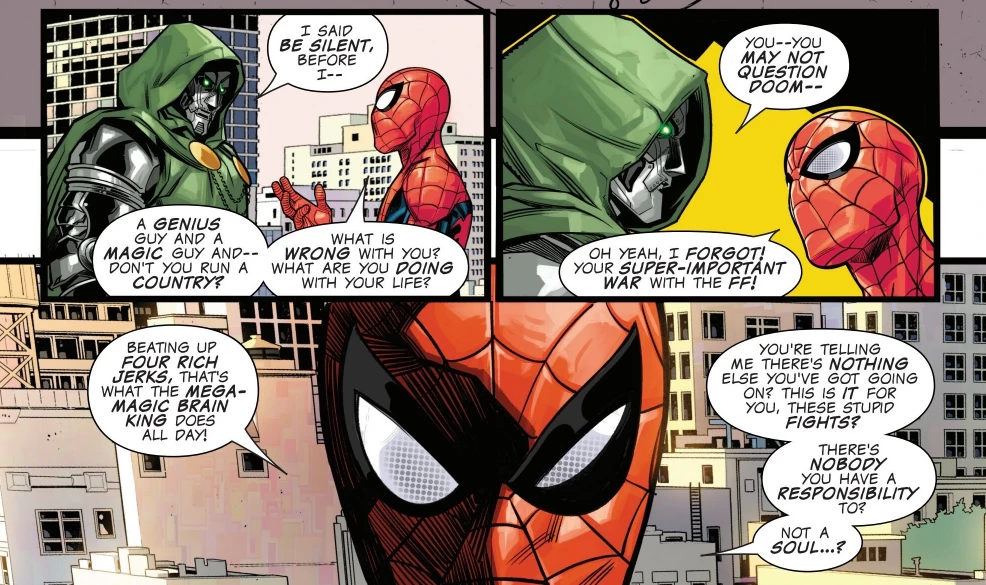
Still pissed, he turns it back on Doom saying he’s one of the most powerful people alive, a genius and a sorcerer who runs his own country, and asks what exactly is Doom doing with all of that power? Is beating up on four people the extent of his ambitions? Is there truly nobody or nothing he feels responsible for?
Doom looks like he’s been smacked. He tells him their fight is over, that he’s free to go. Spider-Man asks if that’s it? Doom confirms it is, and says that even though Spider-Man is a jester who cracks jokes to cope, the role of a jester has always been to say the true things nobody else dares tell a king. He tells Spider-Man to be grateful for his mercy, opens a portal and goes home.
Peter’s Hypocrisy
It’s not pointed out in the comic but Peter’s not telling the whole truth. It’s true that Peter genuinely cares about helping others. He’s a teenager but he’s old enough to understand that making jokes with Doom causes buildings to be blown up. While no one was in the building what are the odds of no one being injured or killed by the debris from the building blowing up?
This is a recurring theme in comics. Humans get hurt from the battles fought by superheroes. Are superheroes attracting villains? Logically, superheroes cost citizens a ridiculous amount of money repairing the damage done in those fights. Who pays for the buildings Doom blew up to be replaced? Taxpayers.
When Peter realized the jokes caused Doom to react more violently, moving the damage done from Peter to strangers, why didn’t he stop? The thrill? Ego in talking back to someone as powerful as Doom and surviving?
While Peter was correct in his assessment of Doom, so was Doom’s assessment of Peter.
Doom’s Reckoning
Back in Latveria, sitting on his throne, Doom reflects on everything that’s happened. He’d set out to see if Spider-Man could be useful to his plans against the Fantastic Four. In the end, he decides the real value wasn’t using Spider-Man. It was what Spider-Man’s question forced him to confront about his life and priorities.
He admits, almost begrudgingly, that a truly great mind has to be willing to keep growing. There’s no shame in learning something new, even from a “shallow” teenager in a homemade costume. He considers the experiment done. If he crosses paths with Spider-Man again, it’ll be for entirely different reasons. The thought makes him grip something in his hand so tight he breaks it.
Then his tone shifts completely. He says aloud, “I know you can hear me. It’s been years since we spoke. Ever since “the sabotage” that destroyed my face and shattered my illusions. I fell into a new one: believing I had already failed.”
Doom refuses to accept that anymore. He says failure is only for lesser men, and that with his power, success has to be inevitable. He has a responsibility to act. If he doesn’t do something, who will?
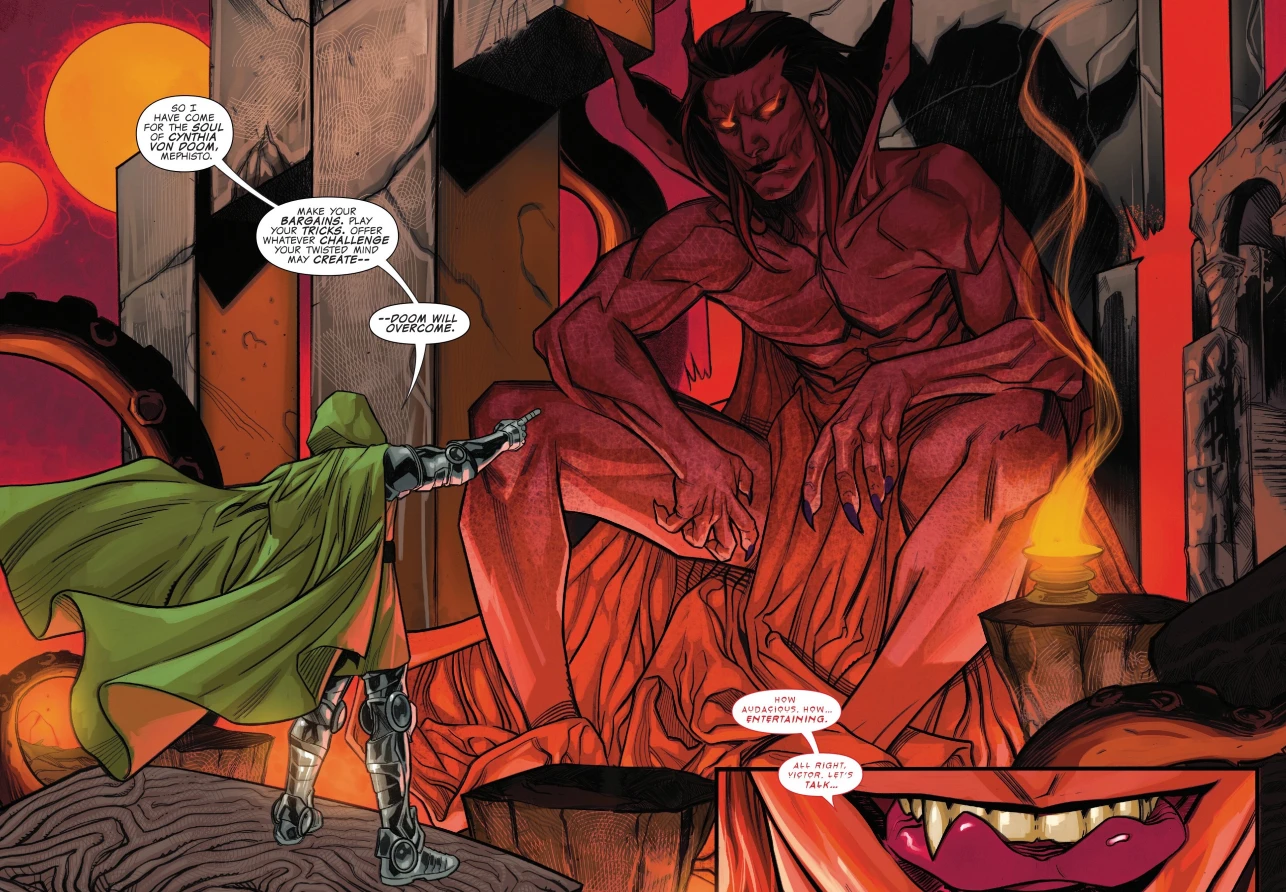
While he is saying this, he draws a magic symbol on the floor, performs a ritual, and opens a portal straight to Mephisto, the demonic figure who holds his mother’s soul.
Talking about his mother looking at Mephisto: “I have come for the soul of Cynthia von Doom, Mephisto.”
He arrives ready to fight for it, telling Mephisto to try whatever twisted tricks he has. Doom will overcome them.
Mephisto, clearly entertained, says, “Let’s talk.