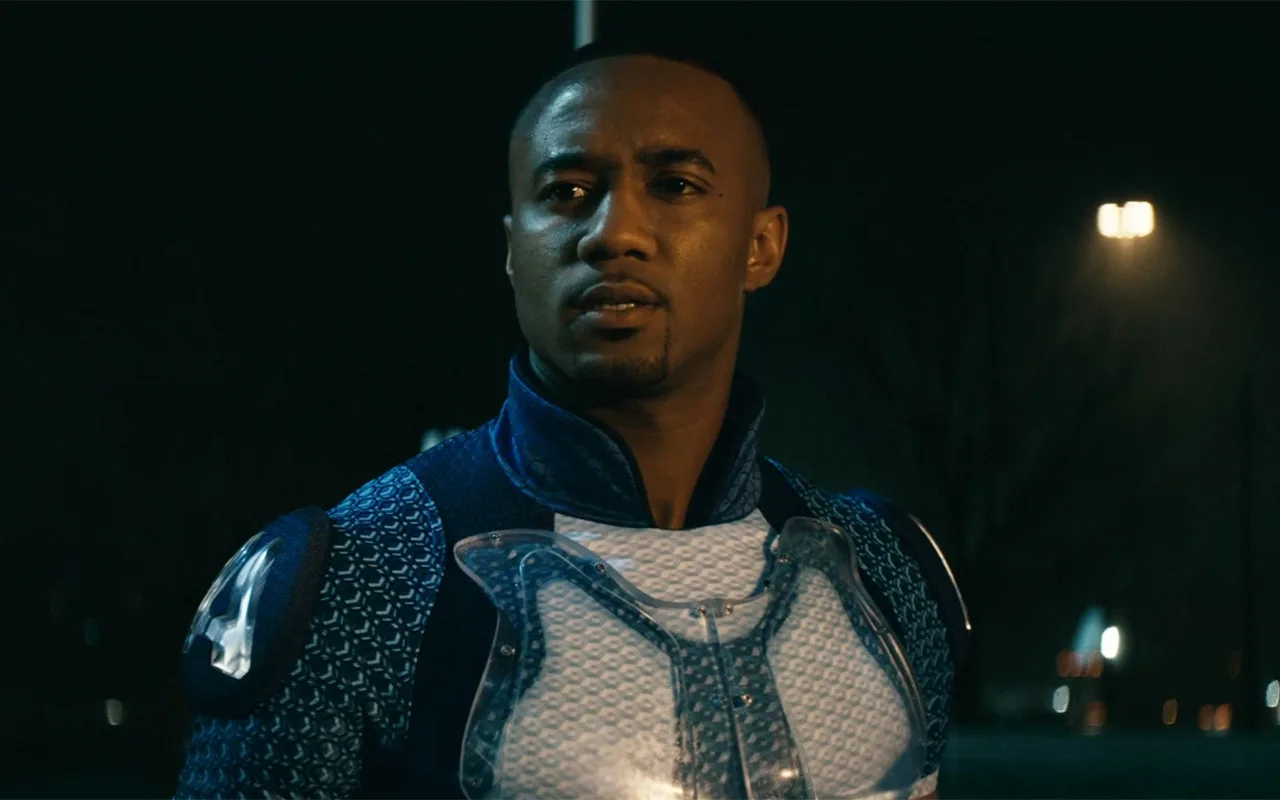
One story arc from Amazon’s The Boys that took fans off guard was A-Train having a redemption arc in season 4.
He put the events of the series in motion when he accidentally liquefied Hughie’s girlfriend Robin Ward while high on Compound V. Most of his actions revolve around maintaining his status as the world’s fastest man and staying in The Seven. Now, he’s risking everything to stop Homelander.
Performative Activism vs Genuine Action
Season 3 plants the seeds for A-Train’s arc through his laughably transparent rebrand. He shows up in an African-inspired costume, ready to capitalize on racial justice movements for publicity. His brother Nathan sees through it and calls him out for it. A-Train tries to do something genuine by going after Blue Hawk, a racist Supe who killed an innocent Black man.
A-Train tries to get The Seven to do something about Blue Hawk, but he gets rejected. This moment matters because it shows us where A-Train is on his journey. He wants credit for caring without accepting the risks. He eventually decides to kill Blue Hawk at the risk of straining his heart.
Why His Brother’s Paralysis Worked When Robin’s Death Didn’t
What really sets A-Train on the path to being a better person is when Blue Hawk attacks his brother Nathan, leaving him paralyzed.
Now at this point in the show, A-Train has witnessed or caused multiple deaths by this point. Robin Ward, obviously. His girlfriend Popclaw, whom he murdered on Homelander’s orders. Supersonic, whose death was the result of A-Train’s betrayal. None of these deaths inspired lasting change.
But Nathan’s paralysis breaks him.
It’s an ugly truth that some folks don’t want to acknowledge: proximity matters more than morality for most people. Some people develop empathy for strangers after they’ve understood suffering through people they love. A-Train needed to see his own brother hurt before he could genuinely grasp what he’d done to Hughie by killing Robin. He doesn’t suddenly realize all life is precious. He just starts to understand what he’s been doing to other people because now he knows what it feels like.
The Heart
A-Train’s heart problems function as a subtle metaphor for what state he’s in. His original heart fails from Compound V abuse and acts as the physical manifestation of his corruption and selfishness. He receives Blue Hawk’s heart after killing him. Now he literally carries the weight of both his brother’s trauma and his choice to finally act on principle.
A-Train gets a different kind of heart in season 4. MM recruits A-Train to become an unexpected ally to the Boys to stop Homelander from taking over the country. Growing disillusioned with Vought and fearing Homelander’s instability, he agrees to leak crucial information about Vought’s plans to the Boys. When A-Train rushes MM to the hospital in “Dirty Business,” he’s spotted by a little boy who looks up at him in awe.
He would later tell MM that saving him was the first time he felt like a real hero. It was his first real save, the first time he didn’t care about the cameras or hate himself for what he’s become. He was just doing something good.
Later in the season, A-Train saves Starlight and Butcher from The Deep and Black Noir II, revealing himself as the leak before leaving the country with his family.
But that’s not where his story ends. The season 2 finale of Gen V reveals he’s joined Starlight’s resistance against Homelander.
A-Train’s redemption isn’t about finding the goodness that was always inside him. He’s just replacing the need to feel special with a genuine desire to help others.
Does A-Train Deserve Forgiveness?
The Boys refuse to answer an important question: does A-Train deserve redemption?
There’s no denying that A-Train did some terrible things. He’s been complicit in Vought’s corruption for years. He’s gotten innocent people killed either due to carelessness or a selfish need to hang onto his fame. But he’s also risked his life to save the Boys multiple times. He tried to stop Homelander, and genuinely tried to become better even when it would have been easier to stay in line.
A-Train’s past and present are two sides of the same coin. One side doesn’t cancel out the other. A-Train is someone who has done unforgivable things and is trying to do better. Both things can be true without pushing a narrative demanding the audience see him as a hero. His journey is messy, incomplete, and uncertain. Just like actual change.