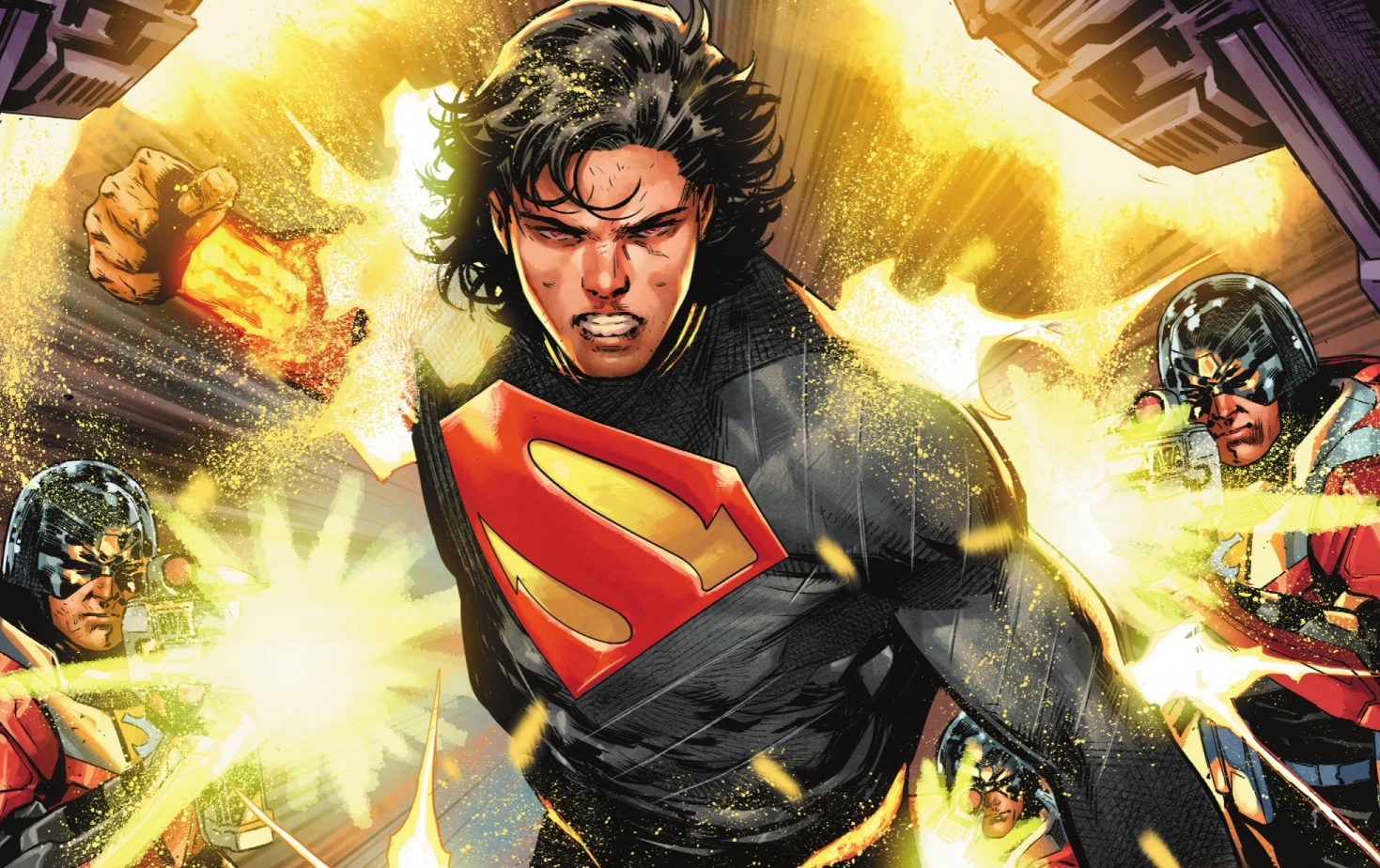
Superman doesn’t have to be the bright, hopeful hero we’ve known for decades. That’s what writer Jason Aaron and artist Rafa Sandoval proved with this arc. Instead, they are telling a darker, gritter story that is more complicated than the original version.
The arc jumps back and forth between two timelines. You see young Kal-El’s final years on the planet Krypton. At the same time, you watch adult Kal-El as he’s living on Earth like a fugitive, fighting a giant corporation. It’s a dual timeline structure that shows you how Krypton’s failure directly led to who he became on Earth.
Issue 1: “Down in the Dirt”
On Krypton: Picture a society split straight down the middle by class. At the top, you’ve got the ruling Science League. At the bottom, the Labor Guild. Everyone wears a caste symbol on their chest to show which group they belong to.
Kal-El’s parents didn’t start as regular workers. Jor-El and Lara Lor-Van were promising candidates to join the Science League. But they got blacklisted for speaking up. Lara criticized the fact that Krypton wasn’t exploring space. Jor-El warned that the Science League’s reckless experiments were destroying the planet. They lost everything and got pushed down to the Labor Guild because they were honest.
Now they work as a mining engineer and a mechanic in the farmlands called the Redlands. They wear their working-class status with pride. They call themselves the “People of Steel.” But Krypton’s about to show them it doesn’t care about pride. A mine collapse releases toxic green radioactive gas that burns anyone it touches. Jor-El barely survives.
This is the first sign that Krypton’s days are numbered.
On Earth: Fast forward to the present day. Adult Kal-El has spent years secretly helping exploited workers at mines and factories across the developing world, all run by a massive corporation called Lazarus Corp. He’s like an undocumented vigilante, staying hidden while he does what he thinks is right.
At a Brazilian diamond mine, he works overnight to clear out asbestos and hidden diamonds to protect the miners. But he oversleeps. The company’s private soldiers, called the Peacemakers, catch him. That’s when his suit, a living artificial intelligence named Sol, wakes him up. Sol powers him, and Kal-El fights back. During the fight, he discovers his heat vision in a terrifying, uncontrollable burst of pain. He destroys the Peacemakers’ drones.
Lazarus sends their elite Phenomena Field Team, along with an agent named Lois Lane. She handcuffs herself to Kal-El with advanced restraints and holds him at gunpoint. We also see a mysterious scientist back at Lazarus HQ in Nevada watching everything (Brainiac). In the background, there’s another clue: the Kents’ old farmhouse in Kansas is already owned by Lazarus.
The issue ends back on Krypton, where young Kal-El watches his father come home, radiation-burned and terrified. His father believes Krypton is doomed.
Issue 2: “Sun of Nothing”
On Krypton (Six Years Earlier): Young Kal-El gets in trouble at school for writing an assignment himself instead of using the Luminarium, which is Krypton’s AI encyclopedia that does everything for you. It’s an early sign that he doesn’t follow the rules just because everyone else does.
Meanwhile, his mom Lara is building something in secret. She’s creating an experimental suit that’s also a spaceship. It’s the early version of what’ll become Sol. His dad keeps gathering evidence that Krypton’s going to collapse. He plans to present it to the ruling council, though Lara knows it won’t matter. After all, why would the elite listen to people from the Labor Guild?
On Earth (Present Day): Kal-El and Lois are handcuffed together during a massive firefight. Both the Peacemakers and Lazarus’s other team are shooting. They don’t care if Lois gets hit. Kal shields her with his body. Sol releases a defensive dust called Sunstone.
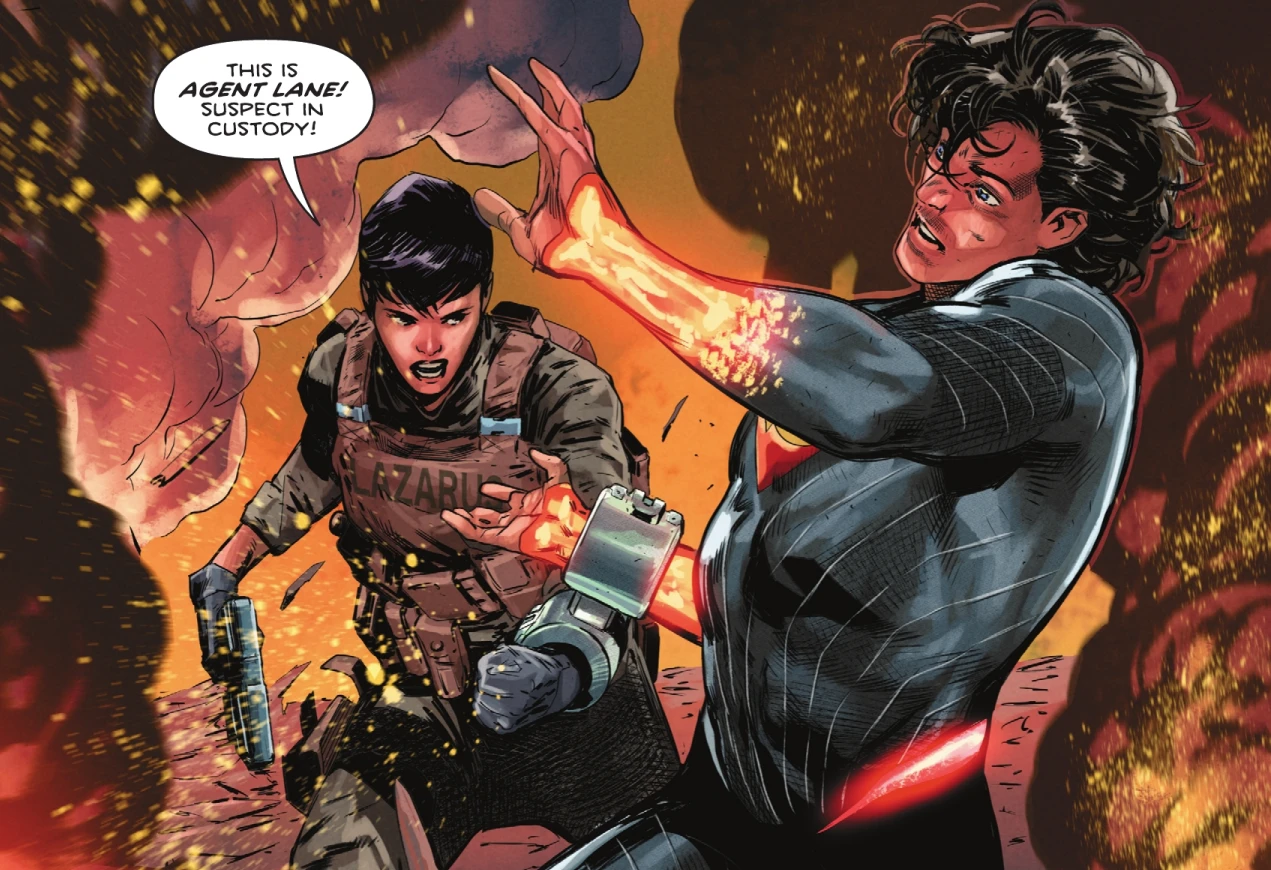
Lois starts seeing what Kal-El’s really about. She came as a loyal company operative, but spending time around him changed her. She also saw how willing Lazarus was to kill her. She starts to doubt everything.
This issue also sets up why Lazarus doesn’t need Kryptonite to threaten Superman. They’ve got Brainiac’s technology. Lazarus made it clear they’ll kill anyone who helps Superman. Civilians who sympathize with him end up dead.
Issue 3: “Boy from the Purple Prairie”
Jor-El and Lara take young Kal on a camping trip and talk to him about why he refuses to use the Luminarium. They explain something difficult: Krypton’s class system doesn’t just discourage doing the right thing. It punishes it.
When Jor-El tries to warn the council that the planet’s collapsing, they do not listen. It’s against his social standing. He’s not supposed to speak up. But he tries anyway.
His parents reveal they’ve been secretly building a spaceship. They want to save as many Kryptonians as possible. They’re not elites trying to save themselves. They’re working-class rebels fighting against the elite Science League.
This issue also shows us where Sol comes from. Lara demonstrates the suit’s incredible abilities when she fights against soldiers from the Military Guild. We also see Krypto, the family’s dog, in these scenes. The issue ends with a mystery: something connects Kal-El to the Kents somehow, but we don’t know what yet.
Issue 4: “Chasing the Storm”
This is all about Lois Lane.
Lois travels to all the poor places where Lazarus facilities operate. She visits every place Kal-El’s helped workers. She talks to João, the miner from the first issue, and tries to convince him to share his story about Superman. She argues it’s only a matter of time before Superman loses control and hurts someone by accident.
But the workers refuse to talk. João tells her something that stops her cold: the real reason she’s chasing Superman is that being around him has changed her. The workers warn her that one day Superman won’t be able to hold back his anger at what Lazarus is doing. They say they’re praying for that day.
Lois investigates a cruel Peacemaker named Crenshaw who likes hurting people with a knife for fun. She gets the upper hand and breaks his fingers before arresting him. Then her father, Sam Lane, calls her. He’s worried about her path and warns her about a mysterious group called the Omega Men.
Another Peacemaker named Chris Smith gets manipulated by Brainiac. The AI convinces him that killing innocent civilians before was just an accident. He’s willing to do it again.
The Omega Men are officially introduced now. Their leader, Omega Prime, violently confronts Lois and it turns out she’s the one who hurt Lois’s father, Sam Lane. Later, Omega Prime tells Superman they want to help him fight Lazarus, but he refuses their help.
Kal uses his freeze breath to freeze a group of arriving Peacemakers and flies off, telling Lois to stop looking for him. The issue ends dark: Peacemaker Smith shoots down all the civilians who were laughing at his frozen comrades. He’s completely out of control.
Jimmy Olsen also appears here as someone called “Alpha,” working with the Omega Men. This sets him up for a bigger role later.
Issue 5: “Ad Astra Per Aspera”
This is the heart of the whole arc. It’s about Krypton’s destruction.
On Krypton: Law Guild soldiers try to arrest Jor-El and Lara at their home. The family escapes in a stolen dump truck. Riots are tearing through Krypton’s cities. They load as many refugees as they can onto their spaceship.
As they escape, Kal-El has one moment of hope. He’s comforting another child who’s watching their world explode. But then something smashes into their ship. A piece of the breaking planet destroys their vessel. The other refugee pods get destroyed one by one by falling debris.
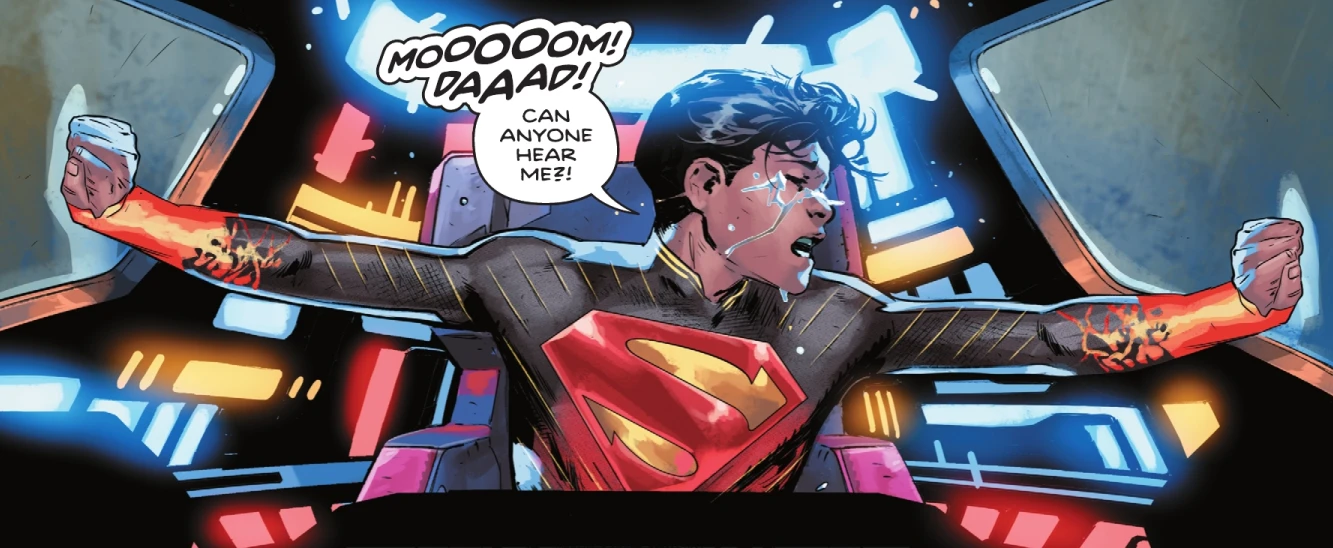
He calls out over the communications system, crying, looking for any other survivors as his rocket launches away from the dying world. Here’s what’s different from other Superman stories: Krypton’s elite, the Klerics, don’t get away. None of their ships launch. The ruling class dies. Nobody confirms whether Jor-El and Lara actually made it off-world. That’s left as a mystery.
On Earth (Present Day): Kal-El is furious about what Peacemaker Smith did in the previous issue. He breaks into a Peacemaker outpost in Pakistan. Smith shoots him with a Kryptonite bullet. Then he beats Kal-El viciously. Smith has been enhanced with Brainiac technology. He fires more Kryptonite rounds into Kal-El.
Kal-El grabs a terrified nearby Peacemaker and demands to know where Smith is. He’s losing control. He’s about to become a killer. But then the man begs for his life, and that stops him. Kal-El looks at himself and thinks he’s becoming a monster.
Jimmy Olsen shows up and opens a boom tube to save him, getting him out of there. Lois gets left behind with the Peacemakers.
Later, on a Kansas highway, Superman tells Sol he doesn’t want to know where Smith is. He’s afraid of what he’d do if he found him. The issue title “Ad Astra Per Aspera” means “through hardship to the stars,” and it’s actually Kansas’s real state motto. Using it here reminds us of everything Kal-El had to suffer before he ever arrived on Earth.
Issue 6: “Son of Smallville” (The Epilogue)
In Space: Sol and Kal-El drift for what feels like forever searching for a world they can live on. They find nothing. The trauma of losing his family and his entire world, combined with being alone in endless space, sends Kal-El into a dark spiral. First depression, then rage, then a kind of numb acceptance.
He starts planning to end his own life. Sol won’t allow it. The AI’s main programming says it has to keep him alive. Finally, Sol detects a living world. It’s Earth. But Kal-El doesn’t react. He’s in pain from the unfamiliar yellow sun as they crash down toward the planet.
On Earth: Jonathan and Martha Kent are struggling. Their farm is dealing with a weird drought. It hasn’t rained on their land in months, even though neighboring farms are getting rain just fine. Martha suspects Lazarus Corp drones are causing this on purpose to force them into bankruptcy and off their land.
Kal-El crash-lands near their farm, unconscious. The local townspeople are suspicious and armed, but the Kents take him in anyway, even though they can’t understand his language.
Something changes for both of them. Kal-El helps fix a tractor. Later, both Kents admit privately that having him there has helped save them emotionally. They’d been struggling.
Sol eventually powers back on and teaches Kal-El English so he can finally talk to the Kents. Then Sol disables the Lazarus drones that have been watching the farm. As the drones fall in flames, rain finally comes.
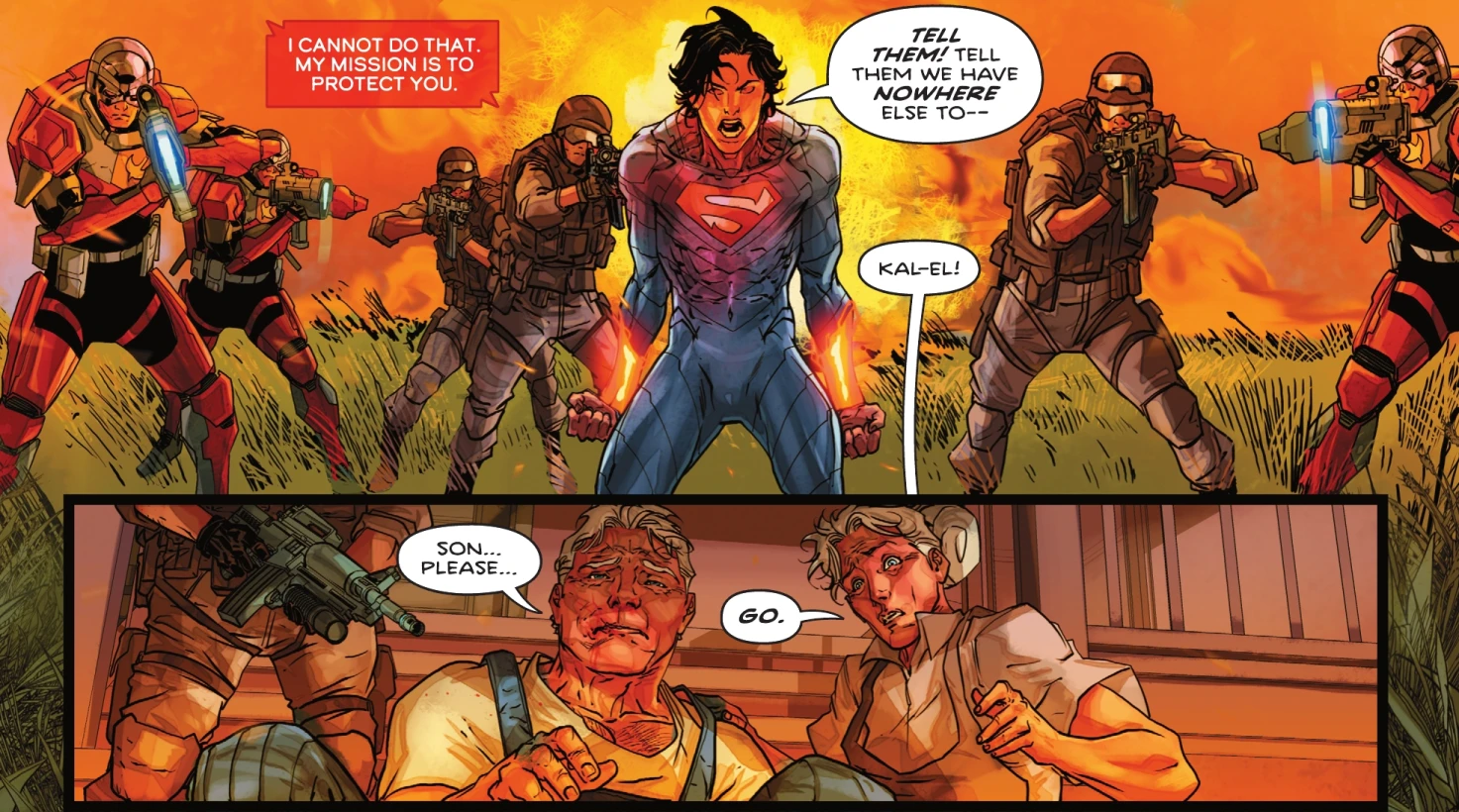
But Lazarus doesn’t let him stay. Peacemakers storm the farm to take Kal-El. Panicking about losing another home, Kal-El wants to fight. The Kents convince him to run instead. He leaves them behind.
Present Day: Lois Lane is investigating Smallville now, searching for Martha Kent. And there’s one more thing: Brainiac has been quietly monitoring Lois’s entire investigation this whole time. The AI is actually pleased with her progress.
This sets up the next story.
How This Absolute Universe Version Is Different
Kal-El actually lived on Krypton: In the original stories, baby Kal-El gets sent to Earth minutes before Krypton explodes. He never remembers his home world. In the Absolute Universe, he’s a preteen or early teenager when he leaves. He has actual memories of Krypton. He knows his culture. He’s not a blank slate absorbing only Kansas values.
Krypton isn’t perfect: In most Superman stories, Krypton is this incredibly advanced, almost utopian place. Here, it’s split by rigid class systems. There’s an elite ruling class and oppressed workers. It’s more like a dystopian society with deep problems. Jor-El and Lara aren’t celebrated scientists. They’re blacklisted workers punished for speaking up.
His parents are rebels: In traditional stories, Jor-El and Lara are prominent, respected members of Krypton’s ruling council. Here, they’re working-class dissidents. They’re building a ship not just to save their family, but to rescue as many oppressed Kryptonians as possible. They’re fighting against the elite, not part of the elite.
Kal-El doesn’t have the typical childhood: No Fortress of Solitude, No Clark Kent civilian identity or Daily Planet job. This version of Kal-El spends years as an undocumented immigrant drifting through the world’s poorest places. He’s living in mines, on corporate farms, helping exploited workers. The classic Smallville upbringing barely matters here. The Kents only show up briefly at the very end of this arc.
The villain is a corporation, not Lex Luthor: The main enemy isn’t a person. It’s Lazarus Corp, a massive worldwide company built on exploitation. It’s secretly run by Ra’s al Ghul (a villain from Batman comics), and it uses Brainiac as its artificial intelligence. Their soldiers, the Peacemakers, are the ones chasing Superman.
Lois Lane works for the bad guys: Instead of being a bold reporter who meets Clark Kent, Lois starts as a Lazarus operative sent to capture Superman. She gradually realizes the company is wrong. She’s not the hero right away. She has to earn that.
The suit talks to him: Superman’s costume isn’t just Kryptonian fabric. It’s Sol, a living artificial intelligence in a high-tech battlesuit made of nanotech and energy. It talks to him. It powers his abilities. It even overrides him when he’s about to hurt himself. It’s a companion, not a costume.
He nearly takes his own life: In issue six, Kal-El actually plans to end his own life during his journey through space. That’s a level of darkness DC rarely shows in Superman stories. They did not downplay Kal-El’s depression.
The elite don’t escape: Most Superman stories have some of Krypton’s ruling class escape through alternate dimensions or other means. Here, none of the Klerics’ ships launch.
The politics are obvious: This series leans hard into anti-corporate themes, environmental collapse, and immigration. Kal-El is fighting a worldwide corporation built on greed, while the exploitation mirrors what destroyed Krypton in the first place. The parallels are intentional.