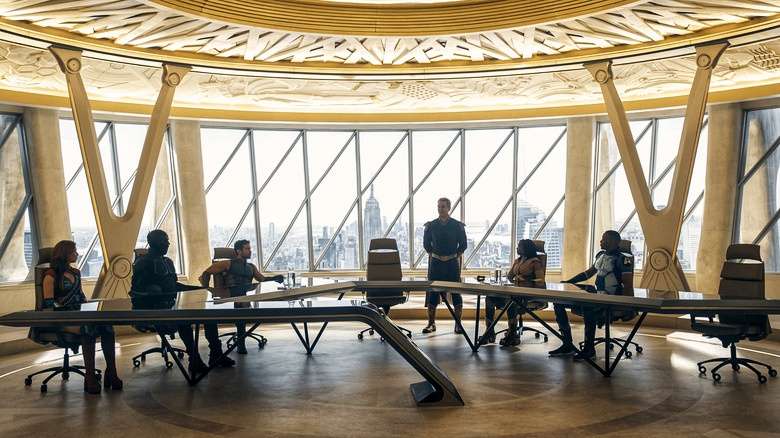
Amazon’s adaptation of The Boys made a lot of changes from Garth Ennis’s original comics. One of the biggest changes was to Vought itself.
In the comics, Vought-American is a defense contractor that can’t get out of its own way. In the show, Vought International is a media empire that’s always one step ahead. And it makes the show’s version of Vought more terrifying.
From Defense Contractor to Media Monopoly
The comics version of Vought is a military-industrial contractor trying to sell superheroes to the Pentagon. Think Lockheed Martin, but with superheroes instead of fighter jets.
Their entire business model revolves around one pitch: let us put superheroes in the military. It’s a satire of defense spending and the corporations that profit from endless war.
The TV show reimagines Vought International as a near-omnipotent, multi-billion entertainment conglomerate. They manage licensed Supes like The Seven, along with several different business divisions ranging from pharmaceutical, film studios, TV networks, sports drinks and fast food, etc. When they’re not pretending to save the world, The Seven are busy filming movies, selling merchandise, and building followings on social media.
This isn’t just an update for modern audiences. The comics were written during the War on Terror, when companies like Halliburton dominated conversations around politics. The TV show arrived in an era of social media influencers and corporations playing a bigger role in shaping the world around us.
Levels of Competence
The comic book version of Vought is dangerous because they’re reckless and incompetent.
They’re bureaucrats who fail upward. They create superheroes that routinely commit atrocities because nobody bothered with proper training. The satire works because it’s about how corporate greed breeds incompetence. They’re too stupid to realize how dangerous their own products are.
The show makes Vought smarter.
Madelyn Stillwell and Stan Edgar are master manipulators who understand PR and branding. When scandals break, they pivot the attention away to something else. They’ll sacrifice their Supes to protect the brand. Disasters are turned into opportunities to manipulate to push their agenda.
Stan Edgar, played by Giancarlo Esposito, embodies this. He’s the only character who can intimidate Homelander. He treats superheroes as replaceable assets in a larger machine.
The comics had James Stillwell as a cold strategist, but he was still just another executive in a faceless corporation. The show gives Vought personality and charisma. That makes them far more frightening than their comic counterparts.
Losing Control of Homelander
In the comics, Vought maintains control through blackmail, surveillance, and airtight contracts. Supes are employees. Terrible and bad at their jobs yes, but employees nonetheless. The company even has a failsafe: Black Noir is secretly a Homelander clone designed to kill him if he ever becomes uncontrollable.
The show doesn’t have such a safety net. Instead, we watch a corporation slowly lose control of its own creation in real time.
Homelander’s arc in the series is him realizing he doesn’t need Vought’s approval. His fanbase will follow him even when he’s openly monstrous. He stops being Vought’s product and becomes Vought itself. He eventually claims leadership of the corporation, turning it into a vehicle for fascistic populism.
Media Manipulation is the Real Weapon
The comics occasionally reference PR, but the focus stays on government-corporate collusion and military power. The Boys are an official CIA black-ops unit whose job is blocking Vought’s lobbying efforts.
The show makes media manipulation the main battlefield.
Vought News Network doesn’t exist in the comics. Neither do the constant references to social media, trending hashtags, or viral moments. The show understands that modern corporations don’t just sell products. They sell narratives, identities, even perceptions of reality.
When The Boys expose the existence of Compound V in the TV series, Vought spins a story of how the drug was created by a renegade faction of the company led by the deceased Madelyn Stillwell. The move serves two purposes. They’re admitting they’re at fault, but they’re doing it in a way where it would be difficult to hold them accountable.
Why Vought’s Transformation in the Show Actually Works
In the comics, Vought-American was a mockery of the military-industrial complex. The TV show satirizes media monopolies, celebrity culture, and corporate authoritarianism.
When Vought spins every scandal into a narrative about “a few bad apples,” they’re mimicking how entertainment conglomerates dominate our lives. The show’s version of Vought doesn’t need government contracts when they can control what people believe.
That’s the real horror. They’re so good at making villains look like heroes, it can be hard to tell the difference between the two sometimes.