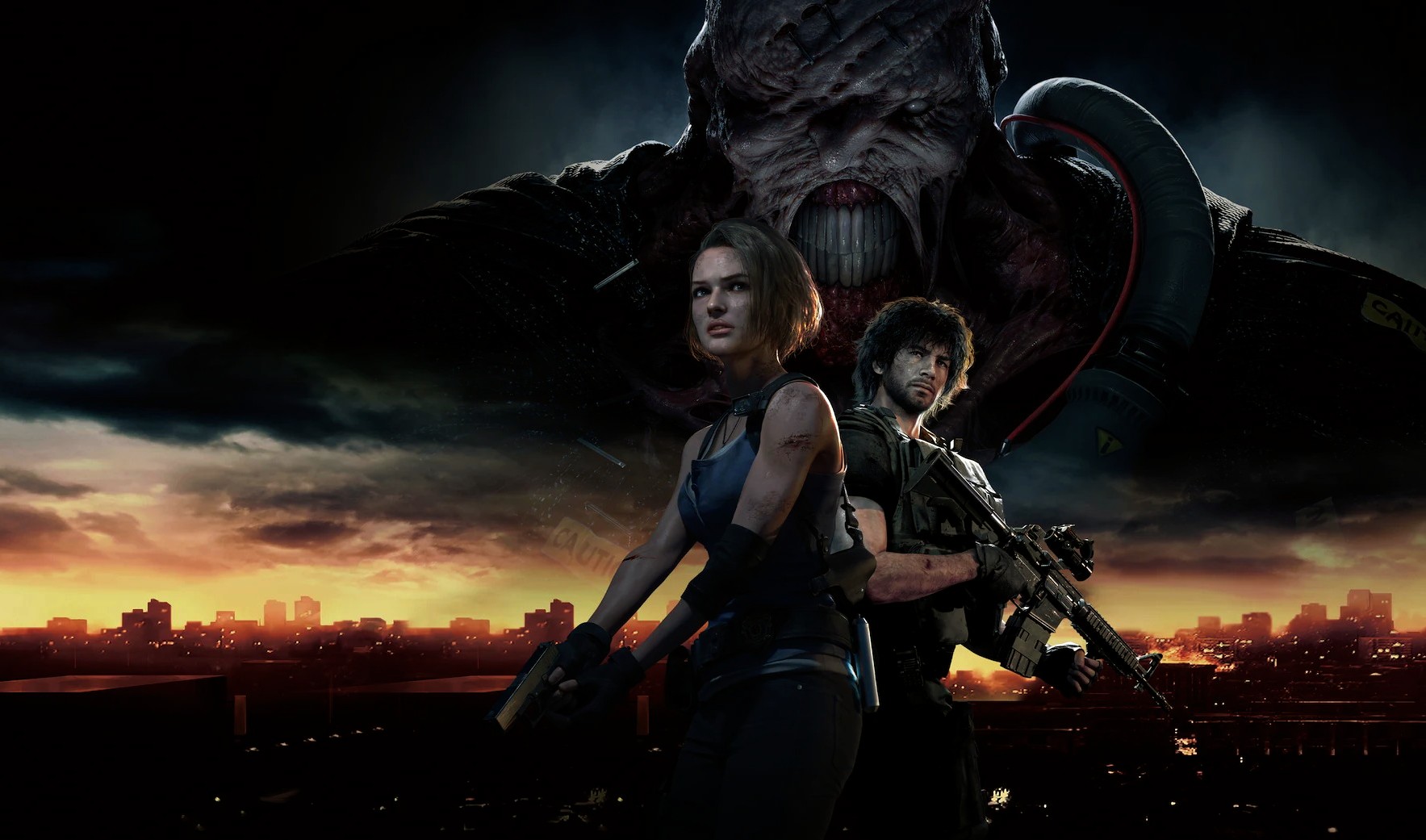
Raccoon City, September 28, 1998. A good chunk of the city’s 100,000 residents are turning into zombies due to a viral outbreak. Strange, mutated creatures are hiding in buildings or sewers. Meanwhile, ex-S.T.A.R.S. officer Jill Valentine is trying to escape Raccoon City alive and in one piece, all while being pursued by a predator who wants her dead at all costs.
This is the original survival horror game Resident Evil 3: Nemesis (1999) and its 2020 remake Resident Evil 3 in a nutshell. It’s the same story with the same beats, but the two games tell it in two different ways.
Note: according to Capcom, the remakes of classic Resident Evil games are canon to the official timeline. Think of them as different interpretations of the same events from the original games.
The Original Nemesis
The original RE3 starts with Jill Valentine taking shelter in a warehouse alongside a civilian named Dario Rosso. His mother, wife, and daughter are all dead. Rather than risk facing the horrors outside, he locks himself inside a shipping container and accepts whatever fate awaits him.
It’s a small scene, but it does give us an idea of how bad things are in Raccoon City. This isn’t just a zombie outbreak. It’s the end of the world for a lot of people. Even Jill gives up on the city and decides to leave while she still can.
This theme of hopelessness is present throughout the game. Unlike the first two Resident Evil titles, which revolve around uncovering conspiracies and solving mysteries, Resident Evil 3: Nemesis is about survival. Jill isn’t trying to save Raccoon City or expose Umbrella. She’s just trying to stay alive long enough to escape.
Jill leaves Dario and moves through back alleys until she crosses paths with her former teammate Brad “Chickenheart” Vickers. He’s panicking as he rants about something hunting S.T.A.R.S. members. She follows him to the Raccoon Police Department where Brad is overpowered and killed by the Nemesis-T Type, a massive bio-organic weapon in a trench coat. It has human-level intelligence, can use weapons like a rocket launcher, and is capable of speaking only one word: “S.T.A.R.S.”
During all of this, Jill meets Carlos Oliveira, a soldier working for Umbrella Biohazard Countermeasures Service, or U.B.C.S. They’re Umbrella Corporation’s private rescue unit sent to allegedly save the residents of Raccoon City. She doesn’t trust Carlos at first since she knows Umbrella is responsible for the outbreak, but they’re forced to work together out of necessity.
As Jill moves through neighborhoods, shopping districts, restaurants, City Hall, the Clock Tower, parks, cemeteries, and industrial facilities, the player sees the consequences of Umbrella’s actions firsthand. You’ll find diary entries of the people who worked for Umbrella and lived long enough to regret it. The exploration really makes it clear that Raccoon City is on its last legs.
Carlos plays a key role in the middle section, heading to a hospital to synthesize a vaccine after Nemesis infects Jill with the T-Virus. Jill eventually recovers and tracks down the villain Nicholai, a U.B.C.S. sergeant collecting combat data on Umbrella’s bioweapons for profit. And Jill finally destroys Nemesis with a railgun. After learning that the U.S. government plans to destroy Raccoon City, Jill and Carlos just barely escape via helicopter right when a thermobaric missile strikes the city at dawn on October 1, 1998.
How the Remake Changed the Story
The 2020 remake keeps the broad strokes of what happened in Resident Evil 3: Nemesis but reworks almost every detail.
Here, Jill is under house arrest in her apartment after she refused to keep quiet on Umbrella’s involvement in the Spencer Mansion incident from the first game. She’s spent weeks investigating Umbrella’s illegal experiments into creating bioweapons. She’s also been having nightmares and is clearly struggling with PTSD. Then Nemesis bursts through her wall right as Brad tells her to leave the city during a phone call.
While Jill’s trauma is emphasized during the opening, it gradually fades into the background. Her nightmares disappear, and her survivor’s guilt rarely influences her decisions. Her distrust of authority figures and Umbrella is acknowledged but not explored in much detail. By the middle of the game, she has transitioned into a confident action hero who’s swearing and firing grenade launchers at Nemesis.
The remake also adds a central subplot that wasn’t in the original: the search for a T-Virus vaccine. Carlos and his squadmate Tyrell Patrick spend much of the game trying to locate Dr. Nathaniel Bard, a researcher who was developing one. Unfortunately, they find him dead after he was shot by Nicholai, who has been undermining their plan for his own gain. The vaccine subplot gives Carlos a clear mission and more screen time than the original gave him. Most players agree that’s one of the remake’s strong points. He’s more likeable and the close bond he forms with Jill is fleshed out.
Nicholai gets a more complex role in Resident Evil 3. Rather than a mercenary motivated by greed, the remake’s version has him working for an unnamed employer who wants to sabotage Umbrella from the inside while collecting bioweapon data. His fate is left ambiguous; Jill and Carlos abandon Nicholai on the roof as the missile strike approaches. The original offered a more definitive conclusion as he’s either killed by Nemesis or Jill depending on what choices the player makes.
The Content the Remake Cut Out
The Live Selection system was also removed to give the remake a single linear ending. The Clock Tower, Graveyard, Park, City Hall, and other locations were all cut from the remake. These locations are important because they make Raccoon City feel like a character within RE3.
The park and cemetery have hidden clues that give players insight into Umbrella’s operations and Nemesis itself. They also reinforce the scale of the disaster by showing parts of the city beyond the downtown streets. Losing the clock tower stings since in the original game, it’s where Nemesis infects Jill with the T-Virus which triggers Carlos’ race to save her.
Without these areas, the player sees less of the city and spends less time taking in its grim atmosphere. Instead of experiencing a city collapsing around you, it can feel like you’re moving through a sequence of connected levels.
Dario Rosso, the survivor Jill encounters at the start of the original, is reduced to a brief cameo. In the original, his refusal to leave and his eventual death gave us a look into the psychological toll of watching everyone you love die or turn into a zombie. That context is mostly gone in the remake.
Nemesis Goes From Hunter to Typical Boss Monster
There’s a huge difference between the Nemesis we see in the original Resident Evil 3 and its remake. In the original, Nemesis acts more like a predator.
He crashes through walls and pursues Jill across multiple areas. He can use weapons and can open doors. He tracks his target with an intelligence that makes him feel more dangerous than the typical monsters you encounter. More importantly, his appearances are completely random. Nemesis is famous for rearing his ugly head when you least expect it.
The remake mostly abandons this approach. Instead of acting as a persistent hunter, Nemesis appears during scripted moments. He arrives when the story wants him to arrive and disappears when the sequence ends. Once players notice that pattern, the tension tied to his appearances disappears.
His design changed too. The original Nemesis had a face with large stitches, exposed skin around his teeth, and a modified trench coat. His final forms in the original were particularly disturbing, especially when his remains consume a dead Tyrant. The remake’s version has a cleaner, more modern look. Many fans felt that the rougher, hand-stitched grotesqueness of the original was exactly what made him work as an antagonist. He’s just your average boss you have to fight throughout the game.
Same Story, Different Game
Resident Evil 3: Nemesis is a survival horror story about a woman escaping a city before it’s literally wiped off the map. The Resident Evil 3 remake is a more cinematic and polished take on the original game. It tells a more focused story with better characterization for characters like Carlos. But by streamlining RE3, the remake loses many elements that made the fall of Raccoon City feel so tragic in the first place.