New to Daredevil? Start here.
- Blind lawyer by day, costumed vigilante by night. Hell’s Kitchen, New York
- Blinded as a child; remaining senses enhanced to superhuman levels
- Trained in martial arts by a blind master named Stick
- His ongoing war: the law he believes in vs. the violence he knows works
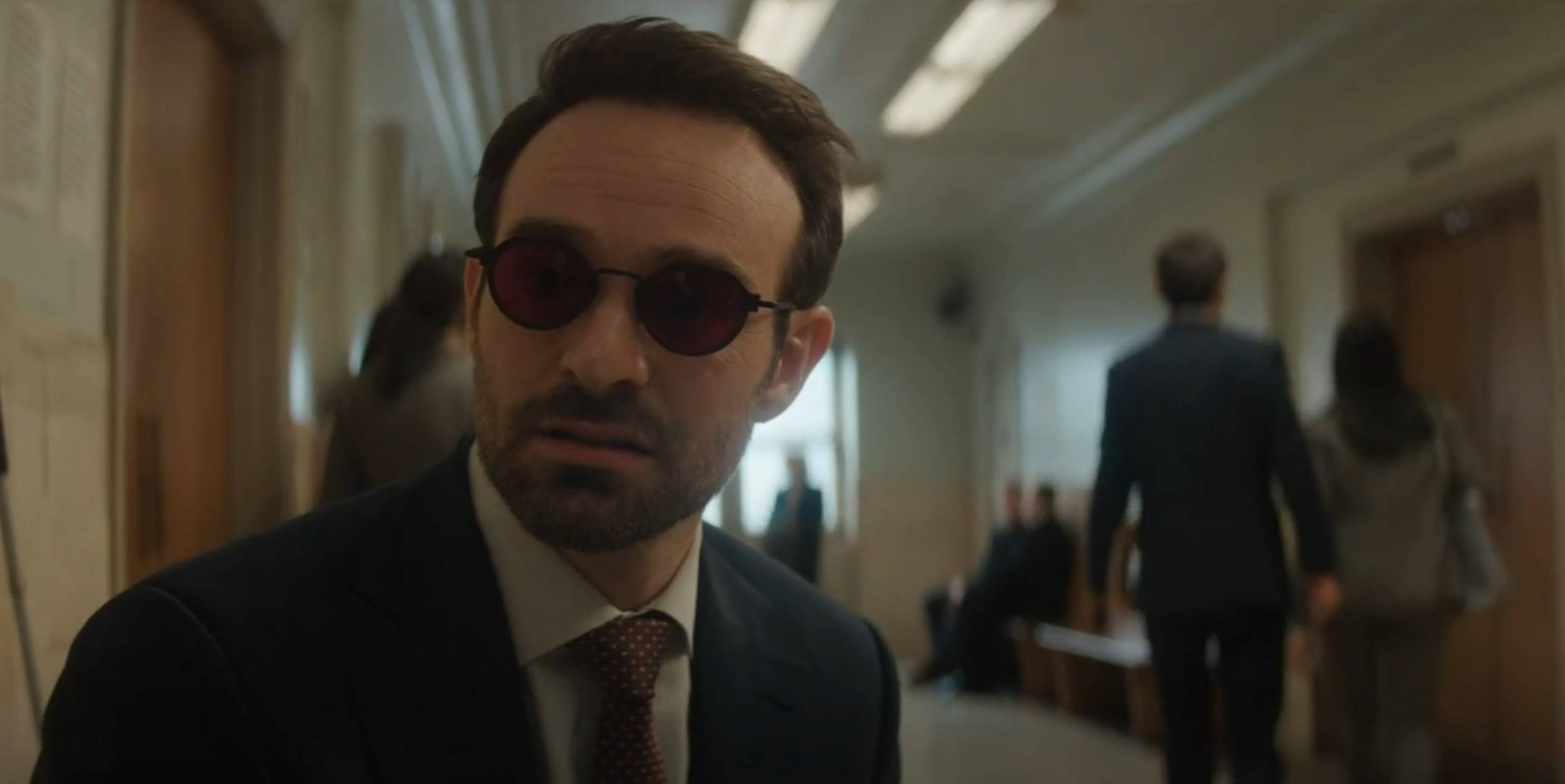
- Played by Charlie Cox across the Netflix series and Disney+ Born Again
- The name “Daredevil” came from the taunts of childhood bullies. He reclaimed it
What kind of person puts on a devil costume after a long day in court defending the innocent? The answer tells you everything about Matt Murdock, and why, after six decades of comics and multiple screen adaptations, he remains one of the most compelling, conflicted characters in superhero history.
It’s not the radar sense. It’s not the fighting. It’s the contradiction. And that contradiction starts on the worst day of his life.
The Broken Promise
The classic origin story goes like this: young Matt Murdock is blinded by a radioactive chemical spill while saving an old man from being hit by a runaway truck. The accident takes his sight but amplifies his remaining senses to superhuman levels. For example, he can hear people’s conversations that are blocks away from him. Eventually, he becomes Daredevil.
Matt’s father, Jack Murdock, was a boxer. A decent man in a brutal world. Jack had one rule for his son: no fighting. He wanted Matt to study, use his mind. To be the best person Matt could be. Matt agreed. He decided to be a lawyer.
Then the mob told Jack to throw a match. He refused. They killed him for it.
Matt remembers his father trying to comfort him as he died. That image, that specific, devastating detail, never left him. When he put on a mask years later and went looking for the men who murdered Jack Murdock, he wasn’t just seeking justice.
He was breaking his father’s only rule. On purpose. Out of love.
The powers are almost secondary. What drives the entire mythology of Daredevil is a son who can’t stop trying to honor a father he lost before he could grow up.
The Double Life
Here’s what separates Matt Murdock from almost every other hero: his two lives are philosophically incompatible.
By day, Matt Murdock, attorney at law, “believes” the system works. He stands in courtrooms and argues that justice has a process, that the law is the most powerful tool against chaos, that civilization depends on everyone, including him, trusting in it.
By night, Daredevil “believes” the system fails. Constantly. Specifically. He fixes what the court system broke. He climbs rooftops and breaks bones.
Matt never resolves this. Not in sixty years of comics. Not across three seasons of Netflix television. Not in Born Again. The warrior and the lawyer, living inside the same exhausted man, neither one ever fully winning.
And this, I’d argue, is Daredevil’s most underrated contribution to superhero storytelling: he’s the only major hero who genuinely believes his daytime self is wrong. Not misguided. Wrong. And he keeps doing both anyway.
Hell’s Kitchen isn’t just a setting in this context. Matt could practice law anywhere. He stays in Hell’s Kitchen because the Kitchen was his father’s world. Leaving would mean abandoning Jack a second time.
The Comics: A Breakdown
You don’t have to be a comics reader to appreciate Daredevil on screen. But knowing where the stories came from deepens everything you’re watching.
Frank Miller’s run (early 1980s) is where Matt transformed. Miller dragged Daredevil into film noir territory: rain-slicked streets, psychological warfare, and moral compromise. He introduced the Kingpin as Matt’s true nemesis and created Elektra, the assassin and lost love who would haunt Matt across every medium. The “Born Again” arc remains the defining Daredevil story: Wilson Fisk doesn’t beat Matt with fists. He buys Matt’s secret identity from a desperate Karen Page, then dismantles his life piece by piece including his sanity. What’s remarkable about Born Again is that Matt comes back. Broken, barely, but back.
The Bendis/Maleev era (early 2000s) asked a crueler question: what happens when the mask comes off on someone else’s terms? Matt’s identity is leaked to the press. His response, public denial, makes everything worse. This era is about shame. About what it costs to have your private self exposed, and how trying to act normal becomes its own kind of violence. The Netflix series lives in this era emotionally.
Mark Waid’s run (2011–2015) is worth reading because it’s a legitimate counterargument to everything above. Waid made Matt funny. Waid argued, convincingly, that a man who has survived everything Matt has survived shouldn’t be perpetually crushed by it. Some readers loved this. Some found it jarring. My thoughts: Waid was right that Matt needed breathing room, but the lightness only works because we already knew how dark it could get. Without Miller’s foundation, Waid’s sunshine means nothing.
Chip Zdarsky’s run (2019–2023) is the best modern Daredevil work. Zdarsky asks the hardest question in the character’s history: does Matt Murdock actually make Hell’s Kitchen better? Or does he feed a compulsion to suffer, a martyr complex dressed in red? The run doesn’t answer cleanly. That’s the point.
The Netflix Series: Three Acts
The Netflix Daredevil (2015–2018) remains the standard against which every superhero streaming series is judged. Here’s why.
Season 1: Matt spends most of it as “the man in the mask”. No name yet, no iconic suit, just a guy in black bleeding into the gutter between episodes. What makes it work is the mirror it draws between Matt and Wilson Fisk (Kingpin). Two men from Hell’s Kitchen, both convinced the ends justify the means. One chooses law, during the day. Being a vigilante at night. The other chooses power and will kill to achieve it. Their paths converge slowly, and when they finally collide, neither one is entirely wrong.
Season 2: Frank Castle (The Punisher) arrives and forces the defining ideological confrontation of Matt’s life: is there a line between Daredevil and Frank, or is Matt just Frank with better PR? Then Elektra returns and forces the personal version of the same question: is there a line between Matt and the darkness he keeps fighting, or is he drawn to it? By the finale, he doesn’t have answers. He has more wreckage.
Season 3: Matt starts physically shattered, spiritually empty, furious at God. His senses are failing. He’s questioning whether any of it served a purpose. It’s not about whether Matt wins. It’s about whether there’s anything left in him worth rebuilding. The deliberate return of the black suit wasn’t nostalgia. It was a regression. A boxer’s son stripped of everything, fighting ugly again, because that’s all that was left.
Disney+’s Born Again Season 1
The Disney+ revival picks up a year after the events of the Netflix series. Matt Murdock hasn’t been Daredevil and is back to being a lawyer again, trying to live with what happened. Bullseye killed his best friend Foggy Nelson. And Matt nearly killed Bullseye in return.
Foggy’s death is the earthquake the entire season is built on. Foggy wasn’t just Matt’s best friend. He was Matt’s conscience. The person who pulled him back from the edge when he was about to go too far. Without Foggy, there’s no one left to do that. The creative team described the decision to kill him as the only thing that made sense for a story about Matt trying to start over.
What makes the season satisfying for longtime fans is how it handles the return to the suit. After years of watching Matt agonize over whether to keep being Daredevil, the show simply dispenses with the internal debate. Someone needs saving. He puts the costume back on. Done.
That moment, Matt just saying the equivalent of “fine, alright” and suiting up without a speech, shows Matt being honest with himself. Because that’s who he is. He was never going to stop. Not really. The only question was always when.
The season also runs parallel arcs for Matt and Wilson Fisk, both being pulled back toward their violent natures like gravity. A cycle neither of them can escape. Which raises the question neither show has answered yet: do they even want to?
Born Again Season 2: The Battle for New York
Season 2 premieres March 24, 2026, on Disney+, with a two-episode drop to start and new episodes releasing weekly through May 12. Have your popcorn ready.
Fisk is now Mayor of New York City, and he’s hunting Daredevil as a public enemy #1. Matt is fighting back from the shadows. Krysten Ritter returns as Jessica Jones, becoming Murdock’s key ally. The showrunner has described her role as comparable to the Punisher’s in Season 1. Bullseye and Karen Page return. And Foggy Nelson (yes, you read that correctly). Matthew Lillard joins as a new villain described as having “Cheshire Cat” energy.
The showrunner has also said the Mayor Fisk storyline concludes this season, with future seasons returning to a more grounded, street-level tone. Frank Miller’s shadow, in other words, is never far away.
Why Daredevil Resonates
Matt’s dual philosophy is incoherent. He traumatizes everyone who loves him. The people of Hell’s Kitchen are arguably worse off for his presence: more violence, more collateral damage, more escalation. Every victory costs him something. Every person he protects comes with someone he failed.
He’s not a hero. He’s a man with a guilt complex who found a very dramatic way to manage it. He keeps going anyway, not because he’s certain it’s working, but because stopping would mean accepting that it never did.
Most of us aren’t fighting ninjas on rooftops (we have video games for that!). But we know what it’s like to be pulled between two versions of ourselves, neither one fully winning. We know what it costs to stay. And we know the strange, stubborn refusal to quit, even when quitting would be reasonable, even when the people we love are begging us to.
That’s what Matt Murdock represents: the experience of trying to fix something that keeps breaking. Showing up for a fight you’re not sure you can win, because the alternative is doing nothing. Of carrying a promise made to someone you lost, long past the point where keeping it makes logical sense.
Matt Murdock doesn’t win cleanly. He never has.
He keeps going anyway.