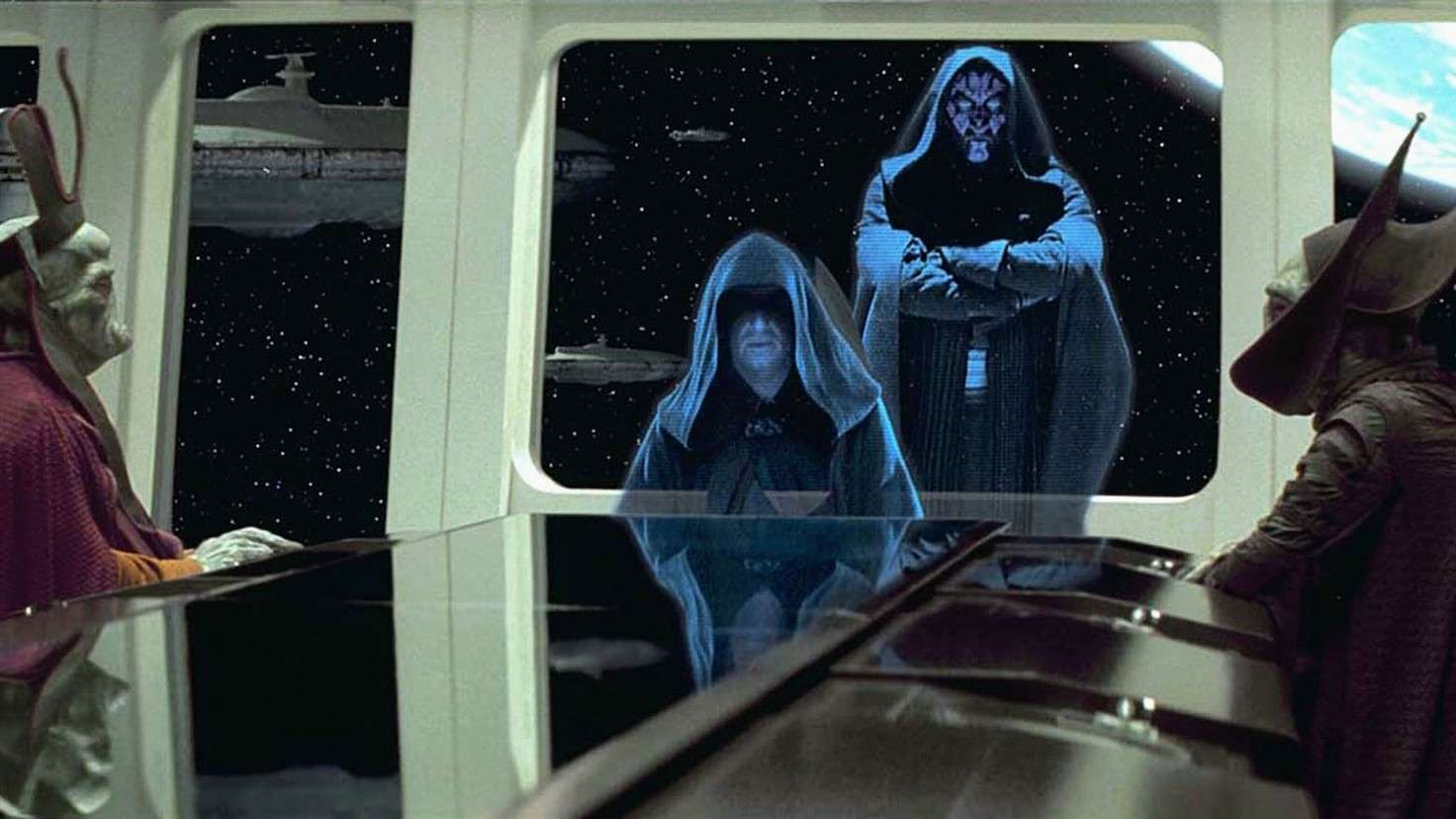
In the Star Wars universe, there’s a philosophy among the Sith that many credit to its survival. It’s called the Rule of Two, where there can only be one Sith Master and apprentice. If the apprentice wants to rise up the ranks, they have to kill their master and take on an apprentice.
It’s a vicious cycle that’s been around for generations. But how can a tradition survive when it relies on the student betraying their teacher? That contradiction is at the heart of the Rule of Two.
Where Did the Rule of Two Come From?
The Rule of Two was established by the legendary Sith Lord Darth Bane around 1,032 BBY.
When the Sith existed in large numbers, their greed for power caused them to turn on each other. Infighting and power struggles tore them apart from the inside, making it easy for the Jedi to decimate the Sith a millennia before the Clone Wars. In the end, Darth Bane was the only Sith Lord to survive the conflict.
To ensure this never happened again, Bane created a new doctrine that would be called the Rule of Two. There would be only two Sith Lords at any given time: a Master to embody power and an apprentice who craves it. The apprentice could only overthrow their master if they were strong enough to survive the encounter, then they found an apprentice of their own to continue the cycle. On the flip side, a master could also train a second apprentice, then have them kill the first one.
A single pair of Sith Lords could operate in secret, infiltrating governments across the galaxy. For centuries, the Sith worked in the shadows towards Bane’s Grand Plan to destroy the Jedi, and restore Sith rule. The rise of Palpatine, who eventually became Emperor and brought the entire Republic to its knees, was the culmination of that long plan.
Interestingly, the Rule of Two wasn’t a part of Star Wars lore in the beginning. In the original trilogy, Darth Vader and Emperor Palpatine were simply a master and an apprentice and that was it. More information about Bane and the Rule of Two was added through stories from the Star Wars Expanded Universe (also called Star Wars Legends), mainly the Darth Bane novel trilogy written by Drew Karpyshyn in the mid-2000s.
Before that, the rule was briefly mentioned in Star Wars: Episode I – The Phantom Menace, one of the prequel films. The death of Qui-Gon Jinn at the hands of Darth Maul confirmed the return of Sith after the Jedi assumed they weren’t extinct.
When discussing Bane and the Sith, Yoda described the rule as: “Always two there are, no more, no less. A master and an apprentice.” The scene was meant to act as a disturbing realization that the Sith survived because they learned to adapt while the Jedi became stagnant due to clinging to tradition.
A Fatal Contradiction
The Rule of Two makes it clear that only two Sith Lords are allowed to exist at the same time. The whole point is to ensure the weak could never team up against the strong. Only the most powerful and cunning were allowed to survive, to pass on what they know to the next generation.
But think about what this asks of both the master and their apprentice.
You must teach your apprentice everything: your secrets, skills, your hard-won knowledge. You must make them as strong as possible, knowing that you’re training this person to kill you one day.
And the apprentice has to remain loyal enough to keep learning, patient enough not to strike too soon, and strong enough to overthrow their master. One wrong move, act too early and fail, or wait too long and miss their moment will cause everything to come crashing down.
You can’t even call it a relationship because there’s no trust on either side.
But does it work? It must, because the Sith have managed to survive for over a millenium. Palpatine is living proof of the concept’s success. He’s the endpoint of a centuries-long chain of masters and apprentices, each one stronger than the last. All of it leading to one man holding the galaxy in his hands.
But even Palpatine still falls in the end. His apprentice, Darth Vader turns on his master in Return of the Jedi to save his son Luke Skywalker. It’s not power or greed that causes Palpatine’s downfall. It’s love, a powerful emotion Bane never accounted for.
The Rule of Two is fascinating because it mirrors something that happens in the real world. Many systems built around competition, whether in business, sports, or politics, have the same flaw. When you replace trust with rivalry, you create something that’s effective and fragile at the same time.
Bane was right that unity makes the Sith stronger. But building this method on fear and dominance, ultimately led to the downfall of his people.
A tradition that relies on betrayal to survive will eventually be betrayed itself.