He never pulled a trigger. He never stalked you through a corridor. He never mutated into something monstrous under flickering laboratory lights. And yet, every zombie that ever lurched toward you in a Resident Evil game. Every outbreak, ruined city, every life destroyed by a virus that should never have existed traces back to one man.
Oswell E. Spencer. British nobleman. Self-declared architect of human evolution.
In most of the franchise’s history, Spencer existed at the margins. A name in documents, a shadow behind the curtain, And then Resident Evil Requiem brought him into the foreground. Not as the god he believed himself to be. But as something far more complicated and far more human.
The Man Who Decided He Was Chosen
In the 1960s, Spencer co-founded the Umbrella Corporation alongside two other scientists. James Marcus, a brilliant microbiologist, and Edward Ashford, a fellow nobleman with a passion for research.
Together, they discovered a rare flower in West Africa harboring what they called the Progenitor Virus, a pathogen capable of rewriting living organisms at a biological level. For Marcus and Ashford, it was a scientific miracle. For Spencer, it was a mandate.
Spencer had long believed that humanity was stagnant. Natural evolution was too slow, too random. He didn’t want to wait for nature. He wanted to engineer a superior race of human beings using the Progenitor Virus, and to stand over the new world that followed as its god. It was a deeply held philosophical conviction, rooted in eugenics-era thinking and inflated by a lifelong privilege that had never once told him no.
So he founded Umbrella to make it happen. Every division, lab, research program like the T-Virus project and the development of Bio-Organic Weapons, was in service of this singular goal. The pharmaceutical empire was a cover. What Spencer was really building was the infrastructure of a new humanity, with himself at the top.
And he was ruthless about it. When his co-founder James Marcus, the very man who made critical breakthroughs with the Progenitor Virus, became an obstacle, Spencer had him assassinated and claimed his research as his own. Edward Ashford died early under suspicious circumstances. One by one, the people who could challenge Spencer’s vision were removed.
Most chillingly of all, Spencer secretly ran what became known as the Wesker Children Project. It was a eugenics program where children from around the world were selected for their genetic superiority. They were abducted and eventually infected with the Progenitor Virus. The goal was to produce a single, perfected evolved human, someone worthy of inheriting Spencer’s vision.
Albert Wesker, one of the sole survivors of this program, was that experiment made flesh. His superhuman speed, strength, and intellect were examples of what Spencer wanted from humanity.
The Irony That Killed Him
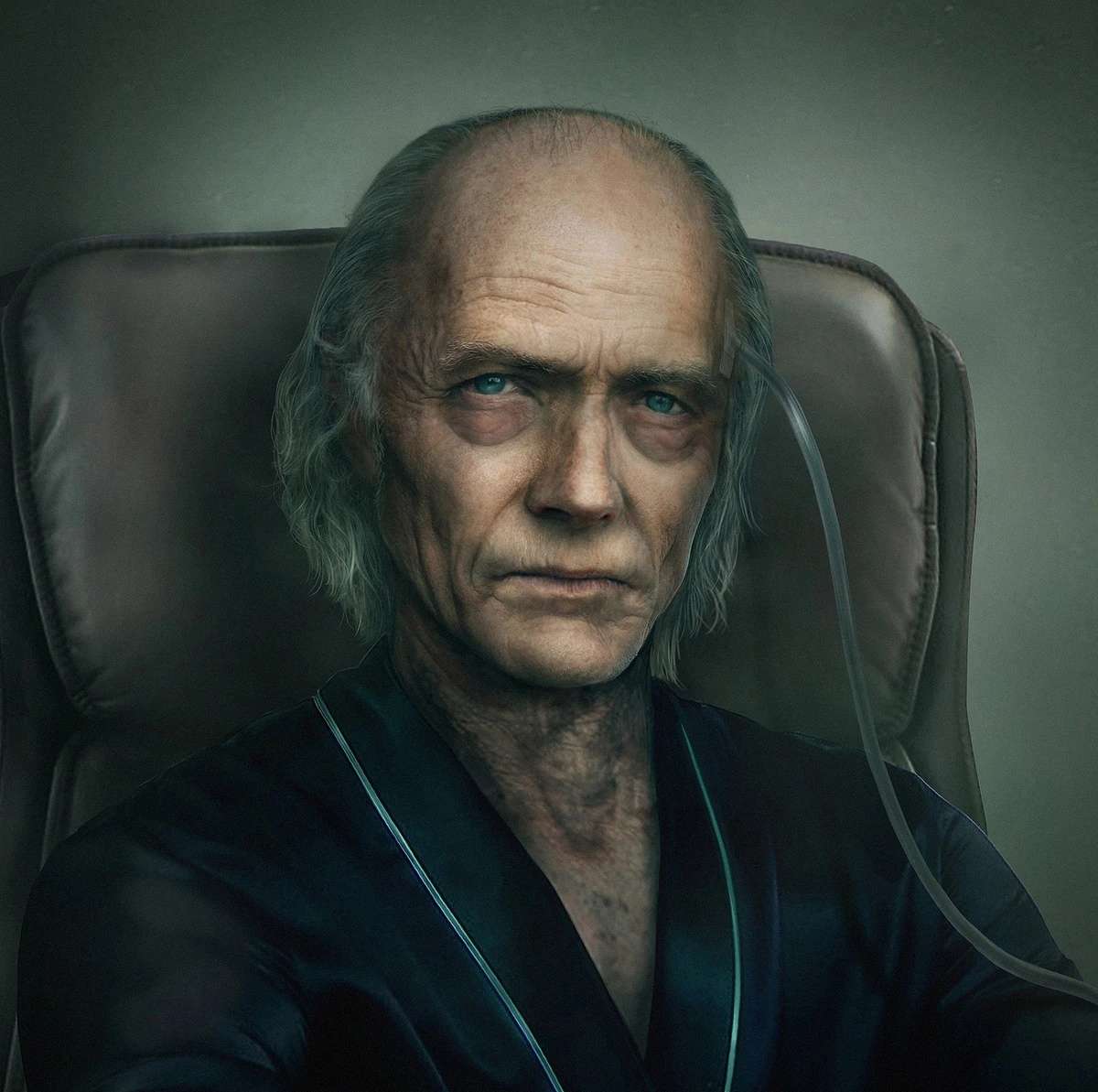
By the time Spencer physically appears in Resident Evil 5, the grandeur is gone. He is ancient and frail. He’s hooked to a life support system in a wheelchair, coughing, barely held together by technology and spite. The man who spent his life obsessed with transcending human weakness is now everything he used to hate.
Wesker finds him in his estate in 2006. Spencer, still convinced of his own significance, reveals the existence of the Wesker Project, believing that Wesker was meant to be his chosen heir. Instead, Wesker kills him.
It is a devastatingly fitting end. Spencer spent decades engineering the perfect superhuman, and that very creation ended his life. The god-complex consumed everything around him, and then it consumed him. Everything about his final moments reads like a man who never once reckoned with what he had done to the world.
Or so it seemed.
Requiem Changes Everything
Resident Evil Requiem introduces a version of Spencer that RE5 never hinted at: a man who looked at Raccoon City and actually felt bad about the destruction he caused.
The catalyst was a double blow. First, the sheer scale of the devastation. An entire American city was consumed by the T-Virus, its population either dead or transformed into zombies. Spencer had always understood the virus as a tool, an instrument of controlled evolution. What happened at Raccoon City was catastrophic. It was the consequence of his life’s work laid bare, and it was undeniable.
Second, he was betrayed. The Connections, a shadowy organization with deep government ties, manipulated events to ensure the thermobaric bomb dropped on Raccoon City destroyed evidence of their own involvement in Umbrella’s research. They then used their influence to make Spencer the sole villain to the public. Wesker, who was secretly linked to Tricell (itself connected to The Connections) presented damning evidence against Spencer at trial.
The man who had spent his life pulling strings from the shadows found himself on the receiving end of the exact same treatment. He lost Umbrella and his reputation. He disappeared from public life entirely.
And then something unexpected happened. He met Grace.
During the chaos of the Raccoon City incident, Spencer encountered a young girl who would become, in his own words, his “hope.” He arranged for Grace to be taken in by journalist Alyssa Ashcroft and raised in relative safety, out of reach of the Connections.
In archival interview footage shown in Requiem, Spencer tells Alyssa directly that he regrets what he did. For him, Grace represents the closest thing he has to hope that things will get better.
For a man who had viewed virtually every human being as either a tool or an obstacle, this is remarkable. Grace didn’t fit his grand theory of superior genetics or evolved humanity. She was a child in the wrong place at the wrong time, and Spencer chose to protect her anyway. Something in that encounter, in her existence, appears to have cracked him open.
Elpis: A Cure Hidden Behind a Lie
The shocking aspect of Spencer’s change of heart is a project called Elpis named, interestingly enough, for the Greek spirit of hope.
Throughout Requiem, nearly everyone believes Elpis is Spencer’s final weapon. A last act of bioterrorism from a bitter, broken old man. They are wrong.
In his final years, Spencer developed Elpis as a universal antiviral agent. A cure designed to destroy all strains of the Progenitor Virus and, by extension, the T-Virus it spawned. It was intended to save the survivors of Raccoon City Syndrome, to offer some counterweight to everything he had unleashed.
To protect it from being weaponized by the wrong hands, Spencer spread false rumors that Elpis was a dangerous Bio-Organic Weapon. He hid the cure in plain sight, behind a lie. Which is, when you think about it, both poetic and suspicious. It is a very Spencer thing to do. Even his act of redemption involved manipulation.
That’s what makes Elpis so fascinating. It’s either the most selfless thing Spencer ever did, or it is one final move in a game only he was playing. The name Elpis alone suggests genuine regret. But Spencer’s entire life was built on controlling the narrative. How do we trust that this, of all things, was real?
Was Spencer’s Regret Real? The Question That Reframes Everything
Requiem doesn’t answer this question easily. It gives us two readings, embodied by two characters: Gideon, who believes Elpis was one final act of spite, chaos disguised as salvation. Then there’s Grace, who believes Spencer genuinely changed and wanted to undo some of the damage he’d cause.
Both of them might be right at the same time.
However, this doesn’t explain the Spencer we saw in Resident Evil 5. His final words carry no trace of regret. He laments that he, a man with “the right to be a god,” must face mortality. Even in his dying breath, the god complex is intact.
Requiem places his change of heart somewhere in the years between 1998 and 2006: between Raccoon City and that estate meeting with Wesker. But RE5’s Spencer doesn’t feel like a man who has spent eight years secretly making a cure out of remorse. He sounds like a man who still believes, on some level, that he was right all along and simply ran out of time.
The most generous interpretation is that guilt and ego coexisted in Spencer until the end. He could believe he deserved godhood AND feel genuine sorrow for the millions who suffered because of his ambition. That kind of internal contradiction is not unrealistic. It is, in fact, deeply human.
It’s also possible that Elpis was never really about atonement. That it was Spencer’s way of shaping the world one final time, of ensuring his influence was felt even after his death. Only this time, he’d be the secret savior who provided the cure. Control, dressed up as contrition.
Every outbreak, every horror, every life lost began with one man’s belief that he had the right to redesign humanity. And that same man, in his final years, appears to have understood what he had done and tried to do the right thing.
That doesn’t absolve him and it doesn’t bring back Raccoon City. Spencer’s legacy will always be defined by what he destroyed rather than by what he tried to save.
But it refuses to let Spencer be a cartoon villain whose death resolved everything. Instead, it leaves us with a figure who is tragic in the truest sense. Someone whose capacity for destruction and his capacity for developing conscience were both real.
Whether you believe that duality will actually help the Resident Evil universe in the end or plunge it into anarchy depends on what you think people like Spencer are capable of.