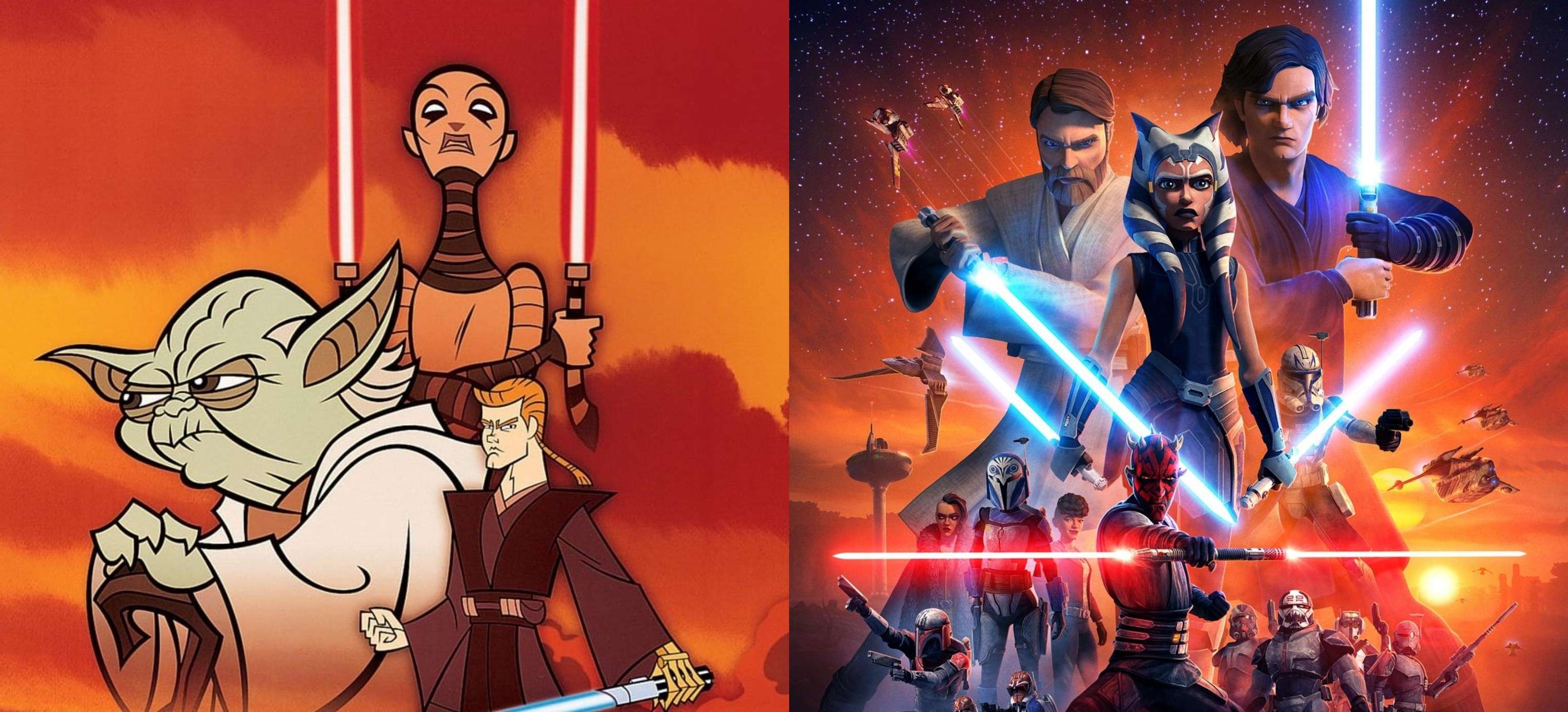
Have you ever searched for an animated series called Star Wars: The Clone Wars, only to find there are two different series with almost the same name? You’re not alone, it happens all the time.
Both series cover the same three-year period between Attack of the Clones and Revenge of the Sith. But they were made at different times, and for very different reasons.
Bridging the Gap Between the Movies
The year was 2003 and Lucasfilm had a couple of problems. Star Wars: Episode II – Attack of the Clones was released in theaters on May 16, 2002. It wasn’t as well received as Episode I – The Phantom Menace, a film that many felt pale in comparison to the original trilogy.
By the end of the year, Attack of the Clones was the fourth-grossing film of 2002. That doesn’t sound too bad until you learn what the top 3 films were: The Lord of the Rings: The Two Towers, Harry Potter and the Chamber of Secrets, and Sam Raimi’s Spider-Man. It was the first time a Star Wars film didn’t top the annual box office charts. Lord of the Rings, Spider-Man and Harry Potter had better reception from movie goers and made a bigger impact on pop culture at the time.
The second problem was that the third and final film in the prequel trilogy, Revenge of the Sith, wouldn’t come out until May 19, 2005. That’s a long wait and Lucasfilm needed something to hold fans’ attention. So Lucasfilm turned to Genndy Tartakovsky, the animator behind Samurai Jack and Dexter’s Laboratory, two of Cartoon Network’s highest-rated original series.
The result was Star Wars: Clone Wars, a micro-series airing on Cartoon Network in three to five minute segments. The series premiered on November 7, 2003 and ran for three seasons, with the third season concluding with five, twelve minute episodes. According to Tartakovsky, the real reason Clone Wars was created was to sell more action figures as the figures based on the prequel films were underselling.
Originally, George Lucas wanted each episode to be a minute long but Tartakovsky shot that idea down because it was the equivalent of making a commercial. Lucas eventually backed down once he learned that Tartakovsky would be involved, since he and his son were big fans of Samurai Jack.
Created by a small team, Clone Wars had a heavily stylized aesthetic based on Tartakovsky’s signature animation style. The action was fast-paced with the best animation you would find on cable television. It won two Emmy Awards for Outstanding Animated Program in 2004 and 2005.
To this day, Clone Wars is considered to be one of the best Star Wars television series the franchise has produced. It was so successful that it actually opened the door for it to be spun off as a new project.
A Second Series with a Different Goal
After Revenge of the Sith wrapped up the prequel trilogy in 2005, George Lucas returned to the Clone Wars era. There were many untold stories set during the three-year war Lucas wanted to explore in more detail, including characters that were briefly mentioned or featured in the prequel films. Lucas brought in supervising director Dave Filoni to develop a CGI animated show with 22 minute episodes, theatrical production values, and original characters.
Star Wars: The Clone Wars (2008–2020) ran for seven seasons, wrapping up its final season on Disney+ in 2020. It used CGI animation instead of Tartakovsky’s 2D style though his designs were a major inspiration. The first two seasons were told out of order so viewers could jump in at any point. The show would start airing episodes in chronological order in season 3, and by season 5 had split episodes into four episode arcs.
The series as a whole was meant to expand the broader Star Wars universe. Instead of revolving itself around a member of the Skywalker family, a wider range of characters got their time to shine. We also learned more about the politics fueling most of the franchise’s biggest conflicts.
One of the most significant additions The Clone Wars made was introducing Ahsoka Tano, a character who hadn’t existed at any point in Star Wars canon. Created as Anakin Skywalker’s Padawan, Ahsoka became one of the most beloved characters in the franchise. Her close relationship with Anakin gave viewers insight into Anakin’s character as he strives to be a good teacher for Ahsoka.
Another major development that came out of The Clone Wars was the return of Maul. Despite getting killed off in The Phantom Menace, Maul was an iconic character thanks to his unique design and being a Sith powerhouse. He’s resurrected near the end of season 4, and becomes a major antagonist in season 5 and 7.
Star Wars Canon Gets a Reset
When Disney purchased Lucasfilm in 2012, they inherited decades of Star Wars stories: novels, comics, video games, and two animated series that had accumulated since the 1970s. In April 2014, Lucasfilm officially rebranded all of that existing material as “Legends” and declared it non-canon.
As a part of this reset, the 2008 CGI series was kept as canon, while the 2003 Tartakovsky micro-series was moved to the Legends continuity.
There were several reasons why Disney made this decision. The sequel film trilogy was already in development, and the Expanded Universe had already detailed what happened after Return of the Jedi. Picking and choosing what’s canon and what isn’t would have been difficult, and contradicting it was unavoidable.
Also, Lucasfilm has always treated the Expanded Universe as a soft continuity. Lucas himself had contradicted it many times with his own films. Decanonizing Legends gave future films and TV shows the opportunity to tell brand new stories while making Star Wars lore slightly less convoluted.
What Did the Canon Reset Change?
The reclassification did create some inconsistencies. The 2003 series showed that General Grievous’s distinctive cough is the result of Mace Windu crushing his chest plate in battle, damaging his lungs. The 2008 canon series never addressed this, leaving Grievous’s condition unexplained.
There were also differences in how Anakin’s knighting ceremony was depicted. The 2003 series placed it later in the war, while Anakin is already a Jedi Knight with a Padawan at the very start of the 2008 series.
Another change is that some characters simply disappeared. Durge, a nearly unkillable bounty hunter and major villain in the 2003 series, has never appeared in the official Star Wars canon. He only exists in Legends now, forgotten by the official timeline.
Other elements survived the transition. General Grievous himself made it through. His visual design and role as the Separatist military commander remained the same, even if his personality is somewhat different between the two shows.
Asajj Ventress, the dual-lightsaber-wielding assassin who first appeared in the 2003 micro-series, became a central character in the 2008 series. She received a detailed backstory connecting her to the Nightsisters of Dathomir.
The ARC Troopers, elite clone soldiers with distinctive armor who were introduced in the 2003 series, were expanded upon in the 2008 series. Several ships and locations from the 2D series also made their way into the 2008 series. This includes the V-19 Torrent starfighters and the planet Rattatak, established as the place where Count Dooku discovered Ventress.
Two Series, One Era
The 2003 series Clone Wars was made to bridge the gap between Episode II and III. Meanwhile, the 2008 show The Clone Wars explored the Star Wars universe on its own terms. Both cover the same period in the timeline, but they were created with different goals in mind by their creators.
Even though it’s no longer canon, I still recommend watching the 2003 series. It’s aged surprisingly well, the animation and action sequences are still top notch. It’ll also make you appreciate the 2008 series as you’ll see how the original Clone Wars pushed the boundaries of what an animated TV series can be.
All episodes of Star Wars: Clone Wars (2003–2005) and Star Wars: The Clone Wars (2008–2020) are available to stream on Disney+.