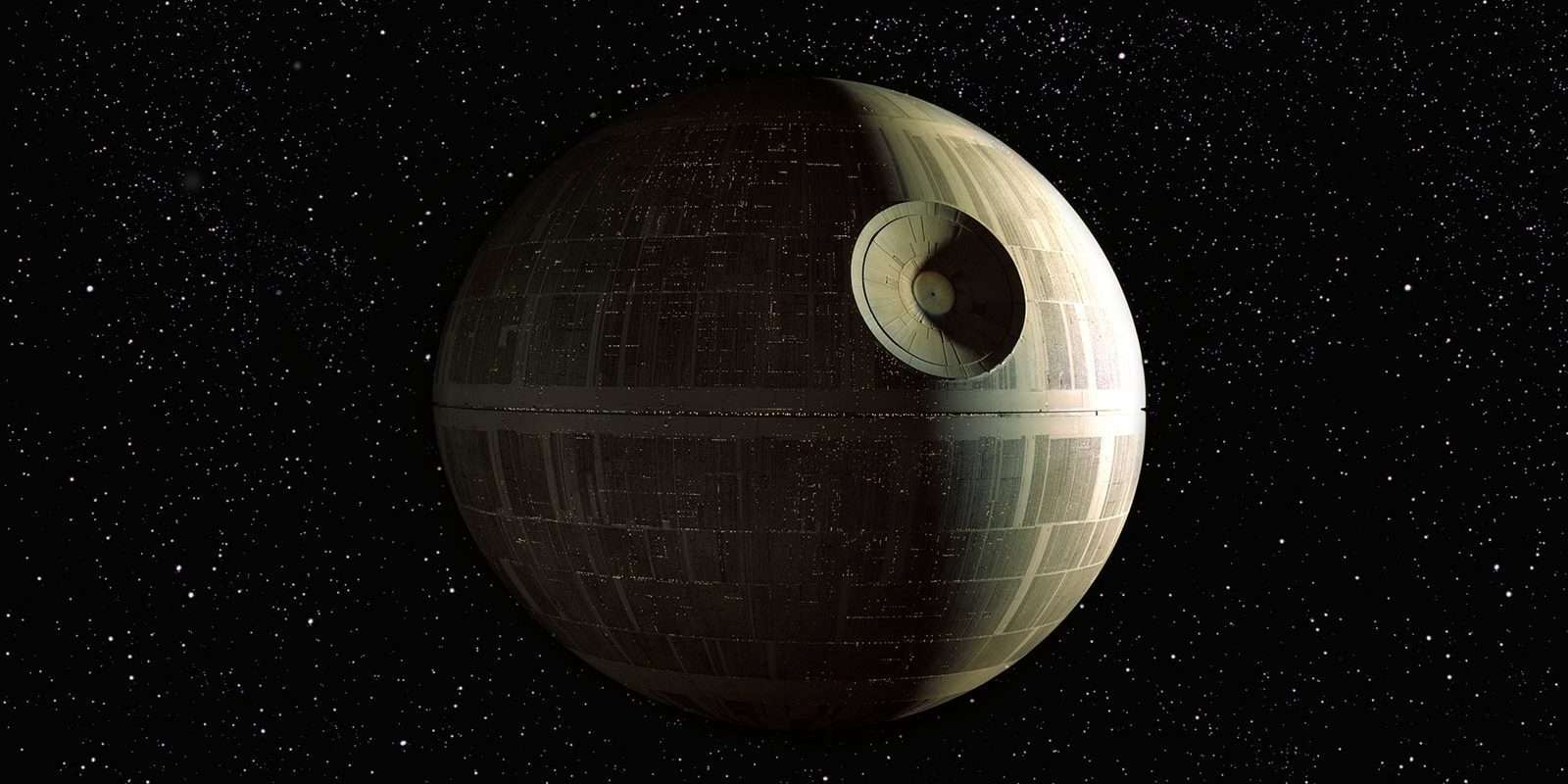
The Death Star is a moon-sized battle station built by the Galactic Empire, armed with a superlaser that can vaporize entire planets in one shot. It’s designed to function as a mobile base and a nightmare for the rest of the galaxy.
The first station, the DS-1, was “hundreds of kilometers” across, with a superlaser that annihilates Alderaan as a demonstration of imperial power. The second, larger Death Star orbiting Endor, was already capable of firing while still incomplete. It’s the Empire’s ultimate weapon, radiating “do not test us” energy.
But it’s not so much what the Death Star can do, but what it says about a regime that thinks building it is a good idea.
Who Made the Death Star?
If you look at how the Death Star is built, you get a cross section of imperial power. Politicians, technocrats, enslaved workers, and one very guilty scientist.
The project was spearheaded by Emperor Palpatine, with key roles from Grand Moff Tarkin and Director Orson Krennic, plus kyber-crystal expertise from Galen Erso. Geonosis provided early construction, droid factories handled large-scale fabrication, and forced labor (including Wookiees) filled in the gaps. It’s not one villain’s creation, it’s an entire Empire’s group project.
That collective effort is what makes Galen Erso’s sabotage so important. Rogue One reveals he added a flaw into the reactor design. He made it so a small, well-placed explosion can trigger a chain reaction and destroy the station. The thermal exhaust port is a subtle act of resistance.
A Monument to Insecurity
At its core, the Death Star represents an insecure regime desperate to remain in power.
The Death Star is both a punishment and a deterrent, a reminder that resistance is pointless. But if you need a moon-sized gun to keep people in line, you’re doing something wrong. It’s a sign that the Empire can’t stand on its own.
A Weapon Destined to Lose
The Death Star is designed to look invincible. In A New Hope, it’s the looming existential threat that forces the Rebellion out of hiding and into open conflict. In Return of the Jedi, the second Death Star is the bait in Palpatine’s Endor trap, meant to end the war in a single decisive step.
Once it’s in the story, a countdown starts. Either the Rebellion dies, or the station does. There is no “Death Star exists for thirty years while everyone adjusts to the new normal” option.
Luke’s trench run in A New Hope makes that explicit. The climax is a bet on a pilot’s ability to exploit a small vulnerability. The most expensive object in the galaxy is defeated by one fighter in one shot. A weapon built to end the hero’s journey instead becomes proof the Empire can be beaten.
Fear, Surveillance, and Political Overkill
Imperial doctrine frames the Death Star as a terror device. Destroy one planet in public, prevent a hundred revolts in private.
Visually, a massive artificial “moon” that can appear over any world is the ultimate surveillance metaphor. People need to believe it could arrive, fire, and turn them into debris. It’s the galactic version of parking a tank outside a polling station.
The overkill is the point. The Empire isn’t trying to be efficient. It is trying to be memorable.
Historical Echoes
The Empire pulls from 20th-century authoritarian regimes: from its rigid hierarchies to the vast atrocities it commits regularly. The Death Star fits into that lineage as a structure built to show that human (or humanoid) will can reshape the galaxy itself.
Real-world regimes have always loved prestige projects. Massive stadiums, showpiece cities, “world’s biggest” everything. The Death Star is that impulse turned into a literal weapon.
Like many megaprojects, it also embodies overreach. By concentrating so much power into a single asset, the Empire creates a single point of catastrophic failure. When it explodes, it destroys the myth of invincibility.
Why a Metal Moon Works
Even if you stripped out the lore, the Death Star would still work as a visual force to be reckoned with.
The basic shape is almost childishly simple. A sphere with a single offset “crater” for the superlaser. That simplicity has made it iconic to the point you can recognize it anywhere.
Its smooth, uninterrupted form looks unnatural compared to the organic shapes of worlds. It feels cold for a reason. When it looms next to a planet, it looks wrong in a very specific way. Like an error in the sky.
Why the Empire Made the Same Mistake
You would think after Yavin, the rational response would be: “never again.” Instead, the Empire starts a second Death Star project.
This isn’t just stubbornness. The Empire can’t admit that the concept itself is flawed. Naturally for them, the solution is another Death Star.
Systems built on domination interpret failure as the result of not being ruthless enough. The second Death Star is the Empire’s attempt to fix that problem with disastrous results.
Starkiller Base in the sequel era is the same impulse with fresh paint. Different weapons, but that need to project fear are still there.
The Death Star is a symbol of the Empire’s delusional relationship with its own power. No wonder it gets blown up twice.