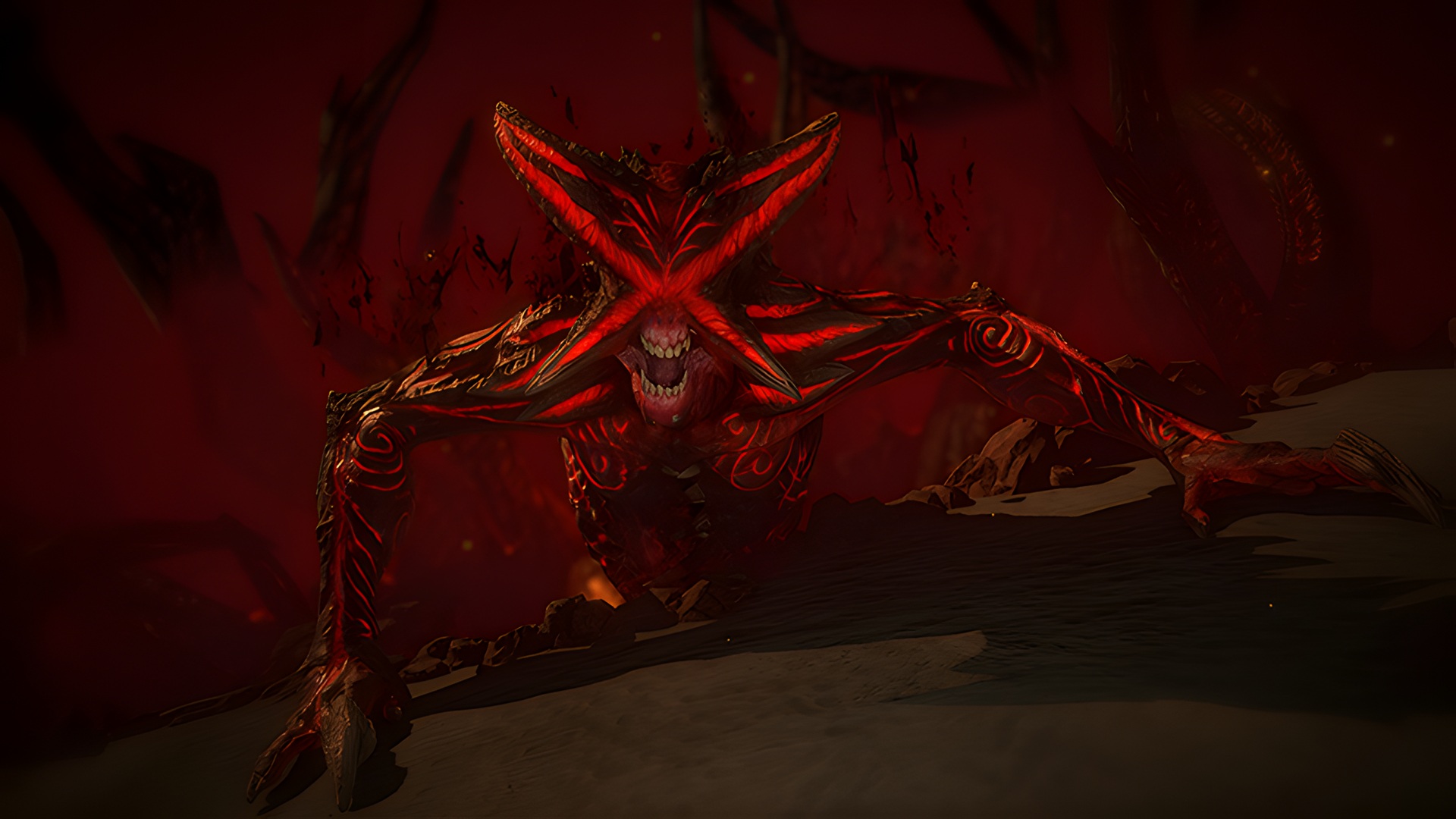
Kitava’s story is often flattened into a single idea. He’s corruption. He’s hunger. He’s the force that devours. That is the version the Karui remembers and the version the player sees. If we step back and ask one question, everything opens up.
Was Kitava always destined to become the thing that ruins Wraeclast, or was he pushed into it by the world he tried to nurture?
To get the full picture, we have to trace who Kitava was before the fall, why his kindness twisted into excess, and how the cultures of Wraeclast helped shape the god he eventually became.
Kitava Before Corruption
The Karui called him the Father of Corruption, but that title is a product of hindsight. Kitava’s earliest nature was tied to generosity and abundance. He is associated with feeding, providing, and offering care to those in need. Kitava began as a god who gave without question.
This is what makes his arc tragic. He is not a god of cruelty in the way Innocence becomes cruel through rigid purity. He is not a god of cynicism like Sin. Kitava is the god who tries to give everything he has until the act of giving breaks him.
At the start, Kitava embodies compassion without boundaries. In Wraeclast, anything without boundaries tends to rot.
How Compassion Becomes Corruption
Kitava’s core sin is excess. He is the god who never stops feeding his people because he cannot emotionally tolerate the idea of someone being left out. When Sin describes him as the youngest and most vulnerable of the gods, that vulnerability matters. Kitava was open to anything and everything, especially praise, trust, and need.
In ancient Wraeclast, the Karui adored him for his generosity. Their adoration fed him, and Kitava fed them back. But… gods in this world gain power from belief, and belief always multiplies itself. If you feed people, they will worship you. If they worship you, you become more powerful. If you become more powerful, you can feed even more people.
This cycle creates a problem that Innocence and Sin avoided in opposite ways. Kitava never says no.
His kindness turns into a hunger for approval, which shifts into a hunger for more offerings, which eventually becomes a hunger for everything. Kitava does not begin by wanting to consume. He begins by wanting to provide. The difference fades as his power spirals out of control.
The tragedy is simple. Kitava wanted to give, and in trying to give without limits, he created a world where nothing was ever enough.
Why Kitava Turned on the Karui
When Kitava finally breaks, it is not a sudden snap. It is a slow distortion of what once made him beloved.
The Karui feed him worship. They offer him tribute. But Wraeclast is unstable, and human devotion inevitably shifts. As other gods rise, fall, or demand attention, Kitava is left with the emotional equivalent of abandonment. For a god whose entire identity is built around giving, abandonment is the deepest wound.
Kitava begins to take because he fears being forgotten. He consumes because he fears having nothing left to give. The Karui call him the Father of Corruption because they watched his generosity mutate into dependency, then into obsession, and finally into a hunger that devoured the very culture he once cherished.
Kitava does not turn on the Karui because he hates them. No, no, no. He turns on them because he cannot stand the possibility of losing them.
Sin, Innocence, and Kitava: A Perfect Contrast
Each of the three major divine figures in Wraeclast represents a different failure of balance.
- Sin represents knowledge without restraint
- Innocence represents purity without compassion
- Kitava represents generosity without limits
The Sin & Innocence fall apart because each of them commits to a single extreme. Kitava stands out because his extreme feels emotionally understandable. Who has not wanted to give beyond their capacity? Who has not struggled to set boundaries with people they love?
Kitava is the god who loved too much and lacked the structure to survive that love.
Why Sin Calls Kitava the Greatest Threat
Sin does not fear Innocence because he understands him. He even proposes a partnership with him in Path of Exile 2 because Innocence is predictable.
Kitava is different.
Kitava is a god who can never be appeased. Not through offerings, not through worship, and definitely not through punishment. His hunger is the logical endpoint of a god who never learned to limit himself, and that makes him unstoppable.
Sin hides truths from Innocence because he knows how fragile and rigid Innocence is. Sin hides Kitava from the world because Kitava cannot be reasoned with. You cannot outmaneuver a being who was once overflowing with warmth and has lost all sense of where that warmth ends.
The Final Confrontation and Its Emotional Weight
Act Ten is the culmination of the player’s journey and Kitava’s downfall. When you face him, you face a god who genuinely believes he is still fulfilling his original purpose.
He is feeding his people. He is taking everything into himself so no one else has to suffer. He sees no problem with this. His tragedy lies in his sincerity.
Kitava thinks he is saving Wraeclast.
This is why the fight feels like a mercy killing. You are putting an end to a god who could never stop himself, even if he wanted to.
Was Kitava Always a Monster
No. The real answer is far more human.
Kitava fell because the thing that made him kind became the thing that destroyed him. He had an abundance of love with no sense of restraint, and Wraeclast is a place that twists extremes into horrors.
Kitava’s story forces us to ask a difficult question. How much corruption comes from evil, and how much comes from love that has lost its shape?
That’s why Kitava is the perfect closing chapter after Sin and Innocence. He completes the picture. He reminds us gods fall because they cannot escape the parts of themselves they never learned to control.