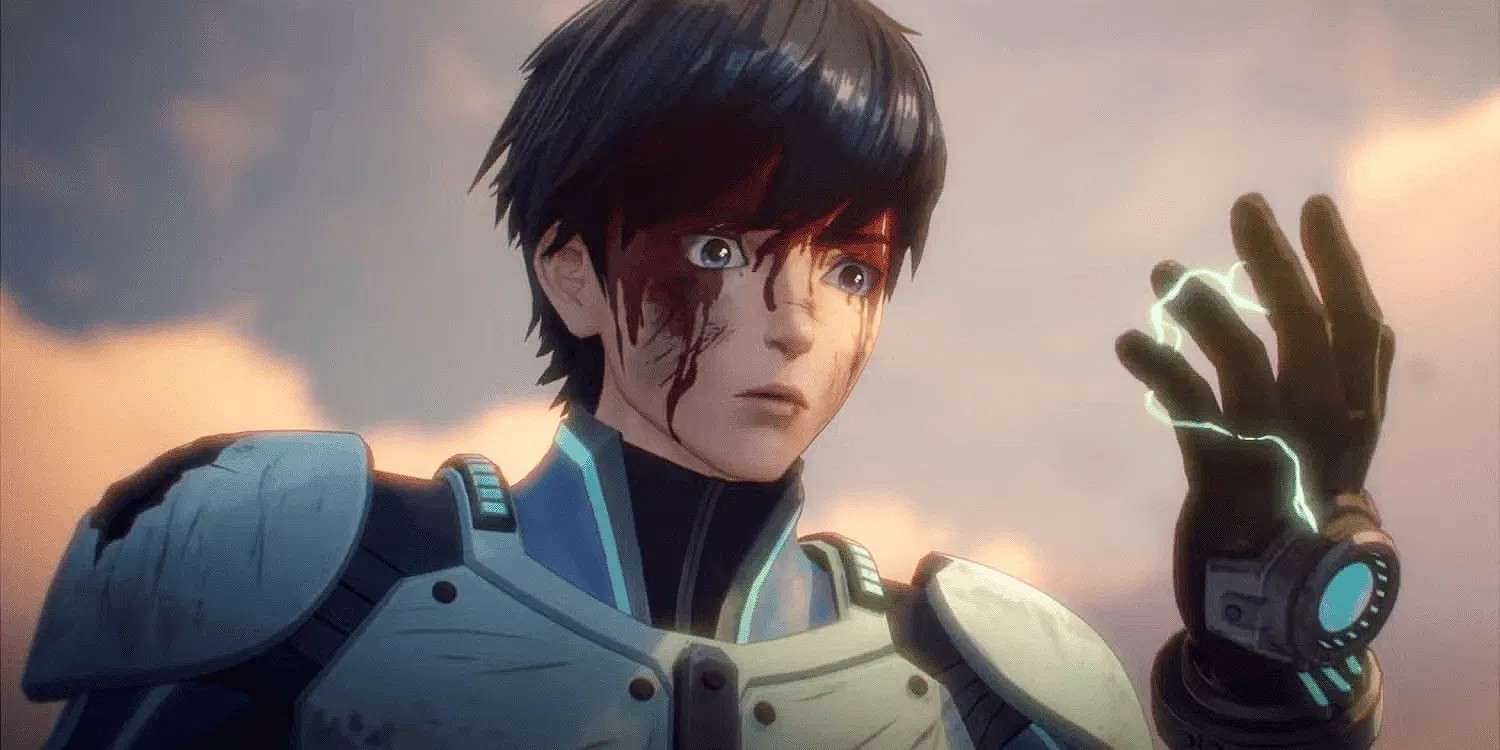
One of the more frustrating things about Yang Cheng from To Be Hero X is that he doesn’t feel like a hero. He comes off more as a villain instead.
He knowingly takes the mantle of E-Soul despite the original still being active as a hero, throwing the Trust System into chaos. Then he kills the original E-Soul in a duel, officially cementing Yang Cheng as his replacement without earning it. It’s implied he killed Moon in the beginning of season 1.
The really frustrating part is that the show doesn’t flesh Yang Cheng out as a character. It’s hard to tell if To Be Hero X wants the viewer to sympathize with him or despise him. He doesn’t get nearly as much depth as Lin Lang or Nice, so it’s hard to get a handle on why he does the things he does.
The show is structured like an anthology, jumping between different heroes and their backstories. Yang Cheng’s arc is mostly self-contained within the E-Soul storyline. Once it ends, the story moves on. That pacing matters, because it’s part of why Yang Cheng feels like a half-baked character.
The only thing that’s clear about Yang Cheng is how easy it is for aspiring heroes to be twisted into becoming the very thing they’re supposed to fight against.
How Did Yang Cheng Become an E-Soul Wannabe?
Yang Cheng is a young man who was saved by E-Soul when he was a child. E-Soul is often considered to be the greatest hero of his generation. A man of quiet integrity who spent 34 years protecting people without ever seeking recognition. That rescue became the defining event of Yang Cheng’s life. He grew up wanting to be a hero. Specifically, he grew up wanting to be E-Soul.
That’s a classic hero’s origin story, an orphan wanting to grow up to become someone extraordinary. The messy part is how that desire evolves as Yang Cheng gets older. Instead of asking “what kind of hero do I want to be”, his goal gradually narrows to “I want to be E-Soul.”
He’s not really inspired by E-Soul or aspires to be just like the hero. Yang Cheng literally wants to be E-Soul from taking the name, wearing the armor, everything.
And then, by accident, it happened. Yang Cheng was working as a children’s entertainer, performing in an E-Soul costume, when he saved his crush Xia Qing’s younger brother Pomelo from kidnappers. Bystanders filmed it and the public assumed he was the real E-Soul. His Trust Value skyrocketed almost overnight.
Remember that in To Be Hero X, heroes are ranked by a system that is essentially a public approval rating with existential stakes. This system will also give and alter a hero’s superpowers based on how the public perceives them. This results in Yang Cheng getting electricity-based abilities similar to E-Soul’s. Because there’s two heroes going by the same name, they ultimately share the same Trust Value. Yang Cheng’s score rises as he grows in popularity (especially among children) , while the original E-Soul’s score plummets.
Grief, Manipulation, and the Point of No Return
What turns Yang Cheng from a complicated dreamer into an up-and-coming villain is a tragic sequence of events.
Shang Chao, Yang Cheng’s classmate from university, is confronted by a masked man holding a gun. Conveniently, this happens right as Yang Cheng and his crush Xia Qing are arriving at his warehouse. Yang Cheng races towards Shang Chao with his powers enhancing his speed.
But he hesitates. As he’s running, memories of Shang Chao and his closer relationship with Xia Qing flash through Yang Cheng’s mind. This surge of jealousy makes his powers cut out at the worst possible time and that moment of hesitation costs Shang Chao his life.
Yang Cheng is wracked with guilt over his failure to save Shang Chao. From that moment on, he vows to “not hesitate anymore.” Unfortunately, this just makes him an impulsive and reckless individual who doesn’t think things through.
Yang Cheng is manipulated into believing that E-Soul and his manager ordered the hit. It doesn’t help that E-Soul’s manager filed a copyright lawsuit to block Yang Cheng from using the original’s likeness, which led to false rumors that temporarily harmed Yang Cheng’s reputation. By the time of Shang Chao’s murder, Yang Cheng grew to hate the original E-Soul due to his inactivity. But his refusal to hesitate, to stop and think about why E-Soul would do such a thing, puts him on a dark path.
Consumed by grief and rage, he challenges E-Soul to a duel to the death. The winner gets to keep the E-Soul identity for good. Yang Cheng wins by delivering the final blow after E-Soul left himself open.
What Yang Cheng never learns is that his grief was engineered. A man named Yan MO (also known as Uncle Rock) orchestrated Shang Chao’s murder specifically to push Yang Cheng into challenging E-Soul. He even arranged Pomelo’s kidnapping which kickstarted Yang Cheng’s rise as E-Soul.
Yang Cheng spends the entire arc believing he’s avenging his friend. He’s actually being used as an instrument to serve a system that needed a new E-Soul and found a convenient, grieving young man to wear the mask.
A Fall Without the Weight
Yang Cheng’s arc has more in common with the protagonist-to-villain trope.
A good person who means well is put through the ringer, which makes them the perfect candidate to be manipulated. They start making choices that contradict the person they used to be. Think of Anakin Skywalker. He lost everyone he loved and used power and cruelty as a coping mechanism.
Yang Cheng’s arc also reminds me of the Sith master-apprentice cycle in Star Wars. In that tradition, the apprentice doesn’t grow to surpass their master. The apprentice replaces the master. Power transfers, but the structure stays the same. The system continues.
Yang Cheng doesn’t become E-Soul by earning the mantle. He steals it from the original and calls it justice. And in doing so, becomes the mechanism that keeps the hero system running. A hero inspires a child. The child grows up wanting to become the hero. The system replaces the old hero with the new one. The cycle continues.
Here’s where the show lets him down. The show gives us his actions. But we never get the chance to sit with him long enough to feel the weight of what he’s becoming. What makes the protagonist-to-villain route engaging is that it makes the audience grieve for the good person the character used to be. That grief requires intimacy. Yang Cheng’s arc moves too quickly for that intimacy to form. We understand his trajectory but we don’t feel it.
The Unfair Verdict
Yang Cheng ends his arc having achieved everything he wanted. He is E-Soul but lost himself and his close friends in the process. The story has moved on.
And the audience is left with an undeveloped villain when we should have gotten a fully realized anti-hero.
The show is structured like an anthology, jumping between different heroes and their backstories. Yang Cheng’s arc is mostly self-contained within the E-Soul storyline. Once it ends, the story moves on.
That pacing matters, because it’s part of why Yang Cheng feels like a half-baked character. As a result, he seems like a villain. Cold, hollow, unsympathetic.
But the hollowness was always the point. There’s no Yang Cheng left inside the armor. The dream consumed him until there was no one left to inhabit it.
That’s not a villain’s story. It’s a tragedy the show didn’t give itself enough time to tell.