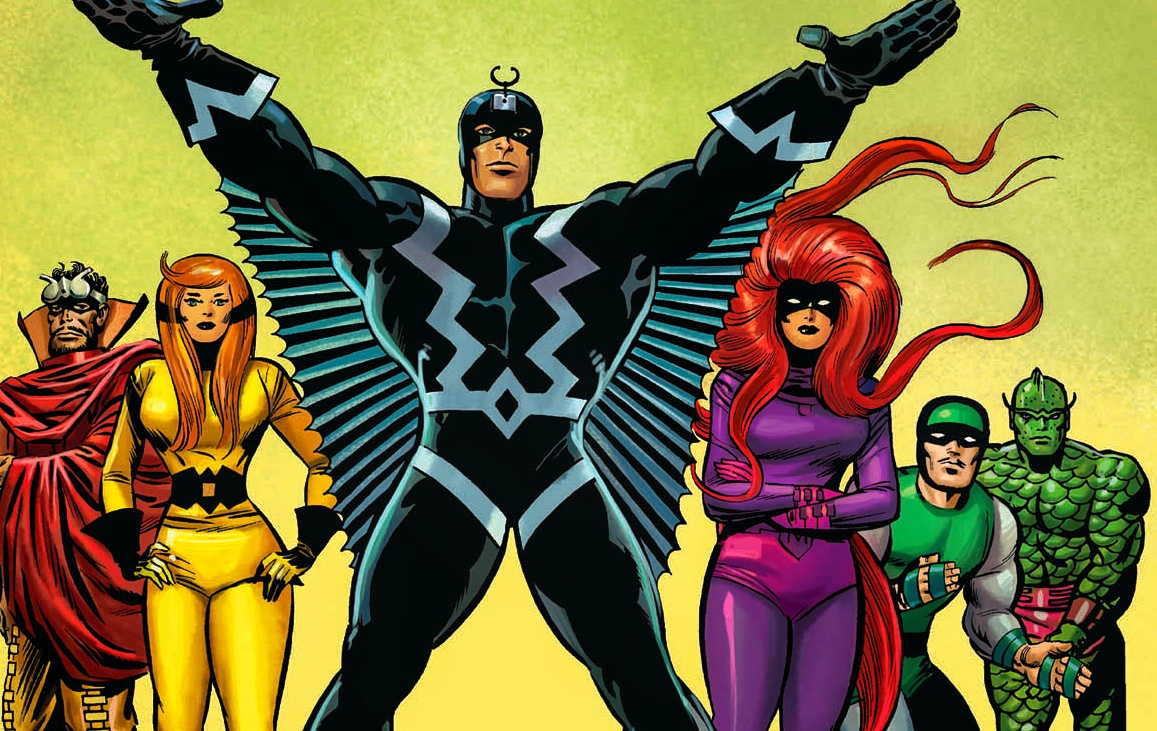
About a decade ago, The Inhumans were everywhere. Marvel Comics would release new titles featuring a mix of old and new characters. A live-action feature film was in the works. They were supposed to be the next big franchise for Marvel. Then, almost overnight, they disappeared. Today, the word “Inhuman” feels like something Marvel would like you to forget even existed.
So what happened? The answer is a cautionary tale of how even fictional characters aren’t immune to the negative effects bad business decisions can have on their brand image.
Marvel’s Mutant Problem
During the 2010s, Marvel Studios didn’t own the film rights to the X-Men; 21st Century Fox did. This meant that every time an X-Man character had their own merchandise appeared in video games or in animation projects, Marvel was basically giving a rival studio’s successful film franchise free advertising.
Reportedly, then CEO of Marvel Entertainment Ike Perlmutter, felt that enough was enough. His solution was to sideline the X-Men and replace them with the Inhumans as an alternative that Marvel could control and monetize.
The X-Men’s presence was reduced across comics, TV, licensed apparel and toy lines. High profile characters, twins Quicksilver and Scarlet Witch had their origins retconned. Instead of being mutants and the children of Magneto, they were now humans whose powers were the result of experiments done by the High Evolutionary. An embargo was in effect that prohibited the creation of new mutant characters or pushing popular X-Men into the spotlight. Meanwhile the Inhumans, a group of genetically altered humans who gained their abilities through a substance called the Terrigen Mist, were suddenly the new “persecuted minority with superpowers.”
Former editor-in-chief of Marvel Comics Axel Alonso was a major force in spearheading this initiative. He oversaw the push from 2011 until his departure from Marvel in November 2017. Interestingly enough, his exit coincided with both the massive failure of The Inhumans TV series (more on that later) and a significant drop in Marvel’s comic book sales.
The groundwork for this was laid out in writer Jonathan Hickman’s Infinity event (2013). Thanos had invaded Earth to search for and kill his secret half-Inhuman son Thane. Refusing to submit, the king of the Inhumans Black Bolt used his sonic scream to detonate the Terrigen Bomb during his battle against Thanos. His scream destroyed the Inhumans’ secret city Attilan, while the Bomb released the Terrigen Mist into the Earth’s atmosphere. It turns out that millions of ordinary people around the world carried dormant Inhuman DNA. Now that drifting Terrigen cloud was activating those genes, transforming countless individuals into a new generation of superpowered beings known as NuHumans. It was a deliberate echo of how mutants gained their abilities: at random and without warning or any say in how this sudden “mutation” will impact your life.
This is how we got Ms. Marvel aka Kamala Khan, a Pakistani-American teenager from New Jersey. The Mist awakened her hidden Inhuman DNA, giving her shapeshifting abilities. Moon Girl (Lunella Lafayette), a child prodigy who would go on to become the smartest person on Earth, also carries Inhuman DNA. While Lunella was already aware of what she was, she was initially terrified of undergoing Terrigenesis until she came into contact with a Terrigen Cloud and gained the ability to switch minds with her partner Devil Dinosaur. Both characters became the two breakout stars of this era, beloved by fans despite the corporate mandate that brought them into the world.
Pushback From Fans
Fans of the X-Men were not pleased with this new mandate. For decades, the X-Men have served as an allegory for marginalized people and the fight for civil rights. Their stories are about celebrating what makes you different in spite of any prejudice and discrimination you may face.
The Inhumans, however, are ruled by a rigid monarchy who practice eugenics. To maintain their utopian society Attilan, the Inhumans created the servant caste the Alpha Primitives to perform menial tasks and manual labor. They have a Genetic Council that dictates who is allowed to marry and reproduce. The Genetic Council is also in charge of determining who’s considered “worthy” of being exposed to the Terrigen Mists. Asking fans to root for a group of superhumans with such a problematic past was always going to be a hard sell.
Then came the Death of X and Inhumans vs. X-Men arcs. These stories revealed that the Terrigen Mist was capable of sterilizing and killing mutants. In other words, the very superhumans Marvel was promoting were being used to commit genocide against the characters they were supposed to replace. Longtime fans of the X-Men (a much bigger fandom that’s been around for decades) were furious and the Inhumans got hit with the full force of their disdain.
That Disastrous TV Series
On October 28, 2014, Marvel Studios president Kevin Feige announced an Inhumans movie was in the works for Phase 3 of the Marvel Cinematic Universe (MCU), initially scheduled to be released November 2, 2018. But allegedly, Feige never shared Perlmutter’s enthusiasm for the project. When he successfully separated Marvel Studios from Perlmutter’s direct control in 2015, Feige scrapped the film. Perlmutter’s camp salvaged what they could and authorized the project as a television series instead.
The Inhumans was a collaboration between Marvel Television, broadcast network ABC and IMAX. The first two episodes debuted exclusively on IMAX screens on September 1, 2017, becoming the first live-action television series to do so. The full series premiered on ABC on September 29.
The production was a catastrophe from the start. Marvel’s choice of showrunner, Scott Buck was also the showrunner for the final three seasons of Dexter, widely regarded as the show’s weakest. He was also the showrunner and executive producer of Iron Fist, another critically panned Marvel series. He was known for getting projects done quickly and on a strict budget. Since the Inhumans as a franchise requires genuine scope and spectacle, that was the wrong thing to prioritize.
To cut costs, Buck made some choices that baffled fans. The most infamous was shaving Queen Medusa’s iconic prehensile hair in the first episode, which is the source of her powers. Lockjaw, the beloved giant teleporting dog, was written out of the series as it went on reportedly due to the high cost of producing his CGI.
Another problem was that the series was supposed to be made for IMAX, which is famous for its ultra-large screens and high-resolution image projection, on a network television budget. The poor quality of the costumes and shoddy visual effects looked even worse blown up to IMAX scale. Audiences who paid for tickets reacted negatively, killing off the show’s early momentum before it even reached ABC.
The first two episodes drew 5.8 million viewers. By the finale on November 10, 2017, that number had plummeted down to 3.6 million. The series holds an 11% score on Rotten Tomatoes and was cancelled by ABC in May 2018 after a single season. It’s widely considered to be one of the worst things Marvel has ever produced.
The Inhuman brand was now radioactive.
Disney Buys Fox and Everything Changes
In 2019, Disney completed its acquisition of 21st Century Fox. Marvel finally had the film rights to the X-Men and with that, the reason to push the Inhumans vanished. There was no longer any incentive to keep them front and center.
In the comics, Marvel wound down the Inhumans’ storylines and sent the Royal Family into deep space. They also launched the massive Krakoa Era, a years-long celebration of mutantkind that restored the X-Men’s place as one of Marvel Comics flagship franchises.
The Survivors: Kamala and Lunella
Ms. Marvel and Moon Girl were the only Inhuman characters to survive the purge.
Kamala Khan’s success had nothing to do with her being Inhuman. G. Willow Wilson and Sana Amanat created a character whose warmth and friendly demeanor transcended the taint that now haunts the Inhuman brand. When Kevin Feige brought her into the MCU, he made her the MCU’s first official mutant, closer to what her creator originally wanted. Marvel Comics eventually followed suit, retconning her into being an Inhuman/mutant hybrid. Marvel kept her Inhuman history out of respect for the source material, but made sure Kamala had a connection to the X-Men’s world.
Moon Girl, a nine-year-old genius who shares a psychic bond with a giant red dinosaur, survived for the same reason. Her Disney Channel animated series Moon Girl & Devil Dinosaur proved she had genuine cross-generational appeal. And NetEase, the developer behind the hit hero shooter Marvel Rivals, loves her enough to include her in the game. She appears in the trailer, has a full in-game model with voice lines, and her technology powers Devil Dinosaur’s shield ability. She’s just not a playable character.
According to prominent Marvel Rivals leaker Miller Ross, there are two reasons for this decision. First, ratings boards prevent child characters from being playable combatants. Second, Marvel Games reportedly prefers not to add her because she’s an Inhuman, and the company is pushing towards a mutant-centric saga across all its media. How ironic is that.
Where Does This Leave the Inhumans?
Can the Inhumans make a comeback someday? It’s possible but that moment isn’t coming around any time soon. The 2017 series did lasting damage, and Marvel is more focused reigniting interest in the MCU with the X-Men playing a key role in their plans. A new film or TV series centered on the Royal Family is very unlikely in the near future.
Instead, Marvel seems willing to invest in individual characters while keeping them separate from the broader Inhuman mythology. For a casual fan watching the Moon Girl animated series or playing Marvel Rivals, she’s just a brilliant kid with a dinosaur. Same with Ms. Marvel if you watch her live-action series or read any comic featuring her. They’re Inhuman origins are minor details that are barely worth highlighting. Marvel gets to use a couple of beloved characters without dragging along a decade of bad will.
The one wildcard is Black Bolt, who appeared in Doctor Strange in the Multiverse of Madness as part of the Illuminati. If the secret collective returns in the post-Doom era of the MCU, it could open the door for some of the Inhumans to return as well.
But for now, the lesson is clear. The Inhumans had potential, but it was burned away thanks to questionable business decisions with a disastrous TV adaptation being the final nail in the coffin. Then they were discarded the moment they were no longer useful. The disaster that was The Inhumans series still echoing nearly a decade later.
Brand damage, it turns out, has a very long shelf-life.