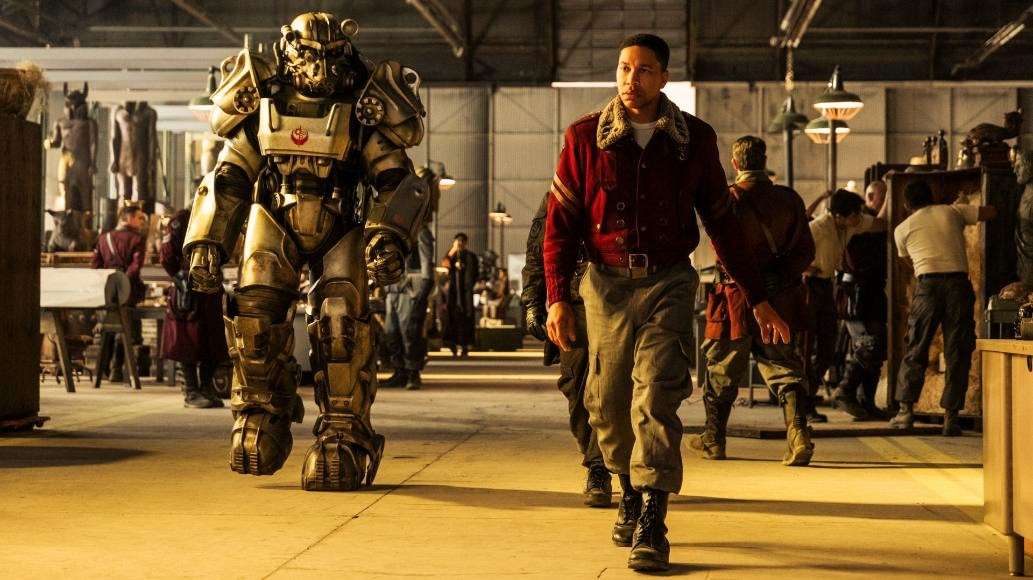
The second season of Amazon’s Fallout wrapped up on February 3. If you felt like you spent eight episodes waiting for something to happen, you’re not alone.
Season 2 was ambitious. It introduced New Vegas, Caesar’s Legion, Mr. House, and teased the Enclave’s master plan. It expanded the world while giving fans of the games little glimpses of how Fallout’s past shaped its present.
The problem is that season 2 was juggling too many story arcs without giving any of them room to breathe. What we got was a season that was both overstuffed and underwhelming.
Season 2 Needed More Than Eight Episodes
Eight episodes has become the default for television shows made for streaming services. This standard is applied to most shows regardless of whether that runtime actually serves the story being told.
Season 2 of Fallout needed more room to grow. The first season worked because it had narrowed its scope. Lucy leaves her vault to find her father and learns some hard truths about the Wasteland. The Ghoul hunts for answers about his family. Maximus tries to survive the Brotherhood. These stories intersect and lead to a satisfying climax. Eight episodes was perfect because there were only a small number of plotlines to follow.
The second season, however, was bouncing between Lucy and the Ghoul’s journey to New Vegas, Maximus’s moral crisis in the Brotherhood of Steel, Norm’s investigation into Vault-Tec, the politics of Vaults 32 and 33, Cooper Howard’s pre-war flashbacks, Mr. House’s schemes, Caesar’s Legion civil war, Hank’s work on the mind control chips, and the looming threat of the Enclave. That’s a lot of ground to cover over the course of 8-ish hours.
The Storylines That Went Nowhere
One subplot that suffered the most from these pacing issues was Norm’s arc. At the end of season 1, he discovered Vault 31 was filled with frozen Vault-Tec employees. Season 2 had him escape into the Wasteland with the employees and did nothing meaningful with it. The little we see of Norm, he’s in a near state of helplessness as he struggles to find answers about Vault-Tec. He’s nearly killed by the employees, only to barely survive a radroach invasion.
What was the point? The entire arc felt like filler to buff up the nearly hour long episodes. Norm learning about the Forced Evolutionary Virus could pay off in Season 3, but that doesn’t make his journey less frustrating to sit through.
The Vault 32 and 33 arcs suffered from the same problem. We spent significant time watching a support group drama play out in Vault 33, complete with Reg McPhee’s privilege allegory and Betty’s attempts to manage a water crisis. None of it leads to anything satisfying. These subplots existed in a vacuum, disconnected from the main story.
Even Mr. House, brought to life by Justin Theroux, ended the season with his fate unclear. After spending so much time establishing him as a key player in New Vegas, the finale just left him hanging. It’s implied that he’s pretending to be offline as he secretly monitors Lucy and Maximus, but we still don’t know what he’s planning. For a show that makes it clear it’s always building toward something, it’s a bizarre choice.
Cooper’s Flashbacks Should Have Been One Episode
Flashbacks of Cooper Howard’s life before the Great War were scattered across the whole season. We got glimpses of his investigation into Vault-Tec and learned more about his relationship with his wife Barb. Most of the time, the flashbacks felt like they weren’t related to the plot.
At least they didn’t when you’re watching season 2 for the first time. Slowly, they began to make more sense the closer we got to the finale. But spreading it across eight episodes fragmented what could have been a powerful deep dive into his past. A bottle episode would’ve been more effective. Give us one hour focused on Cooper before the bombs dropped.
What makes this really frustrating is that the show could have used its flashbacks to explore other perspectives. Why not show us more of the civil war brewing between Caesar’s Legion, or how the Enclave consolidated power after the war? These factions play key roles to the present-day conflicts, but we only understand them through exposition and brief encounters.
Setup Without Payoff
Another problem with season 2 was how much time it spent planting seeds for season 3. “Phase Two” of the Enclave’s plan, Hank’s mind-control chips, the fate of Cooper’s family, Liberty Prime Alpha, the Legion marching on New Vegas. All of these threads were introduced or teased without resolution.
The show assumes audiences will for about a year at the very earliest for a resolution. It creates a viewing experience that feels incomplete. Television should work on multiple levels. Individual episodes should have their own rhythms. Seasons should feel like chapters that stand on their own while contributing to a larger story.
When Action Becomes Filler
Even the action scenes suffered from the pacing problems. The Deathclaw battle in the finale should have been a high point. These creatures are iconic in the Fallout universe, and seeing Maximus fighting them should have been thrilling.
Instead, the fight was split into four parts shown throughout the episode. Each time we cut back to Maximus fighting for his life, the weight of the moment vanishes because it doesn’t last long enough to feel the stakes.
The editing prioritized keeping viewers’ attention through constant scene changes over building tension. It’s the same problem that plagues the season as a whole. The show kept moving, but it wasn’t going anywhere.
The Challenge of Adapting Video Games to Television
Fallout is based on open-world games. Players can spend hundreds of hours exploring, doing side quests, and discovering things at their own pace. That structure doesn’t translate well to serialized television, which needs clear narrative arcs.
Season 1 understood this. It borrowed the games’ aesthetic, tone, and world-building while creating a tight story that worked for television. Season 2 tried to recreate the feeling of playing the games, bouncing between different locations. What we got was a season filled with side quests without a main questline holding them together.
The Streaming Era’s Self-Imposed Limits
The eight-episode model works beautifully for limited series with tight storylines. But for ongoing shows that want to build expansive worlds and juggle multiple storylines, eight episodes isn’t enough.
Ten to thirteen episodes would have given the show the space to develop their plotlines. As it stands, season 2 feels like a thirteen-episode season that was hacked down to eight for no reason.
The show still looks incredible. The production design is meticulous, the performances are strong, the world-building is ambitious. But none of that matters when the pacing is this broken. You can have the best ingredients in the world, but if you’re trying to cook a five-course meal in a microwave, something’s going to come out wrong.
The second season of Fallout had strong performances, with moments that showcased its brilliance. Yet those strengths couldn’t overcome a structure that spread the story too thin. The show had too much to say and not enough time to say it properly.