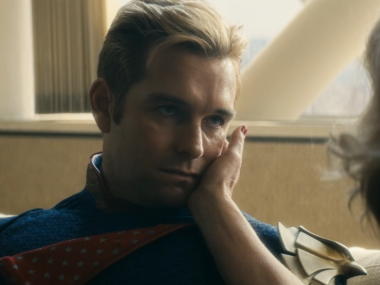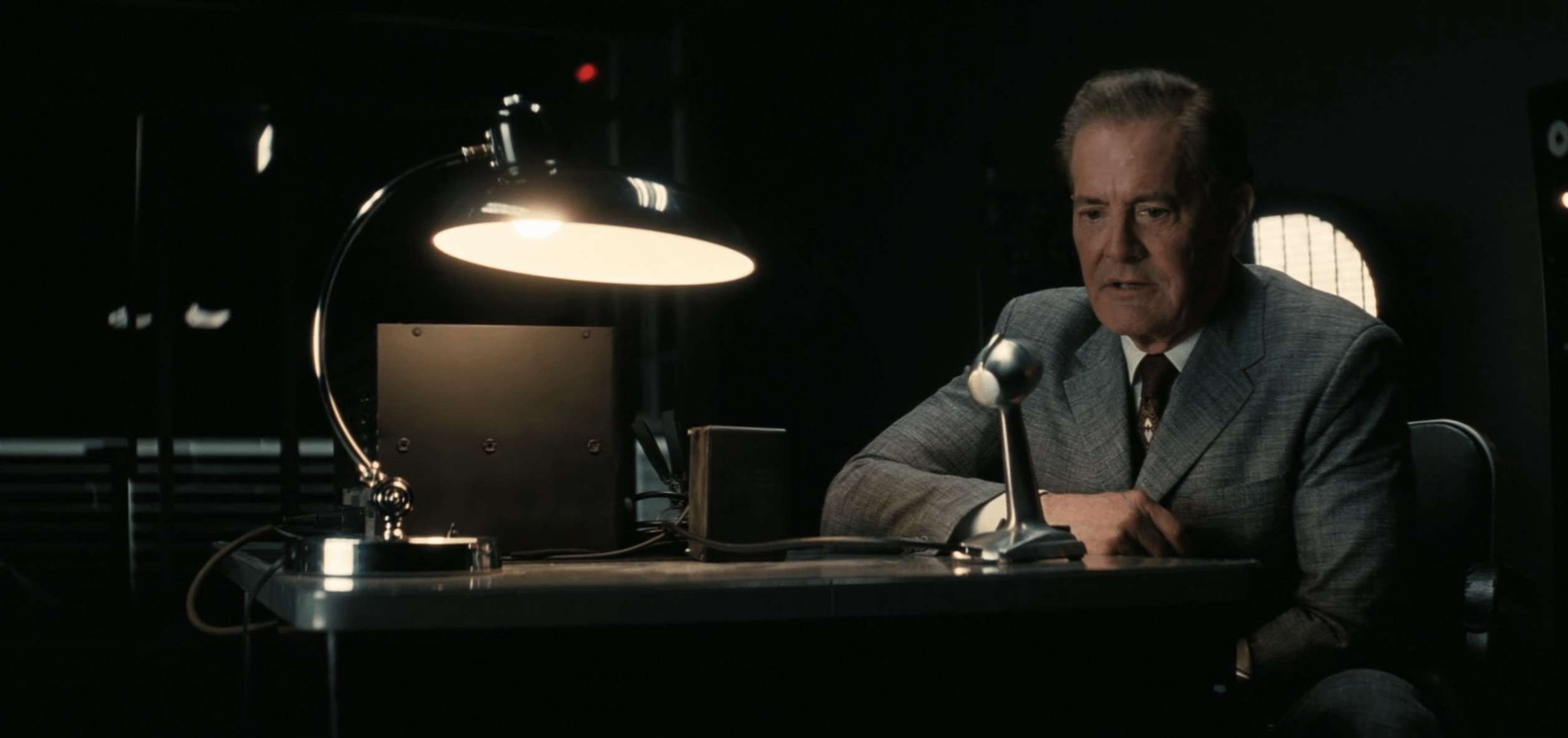
Is Hank MacLean lying about why he’s brainwashing people?
All through the second season of Fallout, we’ve seen Hank working on the mind control chips Robert House gave to Vault-Tec during the pre-war era.
Not only did he fix that strange bug where the chips make the victim’s head explode, he succeeded in mind controlling dozens of surface dwellers. Bandits, murderers, the Snake Oil Salesman, rangers from the New California Republic (NCR). Even members of Caesar’s Legion are transformed into polite, productive members of society.
When Lucy confronts her father about this in “The Other Player,” Hank insists this is all a part of his “redemption arc.” He claims he’s trying to make the Wasteland a better place. And that the only way to achieve that goal is to erase people’s free will and rewrite their entire personality from the ground up.
But is Hank telling Lucy the truth?
Why You Shouldn’t Believe Anything Hank Says
We should question every single thing Hank tells Lucy, because the show deliberately presents him as a character whose words and actions rarely line up. In fact, the series almost invites the audience to treat his stated motives as a façade.
He lied about how Lucy’s mom died. He said it was due to a famine within Vault 33. What really happened was that he nuked the settlement she was staying in, Shady Sands, after she left the vault. The bomb didn’t kill Lucy’s mom but the radiation turned her into a ghoul. The fact that he felt compelled to destroy Shady Sands was because he felt the settlement was a threat to Vault-Tec’s desire to be the one to recreate civilization on the surface.
Also, the beginning of the season implied he’s working independently of Vault-Tec, or at the very least is in cahoots with Robert House. Hank has been shown to be very manipulative, so how can we take his words at face value?
Why Hank MacLean Is So Terrifying
Hank is not a mustache-twirling villain. He’s something far more frightening: a true believer in Vault-Tec’s ideology.
Vault-Tec’s entire philosophy is built on a few core beliefs. Their experiments were designed around the idea that humans need to be controlled, tested, or manipulated “for their own good.” Hank embodies these traits to a T.
Hank paints the surface world as chaotic, irrational, and full of people who “don’t know what’s good for them.” This is classic paternalistic authoritarianism. He believes he understands the world better than everyone else. That others need his guidance. He believes resistance is proof of ignorance, not autonomy.
His behavior also shows a deep psychological need for order. He doesn’t want to help the Wasteland, he wants to fix it. But “fixing” it means making it conform to his ideals of how people should behave.
This is why the mind-control chip appeals to him. It’s the ultimate expression of his worldview.
The worst part is that Hank doesn’t think of himself as cruel. He sees himself as the only practical, sane adult in the room. He believes that only he knows what’s best for Lucy and doesn’t see how his actions are hurting her. When he wipes people’s memories to stabilize the chip, he sees it as “improvement,” not violation.
That Ambiguity Makes Hank a Compelling Character
Does Hank genuinely want to help society despite being a Vault-Tec lackey? Is he bluffing to win back his daughter’s trust? Or is he working outside of Vault-Tec to pursue his own agenda and he’s saying anything that will keep Lucy out of the way of his goals?
That ambiguity is what makes Hank and his story arc so compelling in the series. You don’t know what to believe from him. Every time you see him on the screen, you have to keep your guard up at all times.
Whether he’s lying to Lucy or to himself, the effect is the same. His “better world” is one where he decides everything and no one else gets a choice.