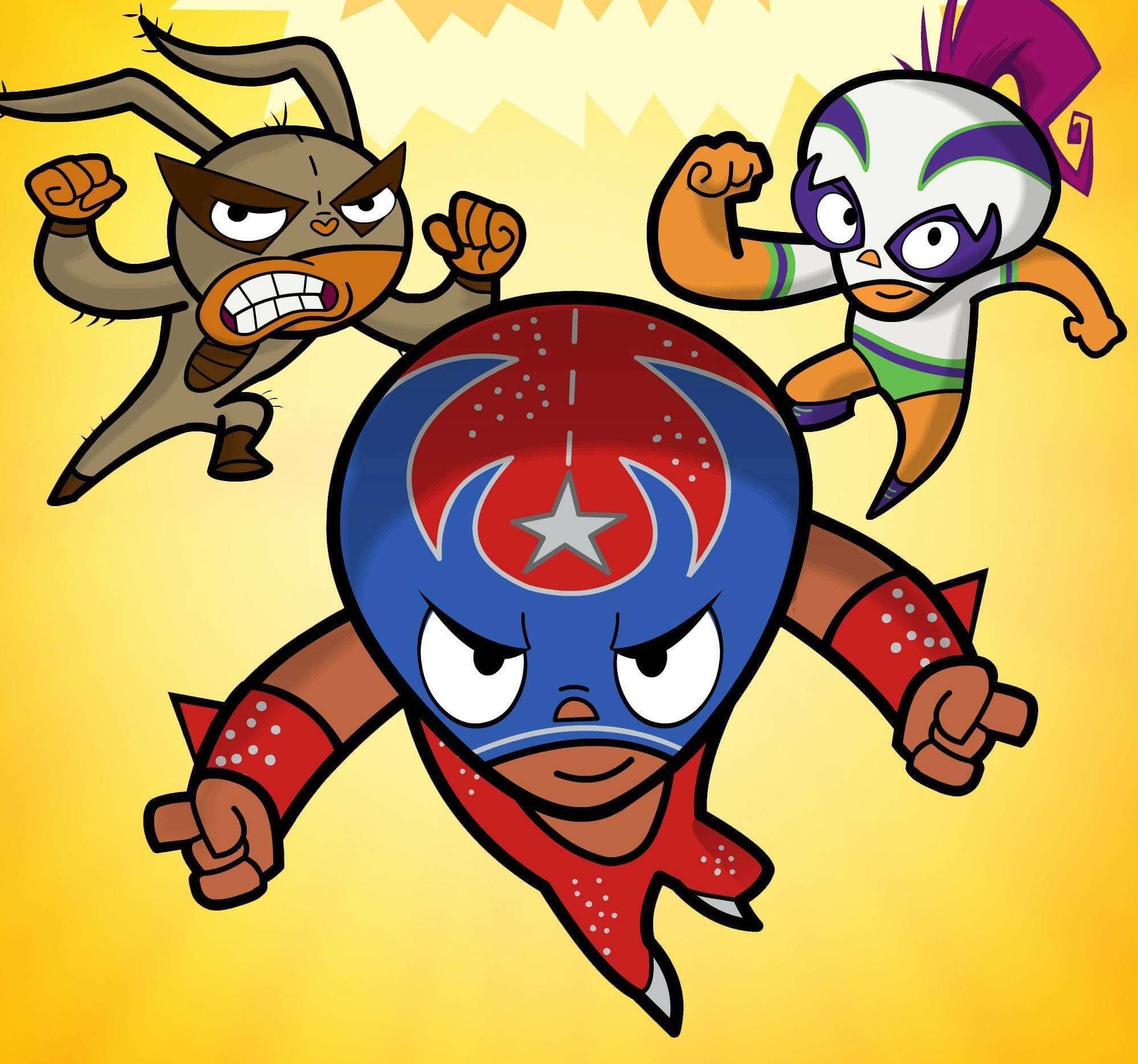
When Backbone Entertainment announced they were working on a game based on ¡Mucha Lucha! at E3 in May 2003, the pitch was genuinely exciting.
Mysterioso Grande was supposed to be a PlayStation 2 arena fighter based on the Kids’ WB animated series, planned for December 2004. According to game artist Ken Cope, it would have supported up to four players, featured levels like “The School” and “The Arena,” and included nearly the entire cast of the show as playable fighters.
Even better, a developer at Backbone figured out how to render a real-time toon shader on PlayStation 2. That meant the game would have the hand-drawn look the cartoon had. That’s a team that took the time to make something they knew fans would love.
Ubisoft was involved as the intended publisher. And then, before Mysterioso Grande ever reached shelves, Ubisoft pulled out. Backbone spent months trying to find another publisher. Nobody stepped in and the project died.
Why? Because by the time Mysterioso Grande was near completion, the name ¡Mucha Lucha! had already become radioactive in the games industry. And Ubisoft was the one who made it that way.
The Game That Ruined Everything
On November 18, 2003, ¡Mucha Lucha!: Mascaritas of the Lost Code was released on Game Boy Advance. The beat ’em up was the first of two planned licensed games based on the show, this one developed by Digital Eclipse and published by Ubisoft.
Critics and gamers ripped Mascaritas of the Lost Code to shreds. It received a critic score of 26 on Metacritic while users scored it a 3.7. It’s considered one of the worst GBA games ever released.
Was the game really that bad? Where do I even begin?
One of the biggest complaints was that despite ¡Mucha Lucha! being an over-the-top love letter to masked wrestling, the game contained zero wrestling mechanics. You had a punch, a kick, a jump, a throw, and one screen-clearing super move with combos.
Enemies needed twenty to twenty-five hits before going down. And no, that wasn’t as challenging as it sounds. The enemy AI was so passive you could pin a sprite to the corner of the screen and hold a button until it died. Reviewers described the experience as “utterly devoid of challenge.” You could finish the whole thing in about two hours.
The visuals had a faint resemblance to the show’s hand-drawn style, a few critics gave it credit for that. But characters moved in what often amounted to a single animation frame per action. IGN called them “rushed” and “chunky.”
The audio looped uninspired Latin-flavored tracks while combat played out in near silence. The story is vaguely about recovering the stolen “Code of Masked Wrestling,” which doesn’t feel like a real plot.
One reviewer writing for GameSpot didn’t mince words. “Point blank, Mucha Lucha is a terrible game with no other purpose other than to make a quick buck.”
The worst part was when reviewers practically begged fans of the series to avoid it like the plague. Not just general audiences, but the people who already loved these characters. That’s a death knell for a licensed property. If your own fanbase is being turned away at the door, you have no floor.
Ubisoft Got Cold Feet After Mascaritas of the Lost Code Flopped
One can argue that Ubisoft’s decision to abandon Mysterioso Grande was just the publisher doing business.
Mascaritas was a cheaper, lower-stakes GBA project. And even at that scale it became a critical embarrassment. A 3D PS2 arena fighter was a more expensive undertaking with a bigger team, a bigger budget, licensing fees, manufacturing, marketing, etc. There was no guarantee that Mysterioso Grande would fare better since it would be coming out a year after Mascaritas massive failure.
But at the same time, the real reason Mascaritas bombed was because it was rushed and badly designed. The fact that it was a ¡Mucha Lucha! game was not the issue. You could replace Rikochet, Buena Girl, and The Flea with the characters of The Incredible or Teenage Mutant Ninja Turtles and the criticisms Mascaritas received would still hold up.
Ubisoft published a bad game, got a predictable result, and then used that result to decide the entire franchise was worthless. Backbone Entertainment paid the price for another studio’s failure.
What the Cancellation of Mysterioso Grande Symbolizes
Mysterioso Grande isn’t just another example of lost media. It’s another example of how a project is always one quarterly forecast away from vanishing. And it’s usually due to circumstances outside of anyone’s control. Mascaritas of the Lost Code failed as a game, but it was Backbone Entertainment that paid the price. ¡Mucha Lucha! as a show was about the opposite. The kids messed up, lost matches, broke the rules, but they found a way to make things right. There was always another match, another chance to redeem yourself in the ring. Unfortunately, Mysterioso Grande will never get an opportunity to prove themselves.