If you’ve played Resident Evil CODE: Veronica, you’ve probably noticed the soldiers in all-black gear following Albert Wesker around like a personal shadow army. Those are the H.C.F., and they’re one of the more interesting loose threads in the entire Resident Evil franchise. So let’s talk about who they are, what they did, and why they basically ceased to exist the moment Wesker was done with them.
Who Are the H.C.F.?
H.C.F. stands for either Host Capture Force or Hive Capture Force. Capcom never gave it an official name so it’s still technically unresolved. Either way, they’re a private special operations unit, basically a black-ops army working for a mysterious company that’s a direct rival (The Organization) to the Umbrella Corporation.
Umbrella, if you’re new to the series, is the pharmaceutical giant responsible for creating biological weapons and accidentally (well, not so accidentally) triggering zombie outbreaks. The Organization is never named either, which tells you a lot about how much Capcom wanted to develop this corner of the story.
What we do know is that the H.C.F. are highly trained, well-equipped soldiers. They wear all-black combat fatigues, they have access to assault planes and submarines, and they answer to one person: Albert Wesker.
Who Is Wesker, and Why Does He Matter?
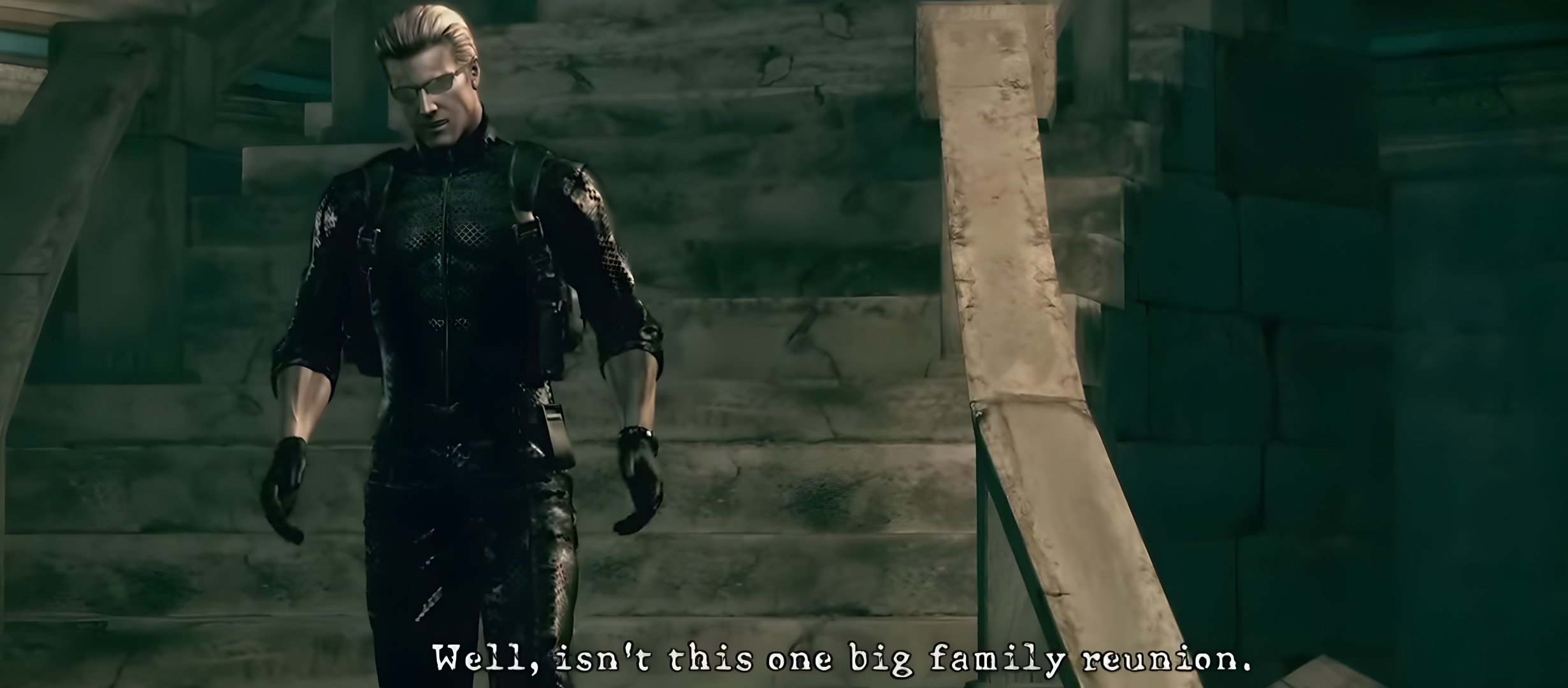
Here’s the quick version for anyone new to the series. Albert Wesker started out as a captain in S.T.A.R.S., an elite police unit. He was secretly working for Umbrella the whole time, feeding them information. During the events of the original Resident Evil in 1998, he was apparently killed. He had injected himself with an experimental virus that brought him back to life stronger, faster, and basically superhuman. He went rogue, cut ties with Umbrella, and joined this mysterious rival company The Organization.
That’s where H.C.F. comes in. When Wesker joined The Organization, he was given a mission: get a sample of something called the t-Veronica Virus, a rare and powerful new biological weapon created by a scientist named Alexia Ashford. H.C.F. was how he would get it.
The Rockfort Island Attack
On December 27, 1998, H.C.F. launched a full assault on Rockfort Island, an Umbrella facility in the South Pacific. They came in with assault planes and bombed the place. The bombing cracked open the island’s labs and released the t-Virus, which quickly spread and turned most of the island’s population into zombies. So right off the bat, H.C.F. caused a massive outbreak just as a side effect of their operation.
As the mission progressed, Wesker stayed in radio contact with his men. Whenever something went wrong or an agent needed backup, Wesker used his viral enhancements to quickly get to their location. It’s one of those moments in the game where you really feel how much his abilities set him apart from everyone else around him.
The problem: Alexia wasn’t on Rockfort Island. She’d been in a self-induced coma for fifteen years at an Umbrella base in Antarctica. So the whole bombing was basically a very violent dead end.
On to Antarctica
The moment Wesker found out Alexia’s real location, he pulled out. H.C.F. abandoned Rockfort Island and headed to the Antarctic Base. It’s a clean, cold decision that says a lot about how Wesker operates: the island only mattered as long as Alexia was on it. When he found out she wasn’t there, it was disposable.
At the Antarctic Base, things got complicated. Alexia had been sleeping for fifteen years because the t-Veronica Virus she’d injected herself with needed time to bond with her DNA properly. When she woke up, she was powerful enough to mutate into several increasingly extreme forms. Wesker couldn’t just take her down and grab a sample. He needed a living host.
Then Chris Redfield showed up. Chris is Wesker’s old S.T.A.R.S. teammate and long-running nemesis. He’s the one who destroys Alexia after she mutates multiple times. Wesker lost his only living host for the virus. It’s a real setback.
Except… Wesker has a backup.
Steve Burnside and the Backup Sample
A young man named Steve Burnside had been captured and experimented on during the events on Rockfort Island. He was injected with t-Veronica, mutated, then died from his injuries. His body was left intact at the Antarctic Base. Wesker ordered H.C.F. to recover Steve’s body because it still contained a viable viral sample.
H.C.F. pulled Steve’s body out before the Antarctic Base self-destructed, and Wesker walked away with what he came for. It’s a victory that’s easy to miss if you’re focused on the main story.
The Eveline Connection
Two years later, in 2000, H.C.F. shows up in the lore one more time. They provided technical assistance to a criminal organization called The Connections, which was working on a new kind of bioweapon. The goal was to create something that could neutralize enemies through mind control rather than just killing them. The result, eventually, was Eveline, a genetically engineered child with the ability to control people’s minds. She’s the central threat in Resident Evil 7, which came out in 2017, set years after these events.
To be clear: The Connections were the ones running the project. But H.C.F. materials were transported to an underground facility called ARK to help with further development. It’s a small footnote, but it connects H.C.F. to one of the biggest storylines in the modern era of the franchise.
So What Happened to H.C.F.?
After the Eveline footnote, H.C.F. basically disappears from Resident Evil entirely. In the ARK facility from Resident Evil Requiem (2026), there are boxes with the H.C.F. logo sitting around. That’s it. No missions, no agents, no storylines of their own. Just branded cardboard.
Wesker dies in Resident Evil 5, and with him goes any last reason for H.C.F. to matter. There’s no splinter group, no successor commander, no legacy operation. They just stop existing as a narrative force.
That’s what makes H.C.F. so fascinating to think about. They’re what storytellers call a satellite organization. Just like a satellite character exists only to serve the story of someone more important, H.C.F. exists only to serve Wesker. Their missions are his missions. Their purpose is his purpose. They have no agenda of their own, no story that doesn’t run directly through him.
Compare that to The Connections, which shows up in Resident Evil 7, Village, and Requiem with independent operations, their own history, and storylines that have nothing to do with Wesker at all. The Connections is a real faction. H.C.F. is a tool with a name.
If you’re a fan of the To Be Hero X anime, think of Moon and how her entire early role in the story exists to illuminate Nice’s character. She has almost no story that doesn’t pass through him. H.C.F. works the same way, just at an organizational scale.
The Story That Never Got Told
An interesting H.C.F. fact that almost happened: H.C.F. were planned to appear in a game called “Castle,” which was being written by Noboru Sugimura, the same writer behind CODE: Veronica. The game was never made. The one person who might have given H.C.F. their own independent storyline never got the chance.
The fact that Capcom seemed to recognize there was more story for H.C.F., and never followed through, says a lot.
The Bottom Line
H.C.F. is one of those pieces of Resident Evil lore that rewards paying attention. They’re the ones who kick off the entire CODE: Veronica incident, they leave a fingerprint on the creation of one of the franchise’s most memorable villains, and then they quietly fade out when their reason for existing walks ceases to exist.
Whether Capcom ever revisits them is anybody’s guess. But as a case study in how game studios build organizations around a single character and then have nowhere to take them once that character is gone, H.C.F. is a pretty perfect example.