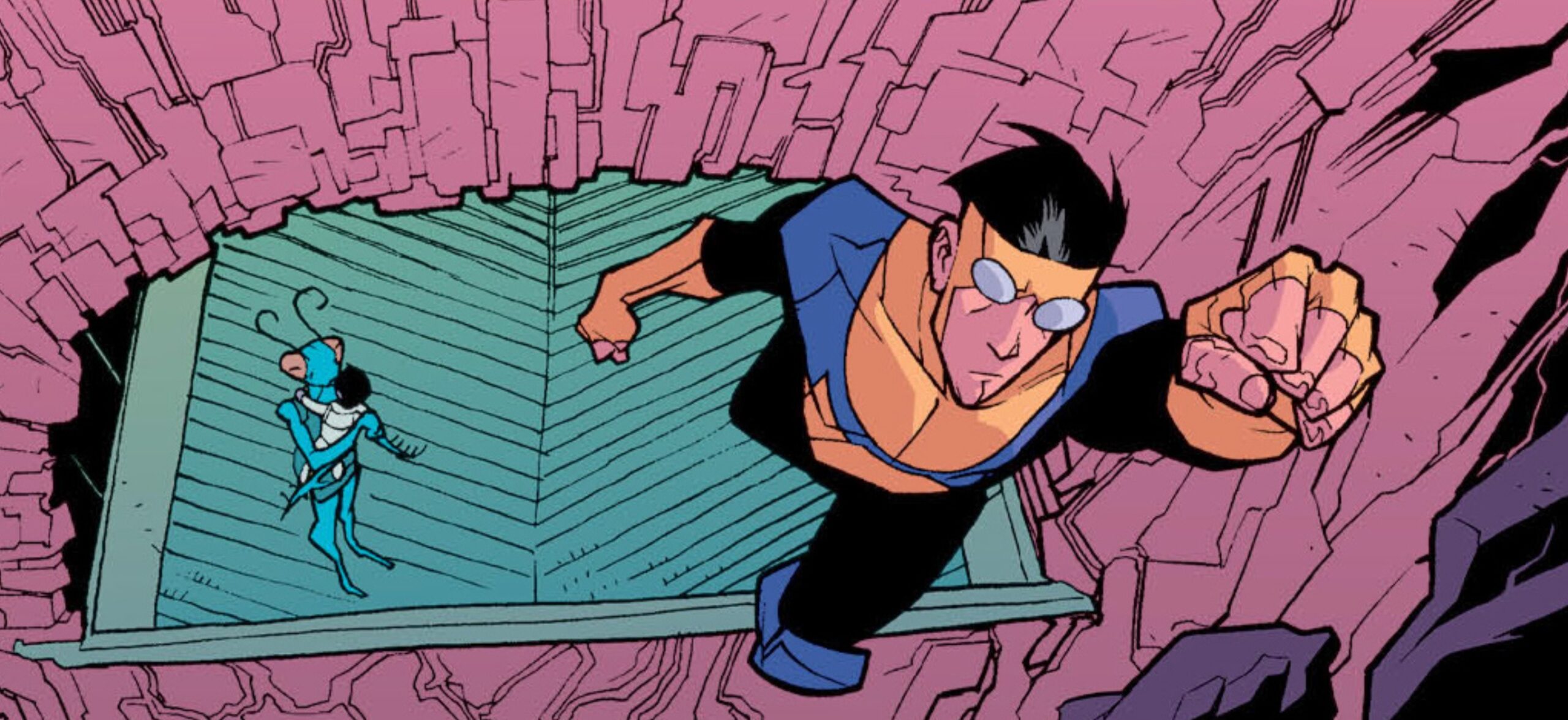
There is a moment in the comic series Invincible that stops you cold. Oliver, a young half-alien boy with enormous power, kills an enemy. Not by accident. On purpose. And then he looks at his older brother Mark and says something that is very hard to argue with: if we let them go, they will come back. More people will die. How many innocent lives is your rule worth?
Mark has no clean answer. Neither do we.
This is not a new question in superhero stories. Batman asked the question for decades. But Invincible asks it more honestly than most. It does not let the hero off easily. It shows the bodies. It counts the cost.
Who are these characters?
Mark Grayson, known as Invincible, is a teenager who discovers he has superhuman strength, speed, and the ability to fly. His mother is human. His father is a Viltrumite, a member of an alien species that is nearly impossible to hurt, nearly impossible to contain, and has spent centuries conquering other worlds. Mark was raised on Earth and thinks of himself as human. He has a human heart. He has human rules.
Oliver is Mark’s younger brother. Also half-Viltrumite. His mother, deceased, was Thraxan (a species that looks like praying mantises). But Oliver grew up differently. He sees threats with colder, clearer eyes. He does not share Mark’s attachment to Earth’s laws. When he looks at an enemy who cannot be imprisoned and will not stop, he reaches a simple conclusion: stop them permanently.
Mark’s ethical position sounds noble. But noble positions have a body count too.
The Viltrumites are not ordinary criminals
Not all threats are the same. A man robbing a bank with a gun? Mark can handle that easily. He stops the robbery, the criminals live and the police take the criminals away. The court system exists for exactly this. It works. Mark is right to step back and let it do its job.
But Viltrumites are something else entirely. They came to Earth not to live alongside humans. They came to take over. That was the plan from the beginning. Quiet, patient, deliberate conquest. Their culture is built around power. Strength is their religion. They do not negotiate. They do not surrender.
They cannot be contained. The comic shows this directly. A government official named Cecil, a man who deals with threats no one else will touch, builds what he believes is an unbreakable prison for one of them. The prisoner breaks out. This is not a failure of effort. It is a failure of physics. Earth simply does not have the tools to hold a Viltrumite.
So the question becomes very clear. If you cannot contain them, they will come back, and people will die when they do… what exactly is the ethical argument for letting them go?
Why Mark struggles with this
Mark is not stupid. He knows all of this. And yet he resists.
Part of it is principle. Once a hero starts killing, where does it stop? Who decides when a threat is bad enough? That is a real concern. Power without limits is dangerous. Even power used with good intentions.
But there is something deeper going on. Mark is half-Viltrumite. His father is one. His brother is one. If he accepts that Viltrumites must be killed when they cannot be stopped, he has to ask a question about himself that he is not ready to ask. His resistance is not just philosophy. It is personal. It is fear. He needs to believe there is another way partly because if there is not, what does that say about his own blood?
That is excellent writing. A hero whose ethics are tangled up with his identity is far more interesting than one who simply follows a code. But it does mean his position is not purely reasoned. It is emotionally motivated. And Invincible is honest about that.
The Batman problem
Batman has never killed the Joker. The Joker has killed countless people. He escapes. He kills more. Batman catches him again. The cycle never ends.
There is a reason for this. If Batman kills the Joker, there is no more story. The writers need the Joker alive. So the moral argument gets bent to fit the plot. Batman insists on the rules. The story insists on the villain. Everyone looks away from the bodies.
Some writers have tried to be more honest. There are stories where Batman essentially admits he knows what he is doing. That he is choosing his principle over the lives it costs, and that he carries that guilt. That is darker. But it is real. It treats the reader like an adult.
Invincible goes further. It does not protect Mark’s clean hands. It makes him watch the consequences of his choices. It does not let the story pretend the rule is free.
Does Mark change?
Yes. And this is where the series becomes something genuinely special.
Mark’s position evolves slowly and painfully over many years of story in the comics. He does not wake up one day with a new philosophy. It happens the way real change happens. Through loss, through failure, through watching people die because he held a line he was no longer sure was right.
He comes to understand what Oliver understood early. That a calibrated response is not the same as cruelty. That killing a conqueror who cannot be stopped is not murder. It’s the only honest answer to an impossible problem. He does not become cold and he doesn’t lose himself. He grows up. He stops letting his personal fear shape his ethics.
The final confrontation with Thragg, the most powerful Viltrumite, the ruler of the empire, the most dangerous being in the story, is the test of everything. By then, Mark does not hesitate the way he would have at the beginning. He has earned a different answer.
So… should superheroes kill?
Here is the most honest answer: it depends entirely on what you are dealing with.
For human criminals who can be contained by human systems: no. The law exists. Let it work. A superhero who kills a bank robber is not a hero. They are a problem.
For an alien conqueror who has demonstrated repeatedly that no prison can hold them, who will return, who will kill more people, who has no interest in peace… the no-kill rule is not about ethics. It is a comfort blanket. It protects the hero’s sense of themselves while others pay the price.
Oliver is blunt, young and lacks the care Mark brings to most of his decisions. But on this specific point, about this specific category of threat, Oliver is correct.And Invincible is one of the rare superhero stories brave enough to say so out loud.