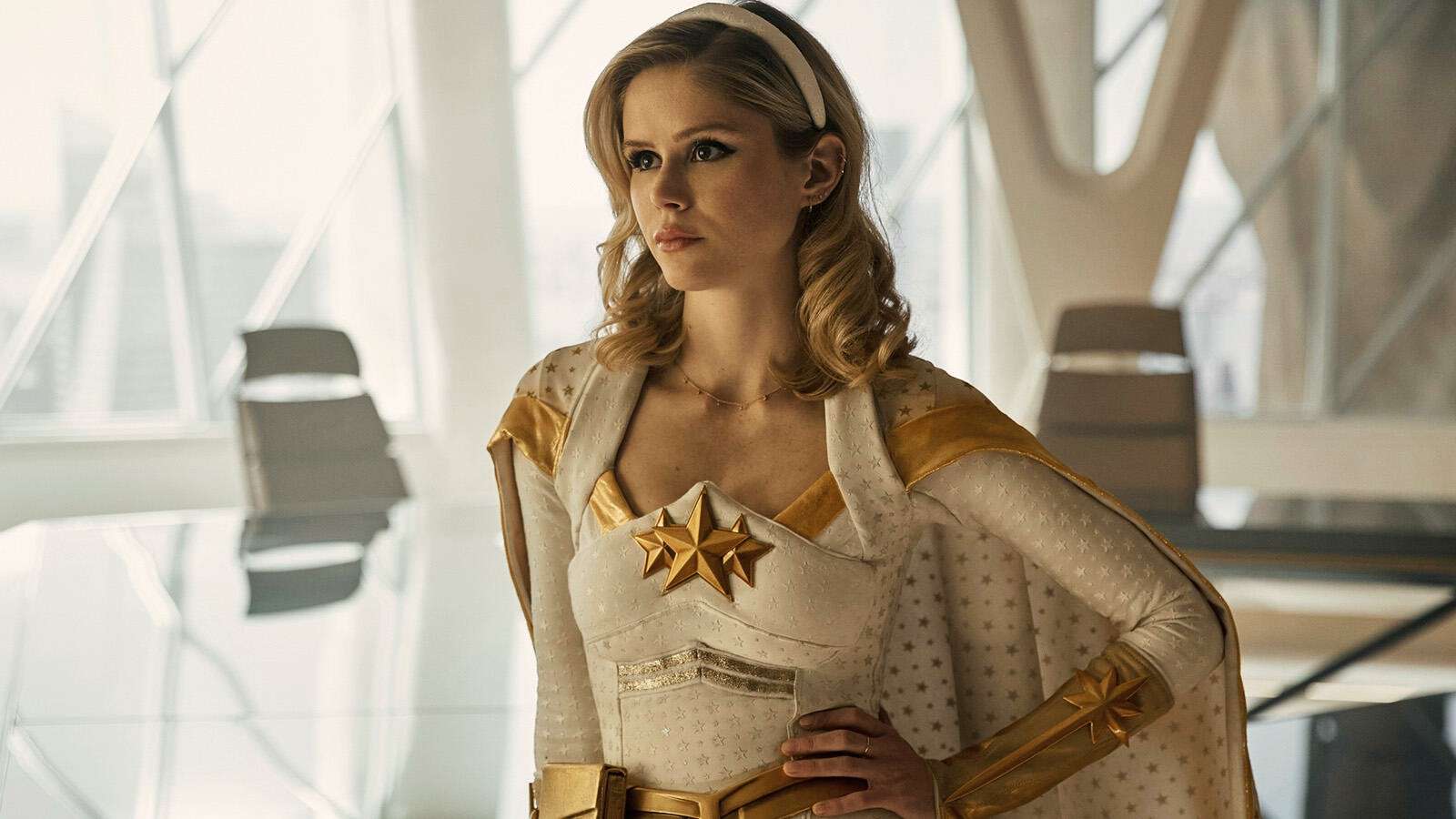
Since the very first episode of The Boys, Annie January isn’t just Starlight, the newest member of The Seven. She’s Starlight™: a curated asset Vought can aim at demographics like an ad campaign with legs. She’s sold as the wholesome “good Supe.” The one you can take home to meet your mom and to church the next day. The perfect fusion of faith, patriotism, and girlboss feminism.
Every part of that is engineered. The changes made to her costume, the staged rescues, the carefully scripted interviews. Any sincere desire to do good like calling out The Deep for sexually assaulting or trying to actually help people is repackaged with a Vought logo slapped on top.
This hit a boiling point after Annie quit Vought and The Seven in season 3. Tired of being complicit in the damage the corporation was causing, she renounces her Starlight persona, which she feels is now tainted. This separation of her dual identities causes her to lose access to her light/electricity-based powers in season 4. Annie’s arc symbolizes what happens to real women turned into endless, marketable inspiration machines.
The “perfect activist” trap
As a young woman who also happens to be a hero, Annie is under a lot of pressure to be perfect. She’s expected to be morally superior to Vought, calm and collected, media savvy while still being relatable, powerful but not intimidating.
Any deviation from this image is punished. Angry? She’s hysterical. Compromise once? She’s a sellout. Acts like a regular person? She’s a fraud.
Things get complicated when Firecracker, a new member of The Seven who’s a far-right influencer, targets Annie in a brutal vendetta that attacks her reputation. In episode 4 “Wisdom of the Ages,” Firecracker leaks Annie’s medical records and reveals she got a abortion during a live broadcast. Furious, Annie delivers a vicious beatdown that goes viral on the internet.
The incident tanks Annie’s public image. Firecracker twists what was supposed to be a private moment into “evidence” that Annie is a hypocritical menace to society. The worst part is that Firecracker used to compete in the same Supe pageants with Annie when they were younger. Until Annie spread a rumor that Firecracker slept with the judges, destroying the girl’s life.
There is no way to sustain that flawless image because Annie herself is anything but flawless. But she keeps trying because everything is going to hell and she thinks she wants to make a difference.
Gendered scrutiny and punishment
The backlash Annie faces after the Firecracker incident mirrors how women in the public eye are policed differently from their male counterparts. Her anger and grief are viewed as instability. Meanwhile male Supes like Homelander can commit atrocities and still maintain cult-like devotion. Women are expected to embody purity while men are free to abuse power.
Vought and the media weaponize Annie’s pain, turning her humiliation into content. The scene is a cruel parody of real-world “gotcha” culture. Where choices women make about sex and reproductive health become fodder for moral outrage.
The Boys doesn’t let Annie off the hook either. Her cruelty toward Firecracker when they were younger shows how internalized misogyny materializes. Instead of supporting one another, women will tear each other down instead. In that sense, Annie’s humiliation is cyclical. She becomes both a victim and a participant.
Annie’s kidnapping in the finale pushes her struggle with identity to its breaking point. When the shapeshifter steals her face, the show makes literal what’s been happening to her since season one: other people have been wearing versions of her for years. Vought packaged “Starlight™.” Firecracker weaponized her image for outrage. Even the public built her into a saint or a villain depending on the headline. But now, that abstraction manifests as a real creature wearing her skin and turning her into the monster everyone expects.
Confronting the mirror
Near the end of season 4, we learn that at some point a shapeshifting Supe kidnapped Annie. For ten days, she’s imprisoned while the impostor tries to destroy her reputation by attempting to assassinate President-elect Singer.
For the first time, Annie is powerless while the shifter stops by to mock her. It’s a brutal metaphor for how women lose control of their own narratives once the media and public perception take over. Vought packaged her as “Starlight™.” Firecracker tarnished her image for revenge. The public made her into a saint or a villain depending on their mood. Now, someone else is wearing her skin.
In that isolation, Annie has to reckon with who she is when there’s no one around. When she fights and ultimately kills the shapeshifter, it’s cathartic. She acknowledges all the good and bad things she’s done, and accepts they make up who she is.
Afterwards, when Annie confronts Hughie on not recognizing she was missing, she accuses him of wanting a “perfect” version of her. She finally admits that’s not who she is; she’s depressed and complicated. But Hughie admits he loves her as she is, mess included.
It’s the first time somebody tells Annie they love her for who she is, not what she can do for them. That inner acceptance reawakens her powers, and even amplifies them. By refusing to live as a marketable fantasy, Annie becomes something new. Not Starlight, but fully herself. The moment she stops trying to save everyone in a way that fits the world’s expectations, she finally saves herself.