Oliver Grayson should not exist.
It is actually one of the most remarkable things about him. A villain named Angstrom Levy reveals something interesting: Oliver is absent from nearly every alternate dimension ever scanned. For him to be born, a long chain of unlikely events had to align perfectly. His father, Nolan Grayson, had to leave Earth, travel to a specific planet, fall in love with a specific woman and have a child with that woman. Within a specific time frame.
Most versions of the universe never get Oliver at all.
But this one did! And that turns out to matter enormously.
Who Is Oliver Grayson?
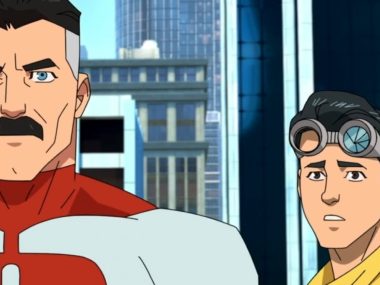
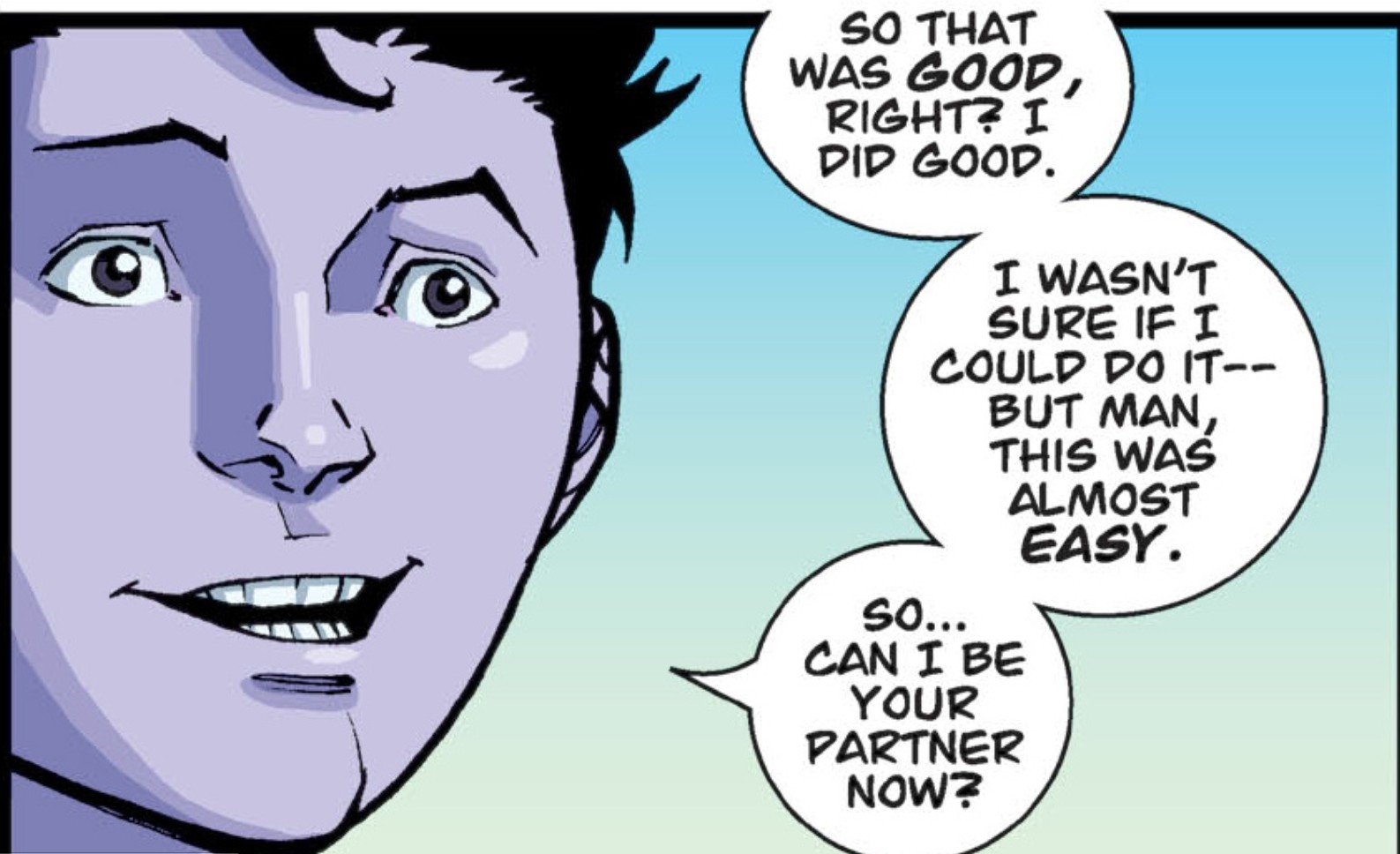
Oliver is the half-brother of Mark Grayson, also known as Invincible (the show’s main hero). Their father is Nolan Grayson, also known as Omni-Man, an alien from a powerful conquering race called the Viltrumites. Mark’s mother is a human woman named Debbie. Oliver’s mother is someone completely different.
Her name is Andressa. She is a Thraxan, an insectoid alien from a planet called Thraxa. Her people look like large insects. They are gentle, peaceful, and community-minded. They are also extraordinarily short-lived. A full Thraxan lifespan lasts just nine months.
Andressa loved her son fiercely. But she knew she would die before he could even speak properly. So she asked Mark, a brother Oliver had only just met, to take him to Earth. To give him a life among people who could actually be there for him.
Oliver could not say goodbye. He could barely say “brother.”
A Child Made of Contradictions
Oliver is half Viltrumite and half Thraxan. Those two species could not be more different.
Viltrumites are warriors. Conquerors. They are physically almost indestructible and believe that strength is the only thing that matters. Their empire spreads across the galaxy by force. They do not feel guilt. They do not hesitate.
Thraxans are the opposite. They live fast, feel deeply, and build communities. Because their lives are so short, they develop quickly, both physically and mentally. A Thraxan child absorbs knowledge almost instantly.
Oliver inherits both. He grows from a baby to a pre-teen in months. He learns everything put in front of him at extraordinary speed. But underneath all that rapid growth is a child who barely had a mother, who arrived on a planet that felt nothing like home, and who was different from literally everyone around him.
His skin is purple. Humans stare. He cannot simply walk outside.
He is, in almost every way, an outsider.
The Philosophy He Carries
Because Thraxans live for only nine months, their relationship with death is very different from ours. Death is not a tragedy to them. It is just the next part of life. It comes quickly, and they accept it.
Oliver absorbed that. Deeply.
He does not see death the way Mark does, the way most humans do. He sees dangerous villains, people who have hurt others and will hurt others again, and his thinking is simple: stop them permanently. Why let them go, only for them to escape and cause more suffering?
When he kills the Mauler Twins, two powerful and violent criminals, he feels little remorse. Mark is horrified. Oliver is confused by Mark’s reaction. They are speaking different moral languages.
And yet. Oliver is not a Viltrumite either. He is not killing for power, or for conquest, or for pleasure. He genuinely wants to protect people. He just weighs individual lives differently.
What he struggles with more is the idea of innocent people being harmed for a “greater good.” He is capable of rationalizing enormous things in the name of protecting those he loves. At one point, he attempts to release a virus that could kill Viltrumites across the planet. Without fully accounting for what else it might do. It nearly kills Mark.
That moment changes him. He apologizes. He means it. And slowly, he begins to change.
The Loneliness Nobody Talks About
Here is something the show handles with quiet grace: Oliver will outlive almost everyone he ever loves.
His Thraxan side made him age fast. His Viltrumite side is now slowing that down and will eventually grant him a lifespan of thousands of years. The people he grew up with: Debbie, friends, neighbors, will all grow old and die while Oliver barely ages.
This is not a small thing. It sits underneath everything he does.
It might also explain the seed the show plants early. And that many viewers miss entirely.
The Fizzy Feeling
In a seemingly throwaway moment, Oliver mentions feeling “fizzy” around a lobster.
He still eats it. But the feeling is noted.
It reads as a joke at first. But look closer. Oliver’s mother was an insectoid alien. Her people had mandibles, shells, compound eyes. They moved and spoke and existed in ways entirely unlike humans. And Oliver, who never truly knew his mother, who was taken from Thraxa as an infant, seems to carry something of her world inside him without understanding why.
There is also a scene, when Nolan offers Oliver Thraxan food (insect-like creatures). Oliver refuses at first. He pulls away. A child being fussy, it seems. But what if it is something deeper? What if, on some level he cannot name, something about those creatures feels too close? Too familiar?
In the comics, this thread is followed to its conclusion. Oliver eventually discovers he is not attracted to humans, or even to other Viltrumites. He is specifically drawn to sentient arthropods. Beings with shells and mandibles, beings that look, in their own way, like his mother’s people.
And practically speaking? Many of those beings live for a very long time. Long enough, perhaps, to stay.
The loneliness of outliving everyone is not just an emotional burden for Oliver. It shapes who he can love.
Debbie: The Unexpected Anchor
When Oliver arrives on Earth, Debbie Grayson takes him in. This is complicated. Debbie had just discovered that her husband, the man she thought she knew, had been deceiving her for decades. He left and started another family.
And now that other family’s child was on her doorstep.
She could have turned him away. Instead, she named him. She raised him. She loved him.
Debbie manages to do that no one else can. Mark tries to teach Oliver through argument. Through rules. Through his own moral code. Oliver resists. But Debbie gets through.
She does not lecture. She connects. She reaches something in Oliver that logic alone cannot touch. The part of him that is still a child who lost his mother before he could remember her. Debbie does not replace Andressa. But she gives Oliver something he desperately needed: someone who stays.
The Slow Burn That Was Always There
When you look back at Oliver’s arc with fresh eyes, the character progression is awesome.
Every piece was laid carefully. The fizzy feeling around the lobster. The reluctance around Thraxan food. The outsider loneliness. The deep, almost desperate loyalty to the few people he loves. The way he was born from a short-lived species that accepts death but is now living a long life. How he has his own personality different from Mark and Nolan.
Robert Kirkman built a character whose alien heritage is not just cosmetic. It is psychological. It is emotional. It is, in the truest sense, who Oliver is.
He carries his mother with him in his instincts. In the comics, Oliver eventually finds Haluma, a lobster-like alien, warm and strong, someone who will not leave him behind. They build a life together on a distant planet. They have children. Oliver, who started this story as an infant passed between strangers on a dying world, becomes someone with roots.
Andressa only lived nine months. But the love she had for her son, the sacrifice of sending him away so he could have more than she could give, echoes through everything Oliver becomes.
She could not stay. But she never really left.
Invincible is streaming now on Amazon Prime Video. The comics, written by Robert Kirkman with art by Cory Walker and Ryan Ottley, ran from 2003 to 2018 and are available in collected editions.