he year was 1972. A new and controversial genre of films called Blaxploitation had exploded in popularity in the early 1970s. These films featured Black actors as the main characters, with soundtracks produced by soul and funk artists. Critics accused these films of perpetuating stereotypes of Black people being involved in crime and drugs. But Black people loved them because for once, they were the heroes of their own stories.
Wanting to capitalize on the popularity of Blaxploitation cinema, Marvel Comics created Luke Cage, a street-level “hero for hire.” He was the epitome of the classic Blaxploitation hero: hyper masculine, sexualized, working-class figure who had his own idea of what justice looks like. Over the years, writers would tone these aspects of Luke’s character. Instead, the focus shifted to Luke’s role as a husband to Jessica Jones and father to their daughter Danielle Cage-Jones.
New to Luke Cage? Start Here
If you’re new to Luke Cage or discovered him through Daredevil: Born Again, here’s what you need:
- Real name: Carl Lucas, raised in Harlem, New York
- Powers: Superhuman strength, healing factor and near-bulletproof skin
- Business model: Hero for Hire. He charges and he’s not sorry about it.
- Family: Married to Jessica Jones. Father of Danielle Cage. Best friends with Iron Fist, Danny Rand.
- On screen: Played by Mike Colter across Netflix’s Jessica Jones, Luke Cage, and The Defenders. Now returning in season 3 of Daredevil: Born Again
- Why it matters now: He was mentioned in Daredevil: Born Again season 2, with a larger role confirmed for season 3 where the Defenders are expected to reassemble.
Origins
Born Carl Lucas in Harlem, Cage wasn’t always the hero. He ran with street gangs called the Rivals, committing petty crimes alongside his friend Willis Stryker on behalf of a local mob figure. At one point, he dreamed of becoming a top racketeer, until he realized how his lifestyle was endangering his family.
Bitter they were both in love with the same woman, Stryker framed him on drug charges. Luke was sent to Seagate Prison, where a racist guard named Albert “Billy Bob” Rackham made his life a special kind of hell. When Rackham was demoted after his abuse came to light, he blamed Cage. Then a doctor named Noah Burstein started recruiting prisoners for medical experiments on cell regeneration, a variant of the Super-Soldier serum, in exchange for parole. Cage volunteered, but Rackham sabotaged the project. The goal was to kill him. Instead, the experiments gave Luke superhuman strength and bullet-proof skin.
Cage made his debut in Luke Cage, Hero for Hire #1 in June 1972, created by Archie Goodwin, George Tuska, Roy Thomas, and John Romita Sr. He was the first African-American superhero at Marvel to star in his own series. He debuted in his now iconic costume of a yellow open-chested shirt, chain belt, silver gauntlets, and a silver tiara. The chain belt was a symbol of his former captivity, and possibly a political statement given the times. The name “Luke Cage” itself carried that same weight with “Cage” being a subtle reference to his time in prison.
Luke also started popping up in unexpected corners of the Marvel Universe. He was the first obstacle Spider-Man faced after the deaths of Gwen Stacy and Norman Osborn, and he temporarily replaced the Thing in the pages of the Fantastic Four. A street-level hero for hire, and yet somehow everywhere.
One more interesting detail is that the actor Nicolas Cage changed his surname from Coppola (yes, he’s related to director Francis Ford Coppola) to build his career without relying on his famous family. He chose the surname Cage from this character. One of Hollywood’s most recognizable names exists because of a Harlem-born Marvel hero from 1972.
Hero for Hire
What set Luke apart from other heroes was that he treated vigilantism as a business. Unlike most heroes who are motivated by altruism or duty, Luke was a hero for hire who charged people for his services because to him, street-level heroes can’t afford to work for free. He needed to pay rent, put food on the table just like everyone else. In a genre built on power fantasies, that felt radical.
Class is a recurring theme in his stories. His persona draws from a tradition of urban folk heroes who represent working people. This set him apart from the other Black heroes Marvel had during this era. The Black Panther was a king with infinite resources. Luke Cage was a man figuring out how to pay rent.
His interaction with Doctor Doom story is the best example of who Luke Cage is.
Doom hired him for a job, then skipped town without paying the $200 fee. How did Luke respond? He broke into the Baxter Building (home of the Fantastic Four), stole a plane, and flew to Doom’s castle in Latveria. He beat up one of Marvel’s most powerful supervillains while delivering what might be the greatest line in his history: “This is a sample of my fist.”
He didn’t care that Doom was a dictator with an army and a castle. Doom owed him $200.
Power Man and Iron Fist
His original alias Power Man came from a moment of defiant humor. When a villain named Orville Smythe was surprised Cage had broken into his escape vehicle, Cage shot back, “Just chalk it up to Black Power, man!”
The name stuck, and his comic was eventually retitled Power Man, then Power Man and Iron Fist at issue #50 once Iron Fist (Danny Rand) was added to the comic.
Luke and Fanny are one of the great odd-couple pairings in Marvel: a street kid from Harlem befriending a billionaire raised in a mystical city called K’un-Lun. Their friendship works because despite their differences, they’re both practical people who care about getting the job done more than the mythology of being a hero. They’re so close that Luke even names his daughter Danielle after Danny in honor of their friendship.
Jessica Jones: An Unlikely Love Story
To say the first time Luke met Jessica Jones was unconventional is an understatement.
Jessica attacked Luke while under the mind-control by Kilgrave aka the Purple Man, a villain capable of compelling people to act against their will. When Luke learned the truth, he didn’t hold it against her. He understood that she was a victim.
During the course of Jessica’s series Alias, the two started a sexual relationship though it was clear their feelings for each other ran much deeper. When Jessica learned she was pregnant, her and Luke decided to pursue a more serious relationship that would led to them getting married.
Luke Cage and Jessica Jones are currently one of the longest-running couples in the Marvel Universe. They also have one of the healthiest relationships in Marvel Comics. Two damaged, superpowered people decided their love was worth the risk. They argue, challenge each other. They show up for one another.
The Bendis Era: From Street Hero to Avenger
In 2005, Luke Cage joined the New Avengers. His defining moment in that era came during Civil War, when the government sought to establish the Superhuman Registration Act, a registry of powered individuals. Luke was against it and sided with Captain America. Of course he did. A man imprisoned by the government for something he didn’t do was never going to hand them a list of people with powers.
He eventually became commander of the Mighty Avengers. The arc from a Hero for Hire who charged $200 to the leader of an Avengers team is shows how the character has evolved over the decades.
The New Avengers run features Luke, Jessica, and baby Danielle crowded into a small apartment while supervillains attack and Avengers argue in the living room. These are some of funny and human moments in the series. Luke Cage once claimed that raising a newborn had given him a tactical advantage. He had, after all, learned to move very, very quietly.
The Netflix Series: Harlem’s Hero
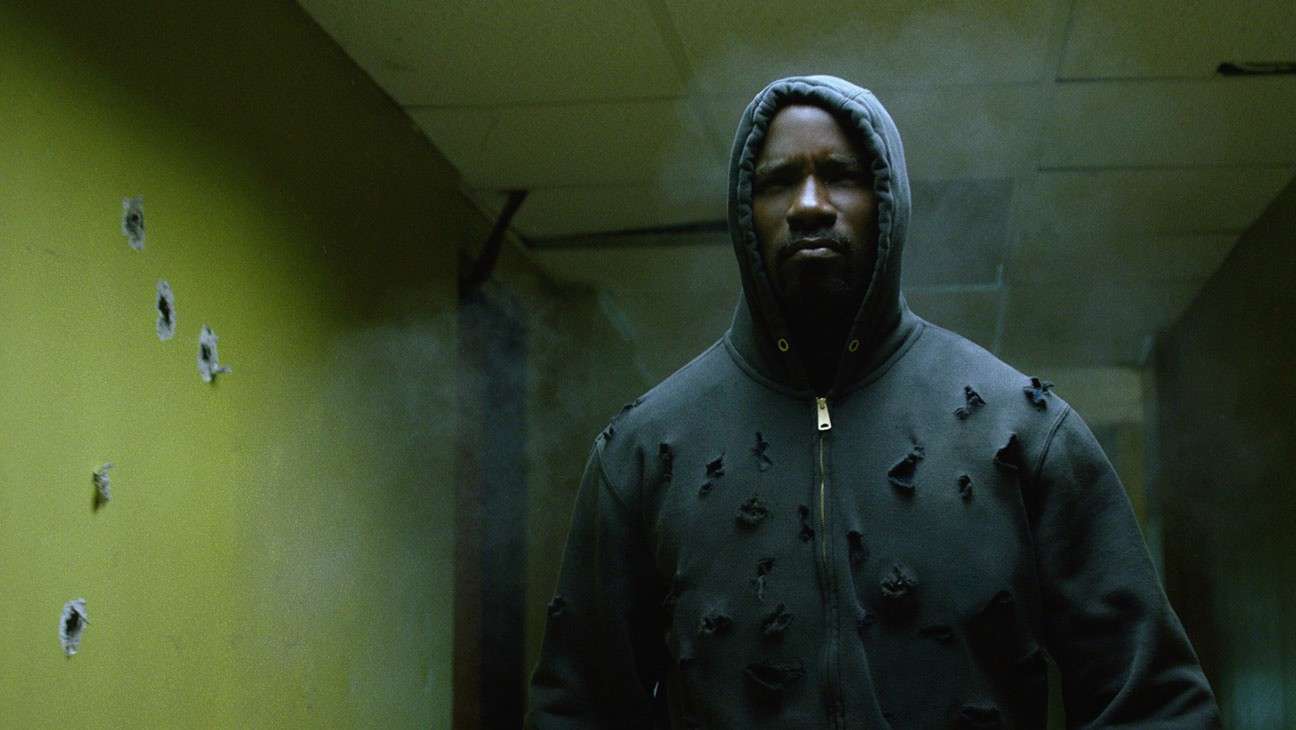
The Netflix Luke Cage series ran from 2016 to 2018. It premiered during a period of renewed conversation about police brutality and how Black men are treated in America. A bulletproof Black man in a hoodie, a direct reference to the murder of Trayvon Martin, wasn’t a coincidence. The show knew exactly what it was doing.
Season 1’s Cornell “Cottonmouth” Stokes remains one of Marvel’s greatest villains. He’s a man with cultural sophistication and a violent disposition he can’t escape, played by Mahershala Ali at full intensity. Season 2 introduced Bushmaster, a villain with a grievance against Luke’s family. The season ended with Luke taking over Harlem’s Paradise from Mariah Dillard Stokes. That ending divided fans, but it actually makes sense. Taking control of the neighborhood’s most powerful crime lords is the kind of morally gray thing a hero like Luke Cage would do.
Daredevil: Born Again and What’s Coming Next
After much speculation, it’s been confirmed that Luke Cage will appear in season 3 of Daredevil: Born Again.
He’s only been alluded to so far during the show’s second season, but we’re slowly getting an idea of what happened with Luke after his TV series ended. It’s heavily implied he got together with Jessica Jones and had their daughter Danielle. However, at some point CIA operative Mr. Charles recruited Luke into doing black ops work on behalf of the government.
We still don’t know why Luke would work for Mr. Charles, though it’s hinted that he’s trying to protect Jessica from a similar fate. With season 3 of Daredevil: Born Again set to premiere in March 2027, it’ll be interesting to see what happens with this storyline.
What Luke Cage Represents
Luke Cage was created at a moment when Black-American heroes were gaining visibility in mainstream American comics. His reception was positive from the start. Fans loved that Luke was dedicated to tackling issues involving race and class in ways superhero comics wouldn’t touch with a ten foot pole.
He’s everything the Black community wants to see more of. A man who refuses to be broken. One who will go out of his way to help his community. Luke never forgot where he came from and strives to be a better man for his family. It’s why, after fifty years since his debut, Luke Cage is still as relevant as ever.
Comics Reading List
In order of importance:
- Luke Cage: Hero for Hire #1–16 (Goodwin/Tuska: essential reading since it covers his origins)
- Power Man and Iron Fist #50–100 (Luke and Danny’s friendship at its best)
- Alias by Brian Michael Bendis (Luke and Jessica’s relationship from her perspective)
- New Avengers by Brian Michael Bendis (Luke as an Avenger and leader)
- Luke Cage Vol. 1 by David Walker & Nelson Blake II (best modern standalone run)
- Devil’s Reign by Chip Zdarsky (Fisk vs. street heroes, relevant to Daredevil: Born Again)