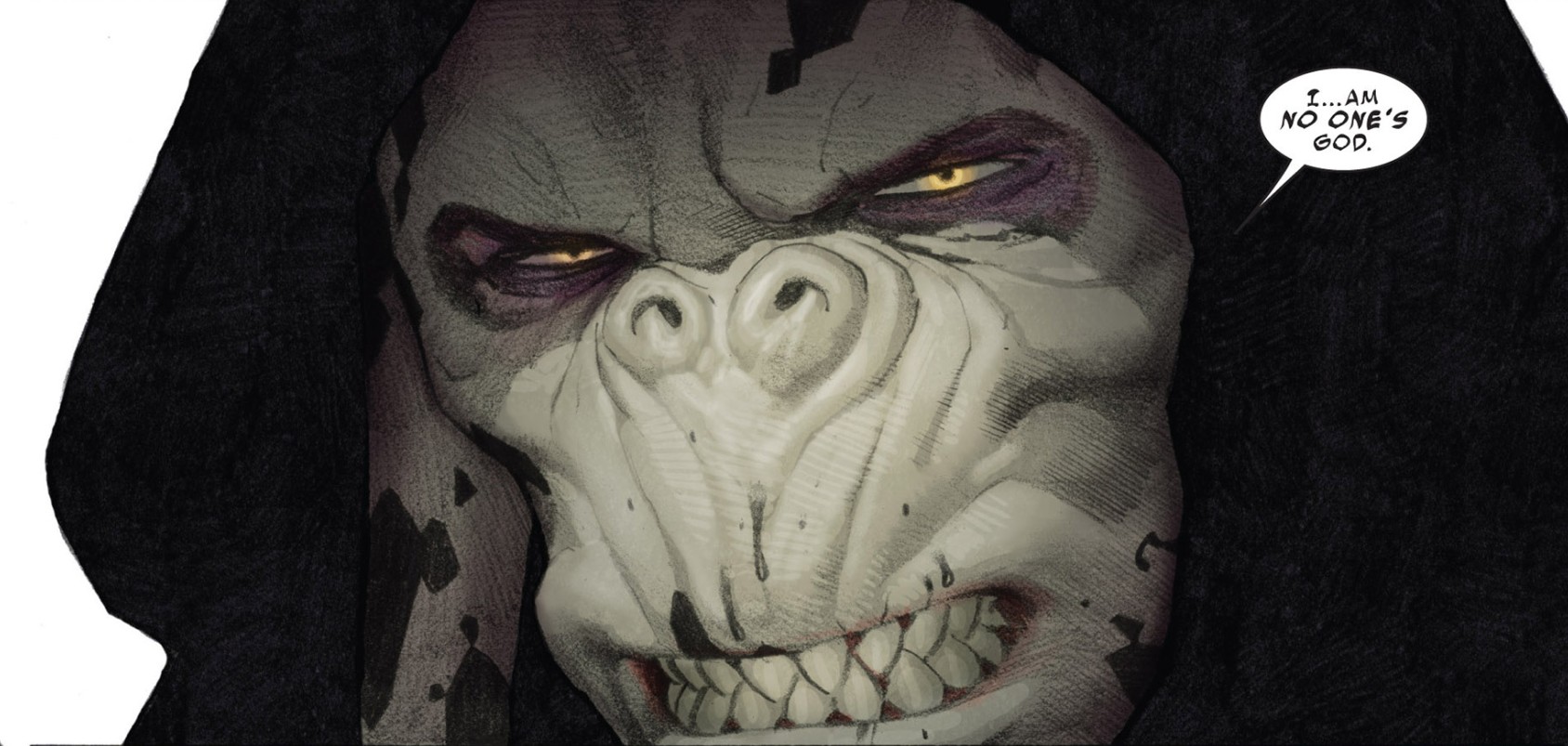
Gorr the God Butcher is one of the most terrifying villains in Marvel Comics history. He hunted gods across centuries. He drained them, slaughtered them, and left their bodies hollow and grey as a warning to anyone who found them.
He’s also one of the hardest villains to simply hate.
Before he was a monster, he was a man who prayed. And his prayers were unanswered.
A Man Who Did Everything Right
Gorr came from a small, dying world. No food. No clean water. No real hope of survival. His people had one thing to hold onto: the belief that the gods were real, and if you prayed hard enough, suffered patiently enough, the gods would eventually come.
Gorr believed this completely.
He prayed. His mother died. He prayed. His wife died. He prayed harder. His children died, one by one, while he kept his faith and kept his prayers going. He did everything his people said you were supposed to do.
The gods never came. Not once.
That’s the foundation of everything Gorr becomes. His faith failed him in the most devastating way possible.
The Moment Everything Changed
Then the most random thing happened.
Two gods fell from the sky onto Gorr’s dying world. Crashing down in the middle of their battle, enormous, powerful and completely wrapped up in each other. One dressed in gold, the other in black.
Gorr had spent his entire life praying to beings like these.
He stared at them, with one thought crossing his mind: you were here all along and you let my family die without helping.
In that moment, the weapon of the god dressed in black sensed Gorr’s rage. It’s an ancient weapon called All-Black the Necrosword. So old it predates Asgard. It reached out to Gorr and bonded to him, giving Gorr immense power.
The god in gold saw Gorr, and asked for his help. Enraged, Gorr killed his first god, the one dressed in gold.
He made a vow. All gods must die.
Why His Argument Is So Hard to Dismiss
To be fair, Gorr isn’t entirely wrong.
The gods in this story are largely absent and self-absorbed. Young Thor, one of the story’s heroes, can hear the prayers of suffering mortals. He ignores them. He’s busy drinking, having sex with women and seeking glory. The prayers of desperate people are background noise he doesn’t feel like dealing with.
Jason Aaron was making a deliberate point. Gorr’s grievance isn’t the paranoid fantasy of a broken man. It’s a rational response to observable behavior. The gods have power. The gods are aware of suffering. The gods choose not to help.
Gorr sees this clearly: if you can help and you don’t, what exactly are you here for? Gorr does not have a reasonable answer.
That’s why he’s different from most villains. He’s not after power, revenge or chaos. He wants accountability. He wants to know why prayer was ever taught to his people as a solution to suffering. He wants someone to answer for the gap between what gods promise and what they deliver.
The Irony: Gorr Becomes a God
Gorr spends centuries carrying out his mission. The Necrosword sustains him far beyond any normal human lifespan. He builds followers who obey his every command. He moves from world to world, untouchable and all-powerful. Killing gods.
A woman who loves him looks at him, really looks at him, and calls him a god. Not mockingly. With genuine reverence. She sees his immortality. His power. His followers worship him. She sees, clearly and lovingly, what he’s become.
Gorr can’t bear it. He’s defined his entire existence by the destruction of gods. His identity, his mission, his reason for surviving everything he survived… all of it is built on the idea that gods are the enemy. Now the person who loves him most is holding up a mirror and showing him that he is one.
Rather than face that truth, he destroys her.
His son watches.
Later, looking at his father, the boy says: you’re the god who killed my mother.
The Son and What He Represents
The boy represents every innocent person Gorr ever claimed to be fighting for. He’s proof that Gorr’s mission didn’t protect the vulnerable… it created new victims. You can’t spend centuries slaughtering in the name of the innocent and then turn around and devastate your own child without the contradiction becoming visible.
Thor has his own complicated relationship with his father Odin. A powerful, often absent patriarch who justifies tremendous violence as necessary. Sons watching their fathers commit terrible things and asking why is a thread that runs across the entire story.
Because Thor had the same questions about his father.
Gorr wanted to be different from the gods he hated. He wanted to be a father who showed up. He failed.
What Makes Him Marvel’s Most Sympathetic Monster
Most villains want something simple. Power. Revenge. Domination. You can dismiss them once you understand their goal.
Gorr wanted justice. He wanted the universe to acknowledge that what happened to his family, and to countless others like them, was wrong.
Those aren’t the desires of a monster. They’re the desires of a grieving man who couldn’t find another way to make the pain mean something.
He’s not sympathetic because he’s right. He’s sympathetic because you can trace, step by step, exactly how a faithful and heartbroken man becomes something unrecognizable.
The Question He Leaves Behind
Thor, eventually, kills Gorr. It takes three versions of Thor (young Thor, present day and an old Thor as he was the only god living by that point) to do it. Plus Thor wielding the Necrosword. And the power of prayer from the gods Gorr made as slaves. That’s how powerful Gorr had become.
The mission ends. But the question doesn’t go away.
Were the gods actually doing their job?
Jason Aaron doesn’t give a clear answer. He can’t, because the honest answer is complicated. Some gods, sometimes, in some ways: yes. But not enough. Not consistently. Not for the people who needed them most.
Thor wins, but he wins knowing that Gorr had a point. He can only try to be better moving forward. Which begins his journey on being able to use his hammer. And his genuine empathy for people living on Earth.
That’s a different article. But the trying starts here: with a villain who asked a question no hero could fully refute.
Gorr the God Butcher is Marvel’s most sympathetic monster because his pain was real, his question was legitimate, and the thing that destroyed him wasn’t evil.
It was grief that had nowhere else to go.