When you watch Thor: Love and Thunder, you see a man trying to find himself. He is funny, lovable, running around space with screaming goats and talking axes. Chris Hemsworth is charming, warm, and you enjoy spending time with him.
Here is what the movie does not show you. In the comics, Thor’s story with Gorr the God Butcher isn’t just an adventure. It stretches across thousands of years. It breaks him. Rebuilds him. And then breaks him again in a way he never fully recovers from.
That story belongs not to one Thor, but to three.
Let’s talk about all three of them and what the movie quietly left on the table.
The Three Thors
In Jason Aaron’s comic series Thor: God of Thunder, the story moves across three different time periods. Three versions of the same man, all facing the same enemy, each one showing us a different stage of who Thor is.
Young Thor: Too Proud to Be Worthy
Let’s start at the beginning.
In the Viking Age, Thor is young and full of himself. He loves drinking, chasing women (sex) and he loves his battles. He travels to Earth and the people there worship him. He enjoys it very much. He’s not a “bad” person but he’s not a “good” god. I mean… he ignored the prayers of people suffering to drink and have sex.
He can’t lift Mjolnir. It tells you everything about who he is at this point. The hammer requires worthiness. Not strength, bloodline or rank. Worthiness. And young Thor doesn’t have it yet.
When Thor encounters Gorr, the God Butcher, Thor is completely unprepared. Gorr has been killing gods for hundreds of years by this point. When Thor finds the dead bodies of gods, which had been dead for hundreds of years. A trail of slaughter stretching across the universe. Thor’s confused and scared (he’d never admit it though).
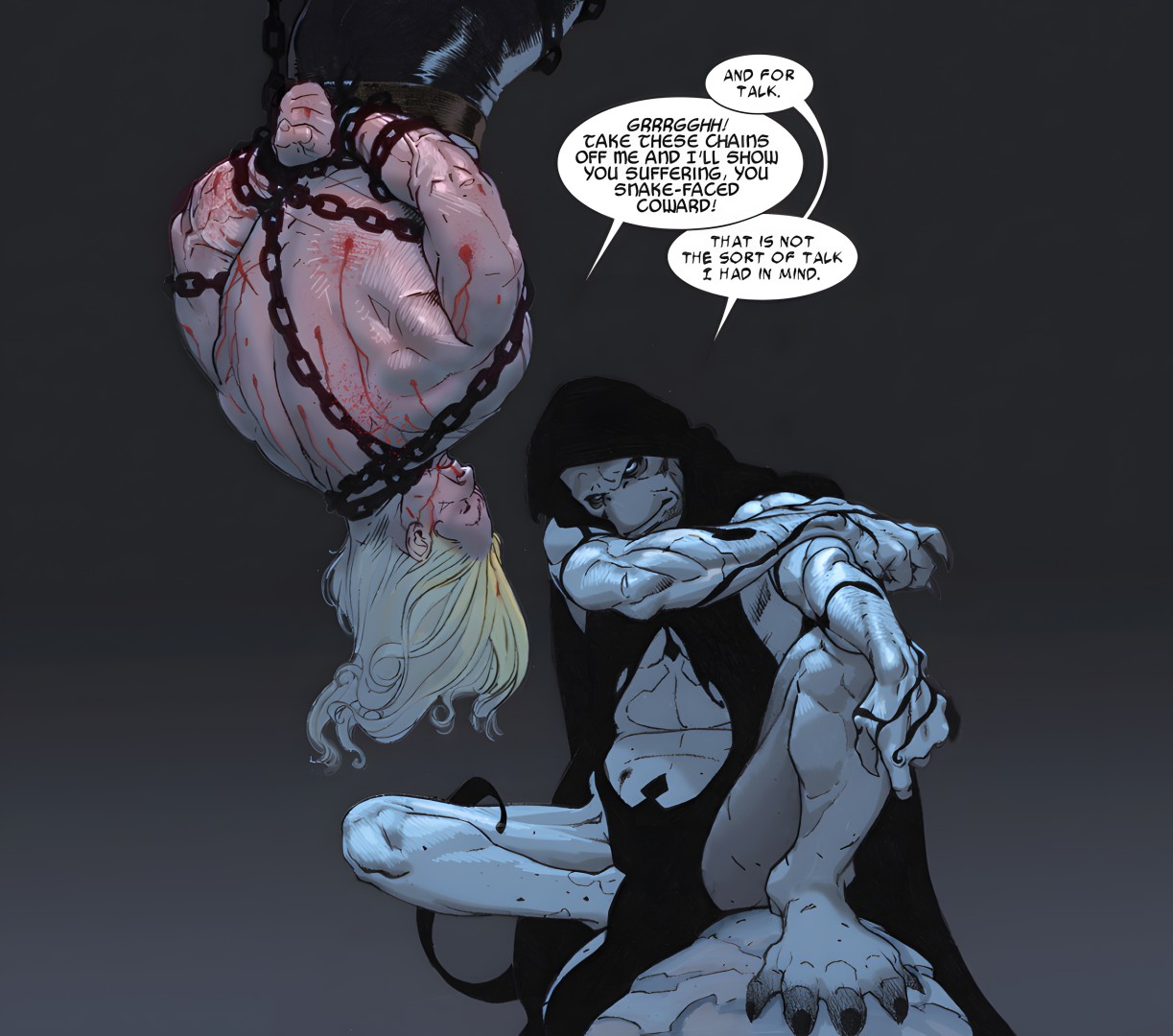
Gorr captures Thor and tortures him for over two weeks. Young Thor survives (barely), but he is shaken in a way he has never been before.
This is the first crack in his arrogance. The first time Thor is forced to ask: are gods actually worth anything? Do we deserve the prayers people offer us?
He doesn’t have an answer yet but he’s starting to question things. A butt-whooping like Gorr gave Thor will cause many to reflect on their actions.
Avenger Thor: The Weight of Responsibility
In the present day, Thor the Avenger is already a changed man from his younger self. He’s lived for centuries. Has seen empires rise and fall. Watched people die for causes he believed in. He carries Mjolnir as a responsibility.
When he begins to piece together Gorr’s trail, gods disappearing across the galaxy, worlds left in chaos, he doesn’t feel glory-seeking excitement. He feels the weight of what it means to be worshipped.
People pray to him. They believe in him. Gorr’s life is an example of how gods can, no… do, ignore prayers. Gorr prayed. He watched the people he loved die. No god came. When two gods in battle fell in front of Gorr (one dressed in gold the other in black), and the one in gold had the audacity to ask him for help, Knull’s weapon (the All Necrosword) sensed Gorr’s anger and bonded with him. Gorr used the power of the sword and killed the god in gold. Gorr decided all gods should die… and he would kill them.
This haunts Avenger Thor. He can’t write Gorr off as a simple villain because Gorr’s argument isn’t wrong. Thor has seen the gods of the Marvel universe. Many of them are selfish, distant, indifferent. Many of them don’t care about the small people who pray to them.
Is he any different? He tries to be.
When Avenger Thor finally meets Gorr directly, the battle is physical and philosophical. Two men: one who has given up on the gods. One who is no longer sure the gods deserve to be believed in.
King Thor: The Last God of Asgard
Now we come to the version that the movie doesn’t show at all. And honestly, this one is the most powerful of the three.
Thousands of years in the future, Gorr’s plan has nearly worked. Almost every god in the universe is dead. Asgard is a ruin. Earth is dying. The universe is growing cold and dark.
King Thor sits on a crumbling throne. He has one eye, he lost the other long ago, like Odin before him. He has one arm, lost in some terrible battle. His three granddaughters, Frigg, Ellisiv, and Atli, are among the very last beings standing by his side. They are fierce, funny, and brave, but even they know the odds are almost impossible.
Gorr’s Black Berserkers, shadow monsters made from the Necrosword, are everywhere. And Gorr himself is close to completing his greatest weapon: the Godbomb.
It is exactly what it sounds like. A bomb designed to send a wave of death backward and forward through all of time, killing every god who has ever lived or ever will live. All of them. At once. Forever.
King Thor knows this. He has been fighting Gorr for what feels like an eternity. He is exhausted in a way that goes beyond the body. His soul is exhausted yet, he keeps going.
Why?
Because somewhere inside this ancient, broken, one-armed god is the same question that young Thor first heard in the Viking Age: do gods deserve to exist? And King Thor’s answer, after thousands of years of life, is still yes. Because someone has to try.
The Three Thors Together: A Battle Across Time
Here is the moment that the movie left out: all three Thors come together.
Through a combination of time travel and desperation, Young Thor, Avenger Thor, and King Thor end up on Gorr’s dark world at the same time, fighting side by side.
Think about what that means. A young man still learning what it means to be worthy. A middle-aged hero still wrestling with what it means to be good. An old king who has paid every possible price and is still standing.
They all carry different weapons. Young Thor wields Jarnbjorn, his axe. Avenger Thor carries Mjolnir. King Thor carries his own ancient Mjolnir, battered and scarred like its owner.
And still, Gorr beats all three of them.
He nails King Thor to a comet and hurls him into space. He defeats the others. The Godbomb is about to go off. Every god who has ever lived is about to die.
And then… prayer.
The Ending That Changes Everything
Avenger Thor, at the heart of the Godbomb’s explosion, grabs both his own Mjolnir and King Thor’s. Two hammers. He takes the full force of the blast into his body to try to absorb it.
Across all of time, gods begin to see what is happening. And they do something remarkable. They pray. Gods, praying to Thor. The people of worlds long dead and not yet born, praying for the one being still trying to save them.
Even Odin prays. The line in the comic simply reads: “Thor… hear my prayer. Hear the prayer of Odin. Do not fall, my son. Be the savior of us all. Be the god of gods.”
That wave of faith and love reaches Thor at the center of the explosion. Instead of destroying him, it empowers him. He survives.
King Thor destroys the Necrosword by throwing the entire planet into a black hole. The Black Berserkers dissolve. Gorr, stripped of the weapon that gave him immortality, dies. Defeated by the very thing he tried to destroy: the bond between gods and the people who believe in them.
The Long Shadow Gorr Leaves on Thor
Here is something the movie doesn’t explore at all, and it may be the most important thing of all.
Gorr wins. Not in the way he wanted to. But he wins in a different, deeper way.
After the God Butcher arc ends, Thor carries the question Gorr planted inside him. Are gods worthy of worship? Do they deserve the faith people give them? Thor tries to push the doubt away. He can’t.
Later, in a storyline called Original Sin, Nick Fury, a man who has spent his life serving humanity, whispers something in Thor’s ear during a battle. We do not hear what he says. But we see the result immediately.
Mjolnir falls from Thor’s hand.
Just like that. The hammer falls. Thor can’t lift it. He’s no longer worthy.
Years later, we finally learn what Fury said:
“Gorr was right.”
That is all it takes. The God of Thunder loses the thing that defined him. Deep down, Thor already believed it since the Viking Age when Gorr first made him question everything. The doubt had been growing for centuries. Fury gave it a name.
Thor spends years as “The Odinson”, a god without his hammer, without his title, searching for what worthiness even means anymore. He eventually reclaims Mjolnir, but not by deciding Gorr was wrong. Instead, he says something extraordinary: “Worthiness is a fragile thing. It is only the struggle that counts.”
He calls himself the God of the Unworthy. He carries the doubt and decides that carrying it honestly is better than pretending it’s not there.
That is a character arc: years of storytelling, built on the foundation that Gorr laid. The movie compressed it into two hours and left most of it out.
What the Movie Shows Instead
Thor: Love and Thunder gives us a Thor who is mostly healed from his past traumas. He is going through a gentle identity crisis, trying to figure out who he is without a relationship, without a purpose. It is soft and likable.
The movie’s Thor never seriously grapples with whether he deserves to be worshipped. He never doubts his own worthiness in a meaningful way. The darkest the film gets is a few quiet moments with Jane Foster, and even those are quickly lightened by a joke.
Gorr, in this version, never truly shakes him. He challenges Thor physically. He kidnaps some children to use as bait. But he doesn’t plant a question inside Thor that will haunt him for the rest of his existence.
That sucks.
The three-Thor structure is gone entirely. The whole arc of who Thor becomes, could become, and has to fight to remain is… gone.
We get one Thor. Funny, charming, a little lost. It is enough to make a movie. It’s not enough to make a good story.
Why This Matters for You as a Viewer
Maybe you watched the movie and enjoyed it. That is completely valid. It is a fun film. Christian Bale gives a haunting performance even with limited screen time. The goats are genuinely funny.
If you found yourself wanting more of a sense that Gorr is a terrifying villain, now you know why.
The three-Thor structure isn’t a storytelling trick. It is an argument about identity:
- Who we are when we are young and reckless.
- Who we become when we accept responsibility.
- Who we will be when we are old and tired and almost out of time.
- Whether who we are is ever really enough.
Those are big questions. The comics ask all of them. The movie asks a gentler version of one.
Where to Begin
If you want to experience what was left behind, the starting point is simple. Find Thor: God of Thunder, written by Jason Aaron, illustrated by Esad Ribić. It was published from 2012 onward and collected into two main volumes: The God Butcher and Godbomb. Marvel has also released them together in one edition called Thor: The Saga of Gorr the God Butcher.
You don’t need to have read any other comics before this. Aaron writes it in a way that welcomes new readers. The story of Young Thor, Avenger Thor, and King Thor is complete in those two volumes.
If you want to follow the longer journey, Thor losing Mjolnir, Jane Foster picking it up, the identity crisis, the War of the Realms, look for the collected series labeled Thor by Jason Aaron. It covers his full run from 2012 to 2019 and is one of the most acclaimed runs in Marvel history.
One Last Thing
Thor: Love and Thunder made over 760 million dollars worldwide. By the numbers, it is a success. And yet Chris Hemsworth himself said the film went too far into comedy, that they probably “took the piss a little too much.” There was a self-awareness there, after the fact, about what was lost.
The movie gives you a Thor you can laugh with. The comics give you a Thor you can grow with.
Thor: God of Thunder (2012–2014) by Jason Aaron and Esad Ribić. Published by Marvel Comics. Thor: Love and Thunder (2022), directed by Taika Waititi. Distributed by Marvel Studios and Walt Disney Pictures.