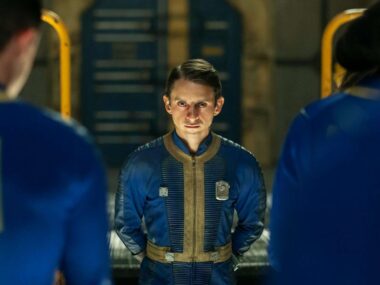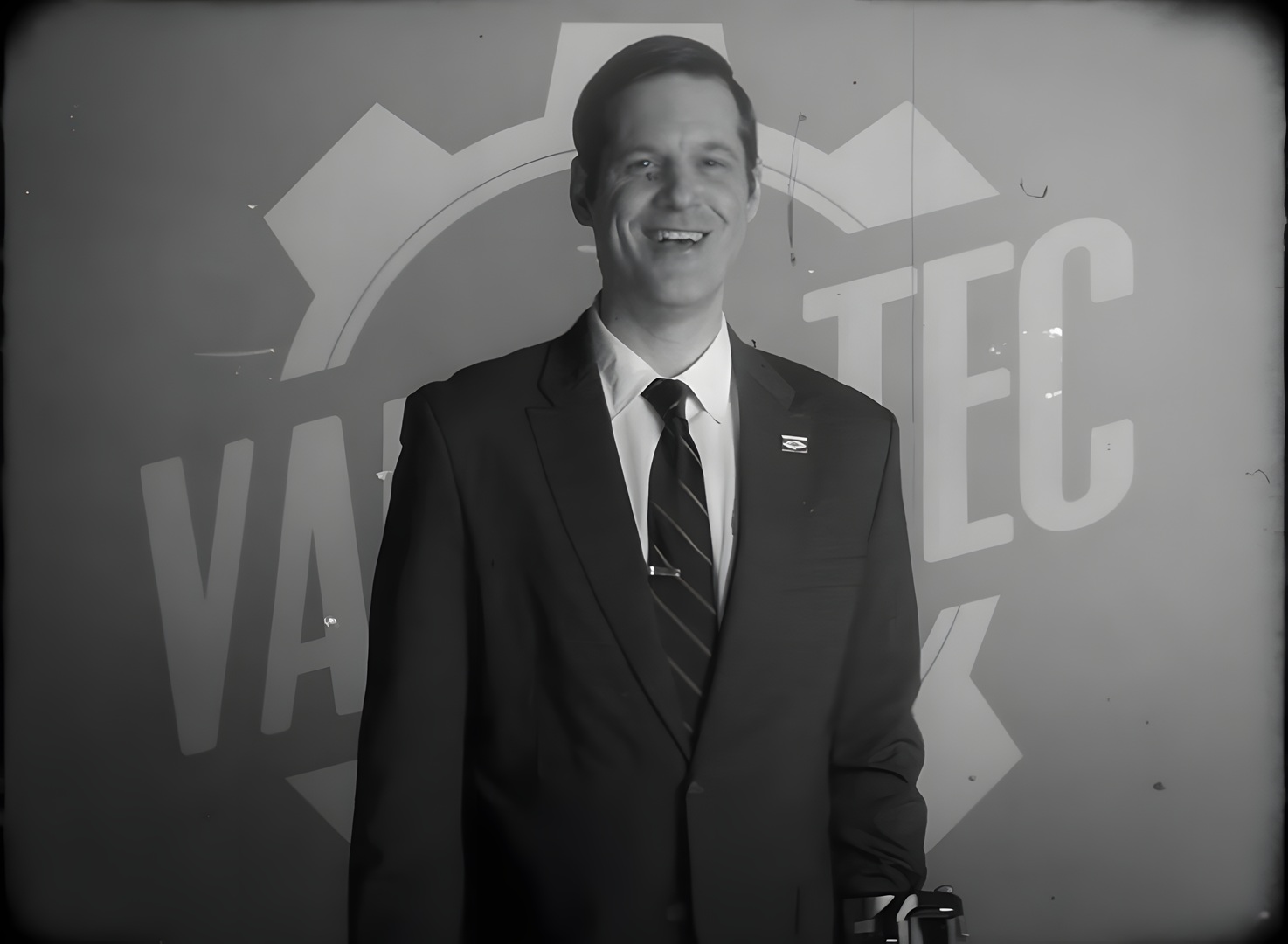
I want to talk about one of the most disturbing characters introduced in the Fallout TV series. Not because he’s a raider, a mutant or some wasteland psychopath. No, Bud Askins is something far more chilling: a corporate executive who genuinely believed he could engineer the future of humanity like it was just another quarterly business plan.
And here’s the thing… he almost had the resources to pull it off.
But he didn’t. And understanding why his plan collapsed isn’t just about plot holes or bad writing. It’s about recognizing a fundamental truth that applies to corporations, governments, and anyone who’s ever tried to control people: humans aren’t variables in a spreadsheet.
Who Is Bud Askins, Anyway?
If you’ve only played the Fallout games, you won’t recognize Bud Askins. He’s exclusive to the Amazon series, and honestly? He’s one of the best additions the show made to the lore.
Here’s what we know:
- Former Senior Junior Vice President at Vault-Tec: Yes, that title is as ridiculous as it sounds. Don’t let the corporate doublespeak fool you. Bud held real power. He was deeply involved in Vault-Tec’s long-term experiments, specifically the ones focused on “repopulation and leadership.” (Translation: eugenics with a corporate veneer.)
- Former West Tek Employee: Before Vault-Tec, Bud spent a decade at West Tek. You know, the defense contractor that created the Forced Evolutionary Virus. The same virus that turned people into super mutants. He had a résumé built sound morally bankrupt science.
- Overseer of Vault 31 (Sort Of): In the show’s timeline, Bud becomes the overseer of Vault 31 but… not in the traditional sense. His consciousness is preserved as a “rollerbrain”, a human brain installed into a robot body. Which is exactly as horrifying as it sounds.
This is where things get interesting.
The Experiment: “Bud’s Buds”
Remember when I said Bud tried to engineer humanity? I wasn’t exaggerating.
Here’s the setup:
- Vault 31 housed cryogenically frozen Vault-Tec executives, including Askins himself.
- Vaults 32 and 33 served as controlled breeding populations, genetically curated to produce “ideal” candidates to pair with the executives once they were thawed out.
- The goal? To engineer a future leadership class. Vault-Tec’s hand-picked rulers of post-apocalyptic society.
Think about that for a second.
Bud didn’t just want to survive the apocalypse. He wanted to wake up centuries later, select a genetically optimized partner from a population specifically bred for compliance, and then rule whatever was left of the world. Yeah… sociopathic isn’t it?
And the worst part? The show makes it clear that Vault-Tec genuinely thought this was a good idea. They called it “Bud’s Buds.” Like it was a networking program instead of a multi-generational eugenics project.
The Philosophy: “Time Is the Ultimate Weapon”
Bud Askins has this philosophy that drives everything he does: “Time is the ultimate weapon.”
On the surface, it sounds almost wise. Patient. Strategic.
What he really means is this: if you can outlast everyone else, you win. If you can freeze yourself, preserve your ideology, and wait out the chaos, you get to shape the future on your terms.
It’s the kind of thinking that only makes sense if you’ve completely dehumanized everyone who isn’t you.
Here’s what Bud doesn’t account for: time doesn’t just preserve. It changes things. Populations evolve. Cultures shift. Infrastructure decays. The longer you wait, the less control you actually have.
Bud’s plan? It never stood a chance.
Why Bud’s Plan Was Doomed from the Start
Bud had everything going for him. A high-ranking position at Vault-Tec. Ambition. Creativity. Access to technology that most people in the wasteland would kill for.
So what went wrong?
His System Depended on Perfect Obedience from Vault 32 and 33
The “Bud’s Buds” program assumes:
- Vault dwellers will never question their purpose
- No one will investigate inconsistencies
- No one will resist arranged pairings
- No one will challenge the authority of Vault 31
This is wildly unrealistic.
Humans don’t behave like stable variables in a closed experiment. People are curious. They disagree. Emotional bonds form in ways you can’t predict. Lucy’s arc alone shows how quickly his plan collapses once a single person asks the wrong question.
Here’s the thing. Bud should have known this. He worked at West Tek. He saw what happened when you treat humans like test subjects. The FEV created super mutants, nightstalkers, and centaurs. Mutations. Chaos. Unpredictability.
Bud thought he could do better. He thought social engineering was more controllable than biological engineering.
Nope! He was wrong.
He Assumes Vault-Tec Executives Deserve to Rule Because They Were Executives
Let’s talk about the circular logic baked into this plan:
- Vault-Tec executives are the “best” people
- Therefore they should lead the future
- Therefore they must be preserved
- Therefore the vaults must serve them
There’s no mechanism to evaluate whether these people are truly competent, moral, or even sane after centuries in cryo.
Think about it. What makes a Senior Junior Vice President qualified to lead a post-apocalyptic society? Marketing experience? Budget meetings? A corner office?
Bud’s plan assumes that corporate hierarchy translates to someone having competent leadership skills. History, real history, not Fallout lore, shows over and over that people who rise to the top of bureaucratic systems aren’t always the best to handle crises.
They’re often the best at navigating bureaucracy.
Cryogenic Preservation Is Treated as Infallible
Vault-Tec’s cryo tech is:
- Unreliable
- Prone to malfunction
- Vulnerable to sabotage
- Dependent on long-term power stability
Any disruption, power loss, mechanical failure, or human interference, permanently destroys the “leadership class.”
In the Fallout universe, cryo is notoriously fragile. We’ve seen it fail in Vault 111. We’ve seen it malfunction in the Institute. We’ve seen it weaponized by raiders.
Bud builds an empire on technology the entire franchise repeatedly shows is unstable. He gambled with the highest possible stakes.
He Ignores the Psychological Consequences of Waking Up Centuries Later
Let’s say the executives survive cryo. They awaken to:
- A world they don’t understand
- A society they didn’t build
- People who don’t share their values
- A power structure that exists only in their minds
No plan for reintegration. No mental health support. No adaptation period.
Bud assumes they’ll simply resume command like nothing happened. Like waking up from a long nap.
Imagine actually living through that. You go to sleep in a world where corporations run everything, money matters, and social order is maintained through law enforcement. You wake up to a wasteland where caps are currency, super mutants roam the streets, and the law is whoever has the biggest gun.
Would you be equipped to lead? Or would you have a complete psychological breakdown?
He Underestimates the Autonomy and Agency of the “Breeding Population”
Vault 32 and 33 aren’t livestock. They’re people with:
- Emotions
- Relationships
- Personal goals
- Moral frameworks
The idea that they’ll willingly accept being paired with thawed executives, strangers from the past, is delusional.
The moment the truth leaks, the system implodes. Secrets don’t survive in closed communities. People talk. People question. People investigate.
Lucy MacLean is the perfect example. She wasn’t supposed to dig into Vault 31. She wasn’t supposed to ask hard questions. She did it because she’s a person, not a chess piece.
He Assumes the Outside World Will Remain Irrelevant
The plan requires:
- No outside interference
- No raiders, factions, or wastelanders discovering the vaults
- No external threats disrupting the vault ecosystem
The problem? The Fallout world is defined by chaos.
The Brotherhood of Steel. The Enclave. The NCR. Super mutants. Raiders. Ghouls. Deathclaws. The wasteland is full of factions that would love to get their hands on functioning vault technology.
The vaults are not isolated enough to guarantee long-term secrecy. The longer they operate, the more likely someone stumbles onto them.
He Believes Time Is a Weapon But Forgets It Cuts Both Ways
Askins’ philosophy is that time gives Vault-Tec the advantage. But time also:
- Erodes infrastructure
- Creates unpredictable mutations in populations
- Allows cultures to evolve beyond their intended purpose
- Weakens institutional memory
The longer the experiment runs, the less control Vault-Tec actually has.
Ironically, Bud’s greatest strength, his willingness to think in centuries, becomes his greatest weakness. He assumes the future will wait for him.
It won’t.
The Rollerbrain Question: Could Bud Have Copied Himself?
Okay, here’s where I’m going to get a little meta.
I’ve been burned by too many stories where a villain “dies” without showing the body. So when I saw Bud’s rollerbrain, my first thought was: “Could he have made a backup?”
It’s not an unreasonable question. In most sci-fi universes, if you can put a brain in a robot, you can probably copy it. Right?
Fallout isn’t most universes.
Lore Answer: No.
There is zero precedent in Fallout for duplicating a biological brain or consciousness. Robobrains and similar constructs always rely on a single, original, physical brain.
Even the most advanced pre-war science, Big MT, West Tek, RobCo, General Atomics, never achieved:
- Brain duplication
- Consciousness copying
- Neural backups
- Mind uploading
- Digital consciousness transfer
Not even the Think Tank in Old World Blues, the most absurdly advanced brain-science group in the franchise, can copy a mind. They can remove, store, manipulate, and transplant brains, but not duplicate them.
What Is Possible in Fallout Brain Tech?
Fallout does support:
- Brain extraction
- Brain transplantation
- Brain-machine integration (robobrains, brain-bots, think tank bodies)
- Memory editing or suppression
- Cybernetic augmentation
But… all of these require the original biological brain. There is never a second copy.
Why Duplication Doesn’t Exist (Lore Consistency)
- Brains are treated as irreplaceable hardware: Robobrains run on the actual organic brain, not a scan or copy.
- Consciousness is tied to the physical organ: Fallout’s science is retro-futuristic: advanced robotics, crude biology.
- Even the most advanced factions can’t do it:
- Big MT can remove your brain and put it in a jar.
- They can give it a robot body.
- They can talk to it.
- They can even argue with it.
- But they cannot clone it.
- No lore mentions backups, duplicates, or parallel brains: Not in terminals, holotapes, DLCs, or side quests.
Could Vault-Tec Have Secretly Done It?
From a strict lore perspective: no.
From a TV-writer perspective: they could invent something new, but it would contradict 25+ years of established Fallout rules.
The show so far has stayed consistent with the idea that Bud’s rollerbrain is his only brain.
What I Learned (And Why This Matters)
Watching Bud Askins’ plan unravel isn’t just satisfying from a storytelling perspective. It’s a reminder of something I think we all need to hear right now.
You cannot engineer humanity.
Not through eugenics, corporate control, cryogenic preservation or selective breeding. Not through careful planning and centuries-long strategies.
Humans aren’t machines. We’re messy. We’re unpredictable. We form bonds in ways that don’t make sense. We ask questions we’re not supposed to ask. We resist control even when it’s “for our own good.”
That’s not a bug. It’s a feature.