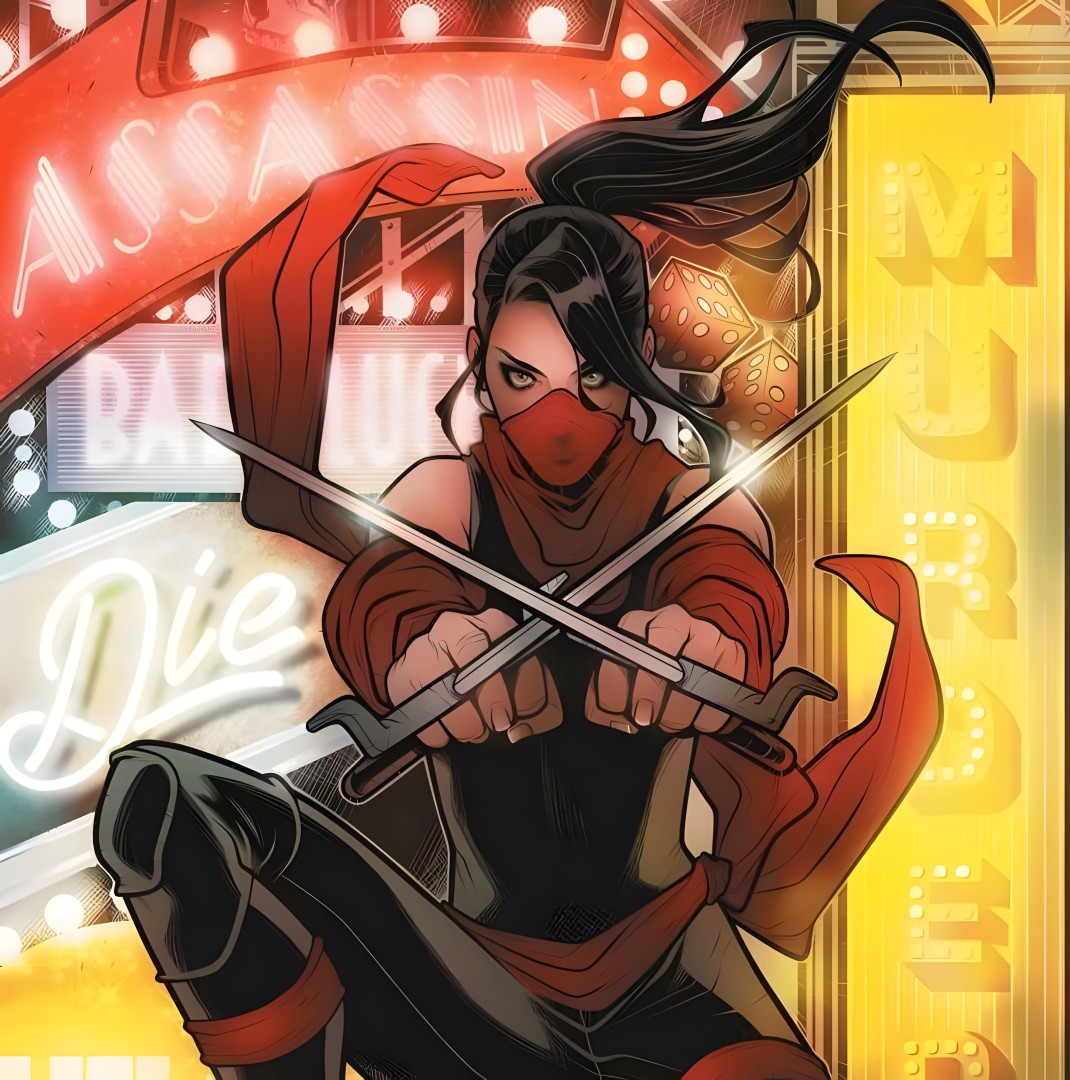
With her signature red dress and dual sai, Elektra Natchios is one of the most recognizable characters in Marvel Comics.
Created by Frank Miller, her name is a reference to Electra, a figure of Greek tragedies who pushes her brother to kill their mother and her lover to avenge their father’s murder. It’s also a nod to the Electra Complex, Carl Jung’s theory that describes a daughter’s need to compete with her mother for her father’s affection.
These references give us a little peek into Elektra’s mind following the traumatic death of her father, something that sends her down to a life as a mercenary. Miller refers to Elektra as “one of the villains who’s got a weak streak in them.” Being a morally gray ninja assassin who’s constantly torn between her violent nature and a desire to do good, Elektra is a defining and influential female character in mainstream comics.
Elektra’s Tragic Origins
Elektra was born on a Greek island near the Aegean Sea to Hugo Kostas Natchios and his wife Christina. Christina died right before she gave birth to a premature Elektra, though there are two conflicting accounts over what happened. One version of events has Christina be a victim of the Greek Civil War. Another claims that Elektra’s older brother Orestez hired assassins to kill their mother. Either way, following her mother’s death, her father became her world.
Eventually, Hugo became the Greek ambassador to the United States. By the time she was nineteen, Elektra was living in New York City and attending Columbia University. It’s where she met Matt Murdock, becoming his first serious relationship. A year later, Elektra and her father were kidnapped by terrorists. Matt’s attempt to rescue them both went wrong and Hugo was gunned down. Shattered by her father’s murder, Elektra lost all hope and faith. She broke up with Matt and dropped out of Columbia to move to China so she could learn martial arts.
Stick, one of the members of the Chaste organization that trained Matt Murdock, decided to take Elektra under his wing. Their relationship fell apart due to Elektra’s inner darkness. Feeling rejected, Elektra turned to the shady ninja organization The Hand to dismantle them from within. Instead, The Hand corrupted her. At some point, she left The Hand and became an assassin-for-hire.
The Anti-Heroine Modern Comics Needed
Elektra debuted in Daredevil #168 in January 1981, where she broke the mold of what a female character should be. Miller drew inspiration from classic femme fatales, specifically Sand Seref from Will Eisner’s The Spirit. He layered that archetype over the Electra complex to create something new.
At that moment in time, most female characters featured in superhero comics were defined by their relationships to male heroes. It didn’t matter if they were a love interest, a victim, or a supporting character. Some examples of this are Mary Jane Watson (one of Spider-Man’s most famous love interests) and Kitty Pryde (known for her close relationship with father figure Wolverine or her romantic relationship with Colossus). Even being a fellow hero wasn’t enough to save you. Elektra was something different. She was an independent, complex mercenary and assassin who could hold her own. Her actions were driven by her own morally ambiguous code, not by her relationship with Daredevil. She wasn’t a damsel waiting to be rescued. In fact, her very first appearance in the comics had her defeat Daredevil’s opponent, only to turn around and fight Daredevil herself.
What makes Elektra more than a “femme fatale” is that she’s a fully realized character. She operates in shades of grey. She has killed for money and some of those people were innocent. But she has genuine love towards the people who are close to her.
A Dark Reflection of Matt Murdock
Foggy Nelson represents who Matt could’ve been if he chose to give up being a vigilante. Bullseye symbolizes who Matt could become if he abandoned his principles. Elektra represents something more unsettling. She’s who Matt already is, only she has chosen to embrace her inner darkness.
Elektra and Daredevil are extraordinary fighters who operate outside the law. Both were trained by the same master. They’ve also lost a father to violence. The only real difference between them is that Matt sticks to his no-killing rule. Elektra crossed that line long ago and never looked back. When Matt looks at her, he is seeing himself with the restraints removed.
Death and Resurrection
Elektra was supposed to be a one-off character. Her death in Daredevil #181 (1982) is still one of the most shocking moments in Marvel history. Bullseye kills her, but she doesn’t die quickly. Mortally wounded, she crawls to Matt’s apartment to warn him. What makes her death so devastating is what she does with the little time she has left. After a lifetime of self-preservation, she uses her last moments to be with Matt one last time.
Miller considered her story finished. Marvel resurrected her within a year in Daredevil #190 (1983), through a Hand mystical ceremony. Miller returned to continue Elektra’s story in three different comics. The surreal political satire Elektra: Assassin (1986, with Bill Sienkiewicz), published as an eight-issue prequel through Epic Comics. Her revised origin story in Daredevil: The Man Without Fear (1993); and the elegiac Elektra Lives Again graphic novel. In the mid-90s, writer D.G. Chichester gave her ongoing prominence in Daredevil. She was given a more heroic role, crossed over with Wolverine, and eventually headlined her first solo series that ran for 19 issues before it was canceled.
Becoming Daredevil
In 2020, writer Chip Zdarsky did what no one had done before: he let Elektra take on the mantle of Daredevil. While Matt Murdock is incarcerated, she puts on the mask and declares: “I am Elektra Natchios. I am the culmination of my past. I am Daredevil.”
That one quote sums up where she stands. She’s just as complex, as capable, and as compelling as Matt Murdock. More recently she has joined the Avengers, completing one of the longer redemption arcs in Marvel history: from hired assassin to Earth’s Mightiest Heroes.
The Fox Era As a Cautionary Tale (2003–2005)
Elektra appeared in the 2003 Daredevil film, where she was portrayed by actress Jennifer Garner. Elektra is the daughter of billionaire Nikolas Natchios. She trained in martial arts from a young age after she witnessed the death of her mother.
She meets and falls in love with Matt Murdock. Unfortunately, their happiness is derailed when her father is killed and she wrongly blames Daredevil, not realizing Matt and Daredevil are the same person. She eventually confronts Bullseye, who stabs her with her own sais. The sequence even mirrors the iconic pages of Daredevil #181.
Her fate at the end of Daredevil is ambiguous. Matt finds a necklace that only Elektra could have given him, placed there after the night she supposedly died. But the film never clarifies if she survived. The 2005 spin-off film, Elektra, revealed that Stick had resurrected her. He also trained her in Kimagure, a style that grants the practitioner precognition and the ability to resurrect the dead.
Instead of exploring what state of mind Elektra would be in following her resurrection, the film makes her an assassin for hire, where she bonds with a young girl named Abby after discovering they both have obsessive compulsive disorder. Ultimately, Elektra refuses to kill her target and dedicates herself to becoming a protector against the Hand. It’s not a bad premise, but the film fails to understand what makes Elektra so fascinating. She doesn’t earn her complexity by becoming a surrogate mother. She earns it by being someone who can’t be saved but you can’t condemn her either.
Garner reprised her role as Elektra in Deadpool & Wolverine (2024), after the film rights had reverted to Marvel Studios in 2014. In that film, she’s been banished by the Time Variance Authority to the Void. She joins a group called the “Resistance” in rebelling against its ruler Cassandra Nova. Garner was honest about her experience of working on the original films: “It’s such a shame, honestly, because once Kevin [Feige] took over everything there was elevated: the writing, the direction, the comedy inside of the stories they were telling. And I did not have that experience.” The Fox-era films are a cautionary tale of what happens when a weak script fails to bring a character with enormous potential to life. The Netflix version of Elektra with Élodie Yung wasn’t perfect either, but it was a significant improvement.
The Netflix Era
Élodie Yung’s version of Elektra made her debut in season 2 of Marvel’s Daredevil (2016). Yung’s chemistry with Charlie Cox’s Matt was real. The mythology around her made her fascinating: you had the Black Sky prophecy, the Hand’s obsession with her, and Stick’s manipulations.
Here, Stick raised Elektra from childhood as part of a mission to draw Matt into the Chaste, and she fell in love with him during that assignment. It’s a different dynamic from the comics, where they meet as college students. In season 2, she’s killed by Nobu Yoshioka while fighting alongside Daredevil and her body is recovered by the Hand.
In The Defenders (2017), she is resurrected and stripped of her memories. She spends most of the eight-episode series as a weapon under the control of Alexandra Reid (Sigourney Weaver). She breaks free in the finale ….and then the building she and Matt are in collapses in on itself. Matt survives but Elektra’s fate is unknown. She appeared once more in flashback during season 3 of Daredevil, but her fate was never resolved before the Netflix era closed.
Élodie Yung has been vocal about wanting to reprise her role as Elektra. When asked by interviewers whether she’d be willing to play Elektra again, she said: “Oh absolutely. That was one of the greatest characters that I had to play.” One of the executive producers of Daredevil: Born Again, Sana Amanat has mentioned that bringing Elektra back is “one hundred percent it’s in the back of our heads. Eventually, we’ll try to figure out a bit more with that.” Season 3 of Daredevil: Born Again is currently in production with The Defenders–era cast set to return. Now that The Hand are confirmed to appear in Spider-Man: Brand New Day, the odds of Elektra making her official debut in the MCU keep getting higher.