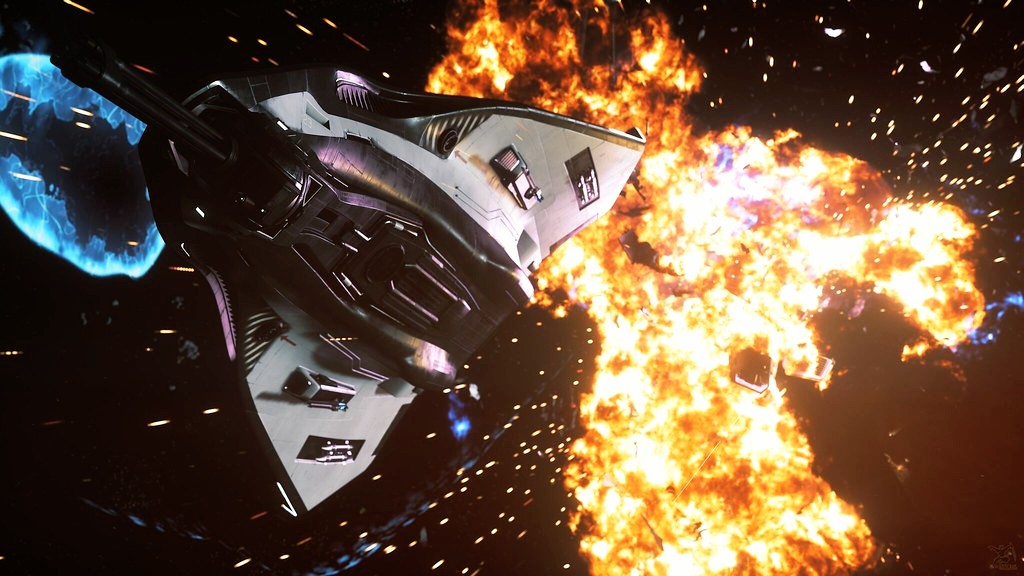
Say you’re logging into your favorite game after a long day. Maybe you’re in one of those big, online, open-world games like World of Warcraft, Guild Wars 2, Star Citizen, or EVE Online… the kind of games where you can supposedly be anything. A crafter, miner, trader, explorer, or of course the hero saving that universe. The whole pitch is freedom, right? You’ve got goals, a route is planned, maybe you have a friend joining up later.
And then, out of nowhere, another player blows up your ship.
Your cargo’s gone. Your progress is gone. And the person who did it? They’ve already moved on to their next target, probably laughing about what they did to you.
It’s called griefing and it’s a problem the gaming community doesn’t want to address.
Wait, What Is Griefing?
Griefing is the act of targeting another player to cause frustration, distress, and basically ruin their experience in a game. It’s the online gaming version of destroying someone’s sandcastle.
Common forms of griefing can range from repeatedly killing players at a lower level than themselves to destroying another player’s base or stealing their resources in sandbox or survival games.
Sometimes it can escalate to where the griefer uses in-game mechanics to trap, block, or immobilize other players. Some will even follow or harass a specific player across sessions. Griefers don’t need to target the same person multiple times, either. They can spend hours moving from player to player, causing nothing but havoc and frustration.
The griefer’s goal is to make other players miserable. That’s what separates griefing from ordinary PvP. A player who kills you in a deathmatch wants to win the match. A griefer who camps your respawn point for an hour, destroys the house you spent a week building, or blocks you into a corner so you can’t move wants to watch you suffer. The game is just the medium.
Most Players Don’t Want to Fight
The biggest issue with griefing is the lack of agency for the other player. In hybrid games, ones that mix player-versus-environment content (PvE) with player-versus-player combat (PvP), the majority of players prefer cooperative or solo play. They want to explore, build, trade, and run missions. They’re not looking for a fight.
Games are supposed to be an escape, a space where you choose to play, you choose your character, you choose what you’re going to do next. When a game forces PvP on you regardless of your preferences, it strips you of your choices.
There’s a difference between opting into high-risk, high-reward combat and having it forced on you while you’re trying to complete a quest, mine asteroids, or haul cargo. The game isn’t serving most of its players anymore. It’s pleasing the loud minority who want conflict at everyone else’s expense.
Star Citizen is a Masterclass on Why Griefing is Bad
Star Citizen is an ambitious space simulation MMO from Cloud Imperium Games (CIG). It’s set in a single shared persistent universe with no opt-out PvP and no separate PvE servers. Every player shares the same space, regardless of whether they’re a combat veteran hunting bounties or a miner trying to haul ore between stations. You’re always a potential target.
The game’s crime and consequence system, known as the “crimestat” system, is supposed to deter this behavior by flagging aggressive players and making them targets for bounty hunters. Unfortunately, players have complained the system is too easy to exploit to act as a real deterrent.
Players have documented cases of griefers using game mechanics like ramming ships in armistice (supposedly safe) zones to cause damage while avoiding crimestat penalties. In some cases, the victim is the one who gets flagged as the aggressor for retaliating.
What makes things worse is that ships are sold for real money, with some vessels costing hundreds or even thousands of real-world dollars. A player can invest in a specialized mining or cargo ship, only to have it destroyed by someone who specifically targeted them for sport. Yes, they get it back but it is not a convenient process.
Defenders of Star Citizen usually dismiss the unchecked piracy and player attacks as part of the game’s design. It’s a dangerous galaxy where risk is baked into the game’s design. That would be great if all players had a say in whether they wanted to engage in a world like that.
The Victim is Always at a Disadvantage
One thing that isn’t talked about enough is that the griefer has the upper hand. They’ve chosen their target, they’re geared up and ready to go. The victim is caught mid-task without the right weapons or mindset needed to protect themselves.
Casual and new players get the short end of the stick. They’re either too unfamiliar with the game to react, or they lack the right gear because they don’t spend over 12 hours grinding. And these are the kind of players a game needs to survive. Griefing is a self-destructive playstyle that hurts everyone over time.
The Toll Griefing Takes on Players
When players know they can be attacked at any moment with no recourse, they stop engaging with open-world content. They’ll avoid certain routes or will go as far as uninstalling the game because the stress isn’t worth it anymore.
Research on loss aversion shows that the psychological pain of losing something hurts roughly twice as much as the pleasure of gaining an equivalent thing. In other words, losing the ship you spent thousands of dollars on, even if they get it back, is going to cause someone more pain than if they bought a new one. It’s the loss of progress… time wasted.
As more people gain a better understanding of mental health, they’re also learning about the importance of setting boundaries. People who understand boundaries are less willing to allow griefers to ruin their game because they have no desire to be a victim so someone else can have fun. No means no.
I spoke with a mental health professional, and they made it clear that this kind of repeated, involuntary frustration isn’t healthy. That stress can follow you outside the game. If stress from work can impact your health, so can stress from a video game.
So Who’s Actually Responsible?
Usually, everyone points at the griefer. Fewer people point at the studio that built the system and decided this was fine.
Coming back to Star Citizen, the game’s pitch is freedom for the players. The allure is the ability to choose your own path in a living universe. Explorer, bounty hunter, medic, miner, whatever you want.
Except if what you want is to mine in peace, you might not get that. Because someone else wants to be a pirate, and the game’s mechanics allow them to act on that without your agreement.
That gap between what’s promised in the marketing and what’s actually delivered is beyond frustrating. Enabling one player to ruin another’s experience without consequence is a choice to prioritize the griefer’s fun over the victim’s. Calling it freedom obscures the fact that one player’s freedom is being exercised entirely at another’s expense.
There’s a Better Way, and We Know It Works
Some games have solved this problem. These solutions aren’t perfect, but they’re better than nothing.
Elite Dangerous gives players three modes: open play (full PvP), solo play (no other players), and private groups (play with chosen friends). Same universe, same content, your choice of who can reach you and it works. Players who want to fight can fight. Players who don’t can still access everything the game offers.
Final Fantasy XIV, Guild Wars 2, and Elder Scrolls Online keeps PvP separate from the main game. You choose to enter PvP zones. Nobody can drag you into one. The result is one of the most welcoming, player-friendly communities in online gaming and it’s not a coincidence.
World of Warcraft has PvP zones as well but also allows players to opt into PvP in the open world.
EVE Online has an always-on PvP environment. The difference between it and Star Citizen: EVE advertises on the front page it is a dangerous world with PvP. New players know what they are getting into. Unfortunately, as of this writing, Star Citizen does not advertise on their front page that the game has always-on PvP on their front page.
These aren’t compromises. They’re proof that you can design for both kinds of players without sacrificing either. The studios that do this tend to retain players longer, build healthier communities, and avoid the burnout cycle that drives people away from harsher games.
I’m not saying that PvP or open-world combat doesn’t have a place in games. But it should be something you choose to opt into and engage with.
Griefing is fun for only one person: the griefer. The victim who doesn’t feel safe or the new player who logs off and never comes back pays the price while the griefer has their fun.
Games with opt-in PvP systems, PvE server options, flagging mechanics, and safe zones have proven that PvP and player choice aren’t mutually exclusive. Everyone gets to play the game they want to play. And PvP players should enjoy playing with other players that enjoy PvP, right?
Star Citizen doesn’t need to eliminate PvP or piracy to fix its griefing problem. It needs to give players who aren’t there for PvP combat, like the ones in expensive VR headsets, a way to avoid being hunted.