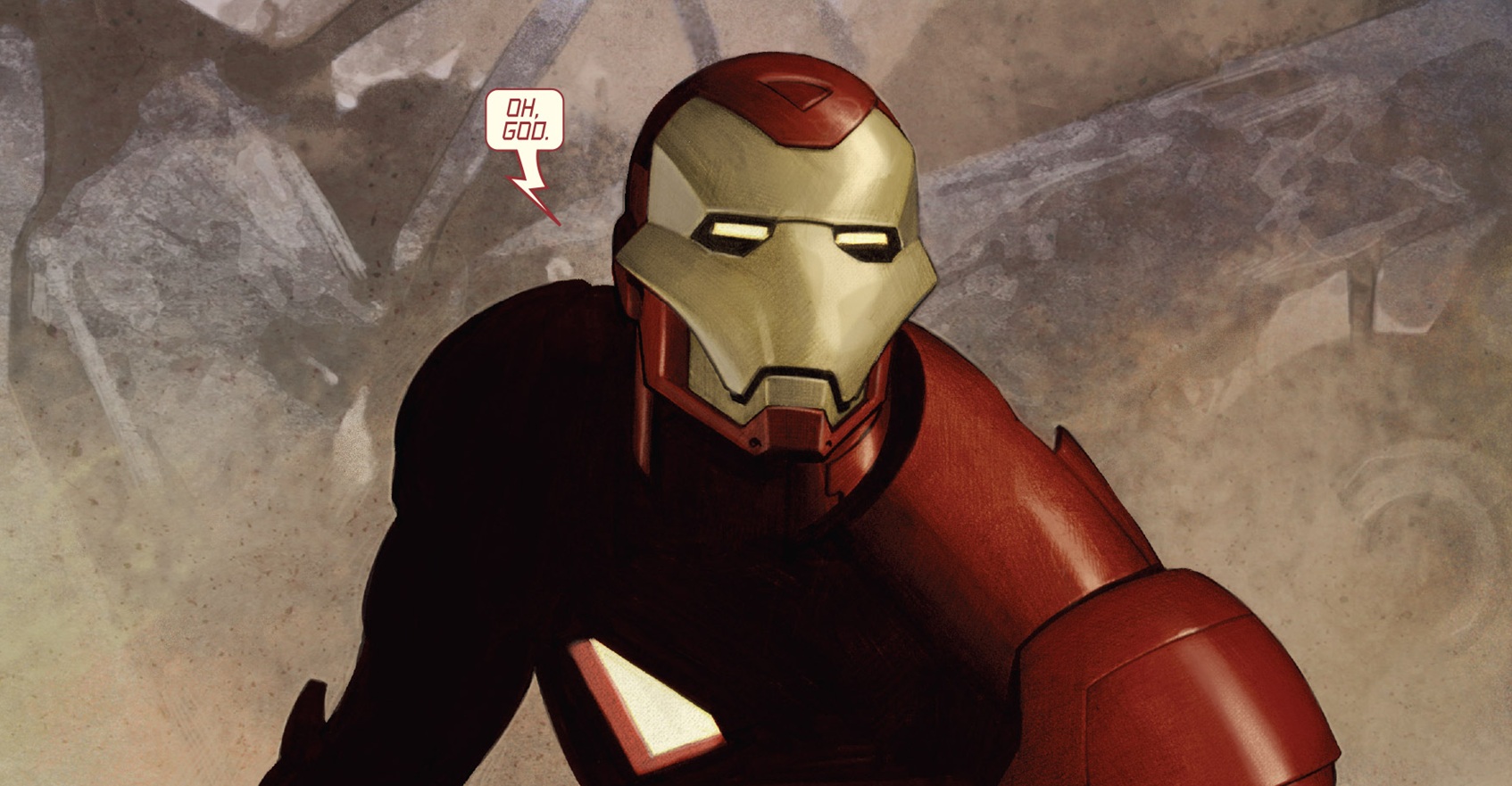
Recently, I read Iron Man: Extremis, Warren Ellis and Adi Granov’s six-issue arc that gives us a fresh take on what Iron Man is.
This isn’t your typical superhero upgrade story, where the hero gets beat up, goes to the lab, comes back with shiny new armor. Extremis goes somewhere else entirely. Somewhere uncomfortable.
How to Lose a Fight
Domestic terrorists steal a biotech serum called Extremis. Basically it’s a Super-Soldier Serum built with nanotechnology that rewrites your body at the cellular level. One of them, a guy named Mallen (who is angry at the world and looking for someone to blame), is injected with it.
The transformation is horrific. He’s covered in strange scar tissue. When the transformation is over, he emerges with enhanced strength, speed, durability, regeneration. Oh, and he can breathe fire which he immediately uses to massacre people at a highway checkpoint.
Tony Stark, at this point in his life, is struggling. He’s a disillusioned futurist wrestling with the moral weight of his legacy as a weapons designer in a post-9/11 world. The story includes flashbacks to a reimagined origin. Captured in Afghanistan, he builds the first armor with Ho Yinsen, and escapes by killing his captors. That guilt, especially over Yinsen’s death, drives everything that happens next.
When Iron Man confronts Mallen, he gets absolutely destroyed. And I mean destroyed. Mallen shrugs off repulsor blasts, tears into the armor like it’s aluminum foil, breathes fire directly at Tony, and leaves him critically injured with his suit wrecked. Civilians died despite his best efforts.
That’s when Tony realizes something that changes everything.
Bodies as Upgrade Platforms
Conventional upgrades won’t cut it. More armor plating? Bigger weapons? Irrelevant when your opponent can literally rip through metal with his bare hands.
So Tony makes a choice that, honestly, you could argue wasn’t really a choice at all. He has himself taken to Maya Hansen’s lab. She’s Extremis’s chief scientist and an old flame. He reveals his identity to her, and injects a modified version of Extremis into his own body.
The process nearly kills him. For days, his body dissolves into a cocoon of scab-like tissue while Extremis rewrites his biological “blueprint.” It grows new organs for him, boosts his healing and immune system to superhuman levels. And hardwires a techno-biological interface directly into his nervous system.
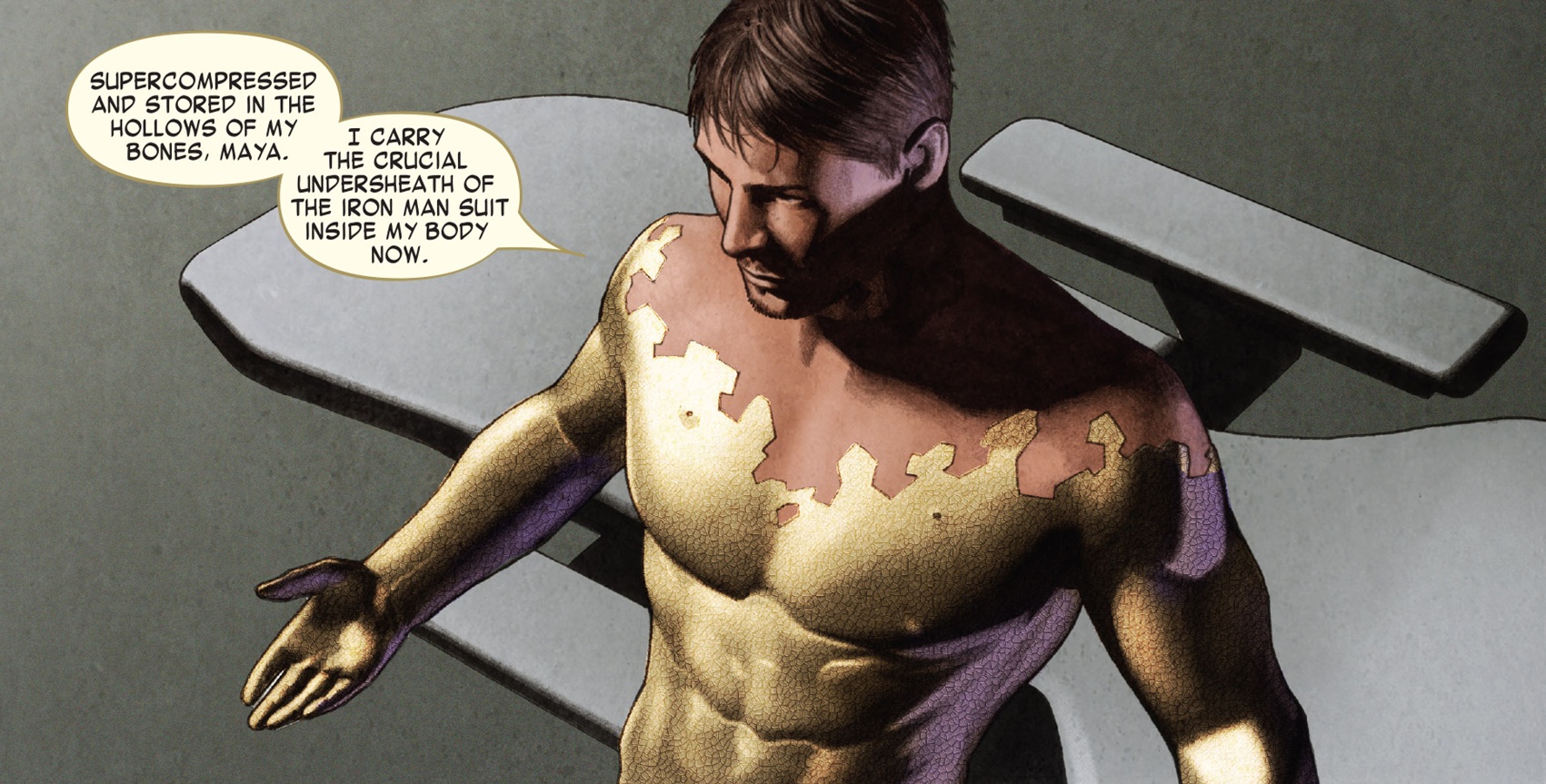
When the cocoon bursts, Tony emerges as a human cyborg. There are microstructures in the hollows of his bones and under his skin, an internal control sheath that lets him store parts of the Iron Man armor inside his body and summon them on mental command. His brain now processes information at incredible speed and can wirelessly interface with phones, computers, satellites. He’s a living network node who can control his armor and external systems as easily as moving a limb.
He’s not a man in a suit anymore. He is the suit.
The Cost of Inevitability
Here’s what gets me about Extremis is that it paints Tony’s transformation as something that’s inevitable. Once Mallen injected himself and that technology was in hostile hands, Tony had to match it or die trying.
But was it really inevitable? Or did Tony just decide it was?
In the final battle, Tony tracks Mallen through satellite surveillance (something he can now do just by thinking about it). He discovers Mallen is heading to Washington D.C. to kill the president, and confronts him in his upgraded armor. It’s a vicious fight that levels the streets. Two Extremis-enhanced beings testing the limits of what biotech can do to a human body.
During the fight, Tony tries to reach Mallen verbally. He contrasts their different responses to trauma. Tony reminisces on the captors he killed to escape during his origin. But he used that experience to become more responsible so he could protect the future, while Mallen chose indiscriminate destruction.
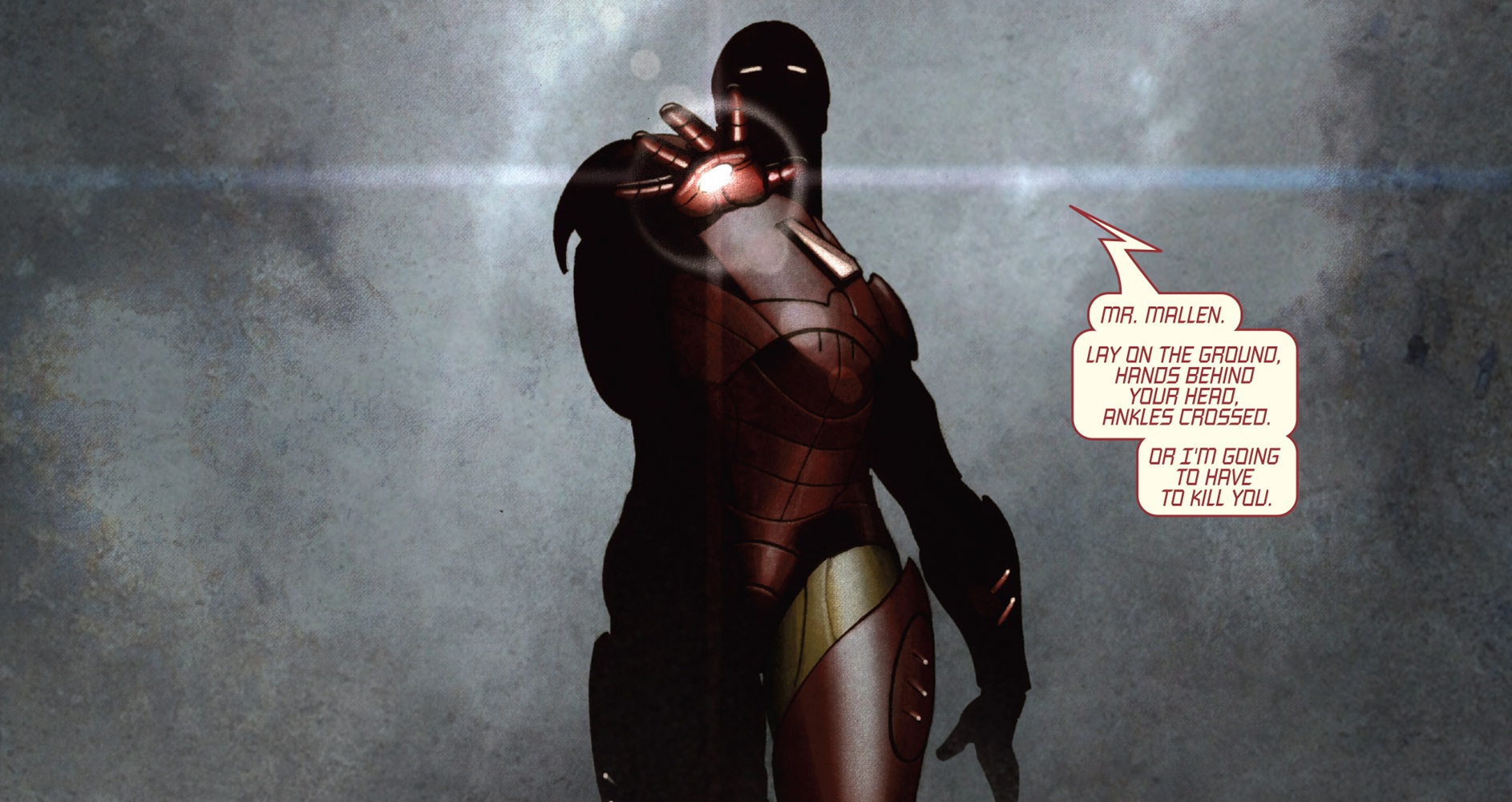
Mallen rejects Tony’s attempt to talk him down. He pins Tony down and vows to “kill the future.”
Tony uses his unibeam to blast a hole through Mallen’s chest. When Mallen’s Extremis body still tries to attack (because that’s how powerful regeneration is now), Tony obliterates his head with repulsors.
Horrified at what he’s been forced to do, yet convinced it was necessary, Tony reflects that Extremis represents the true “next step” for Iron Man. Not just a man in a suit, but a man who is the suit. An integrated weapon and futurist trying to steer humanity’s future in the right direction.
When Innovation Becomes Irreversible
Ironically, the story doesn’t celebrate Tony’s transformation. Ellis makes sure you feel the weight of it. Tony didn’t just upgrade his armor. He fundamentally altered what it means to be Tony Stark, rewrote his biology, turned himself into something posthuman. And for what? To stop one guy with a stolen serum.
Except it’s not really about one guy, is it? It’s about what happens when you open Pandora’s Box. Once a virus like Extremis exists, a bioweapon that can rewrite the human body at the cellular level, that technology doesn’t go away. It spreads, evolves. Someone else will use it, improve it, and eventually weaponize it.
Tony’s choice to inject Extremis wasn’t about winning one fight. It was about accepting that the future now includes this technology, and someone has to guide where it goes. If not him, then who? Mallen? The next angry person with access to a lab?
What This Means for the “Man” in Iron Man
The title of this story arc is doing a lot of work. “Extremis” sounds clinical, scientific. How far should you go to keep up with evolving technology? When does upgrading yourself stop being a choice and start being about survival?
Tony Stark has always used technology to solve problems. Build a better suit. Design smarter weapons. Create cleaner energy. But Extremis crosses a line by making him the tool. His body is now the platform. His biology is the interface.
And… you can’t uninstall that.
The story ends with Tony vowing to use his new abilities to shape a better future, but Ellis leaves some questions hanging. What happens when one person, even a well-intentioned one, becomes that integrated with technology? What happens when your body is your weapon system? When your nervous system is hardwired to satellites and you can process information faster than most computers?
What happens when you’re not really human anymore, but you’re still trying to protect humanity?
Why This Story Still Hits
Warren Ellis wrote Extremis in 2005, but reading it now feels almost prophetic. We live in a world obsessed with optimization. There’s biohacking, performance enhancement. Wearable tech that monitors every heartbeat. Neural interfaces that promise to connect our brains directly to computers.
We’re not injecting ourselves with nanotech serums (yet), but we’re treating our bodies as platforms for technological integration. Like Tony, we’re claiming it’s inevitable. Keep up or fall behind.
Extremis doesn’t tell you whether that’s good or bad. It shows you what it costs. Not in money or time, but in what you give up when you decide your humanity isn’t enough anymore. When you choose to become something else entirely because the alternative is losing.
The horror isn’t that Tony becomes a human-machine hybrid. It’s that he’s probably right. It was the only way forward. Once you accept that logic, where does it stop?