Most arcs in To Be Hero X are about falling. Ambition curdling into obsession. The hero system grinding people down until there’s nothing left but their ranking. Lin Ling, E-Soul, Moon… those stories “hurt” because they’re about how a world built on public belief can consume the people inside it.
Lucky Cyan’s arc is different. It moves upward.
That’s not to say it’s light. Exploitation, survivor’s guilt, public scapegoating… her story has all of it. The distinction in the direction of her story arc is what makes her one of the most thematically complete characters in the series.
The Miracle She Never Asked For
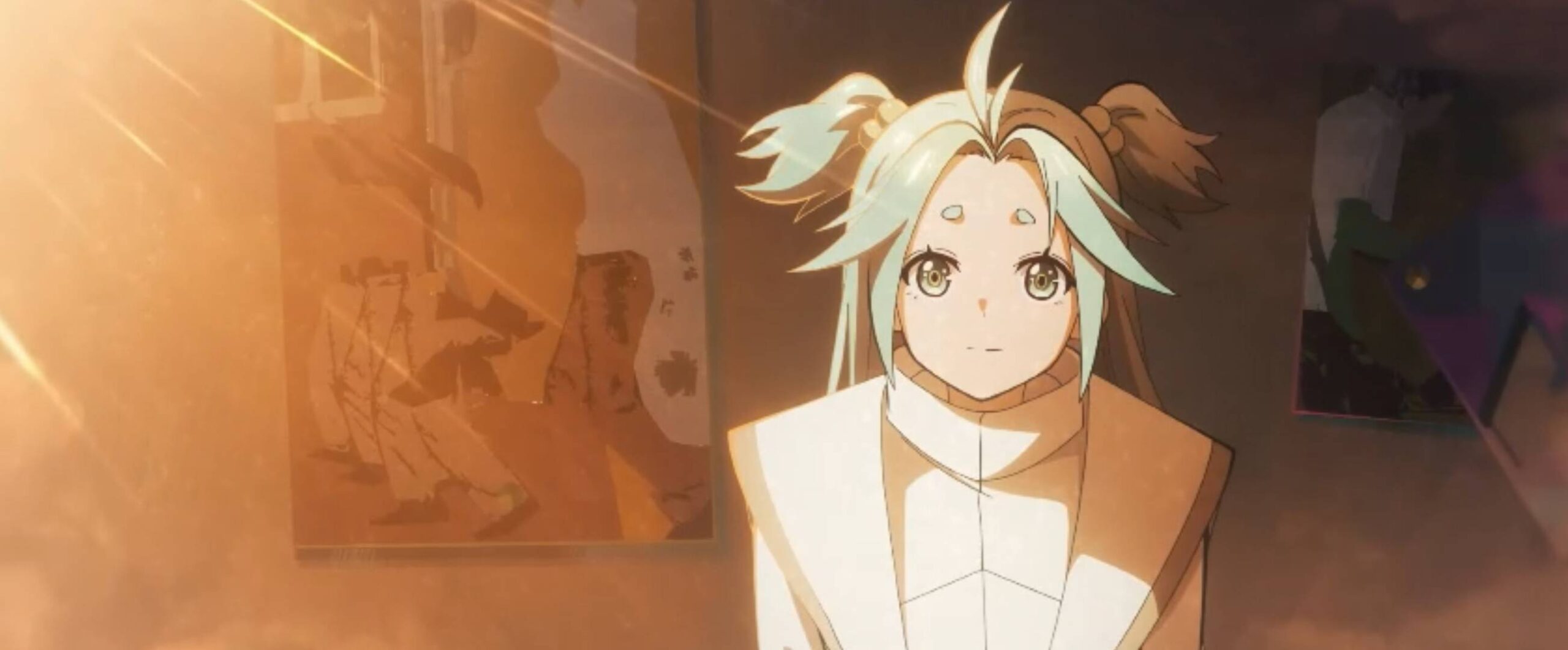
Cyan’s story begins before she has any say in it. She survives a plane crash as the sole survivor, as a baby. The fact is hidden from most people. However, as she got older, her luck, and her ability to make others “lucky”, was impossible to miss. The people around her looked for a story to explain it. She becomes a miracle. A sign. The orphanage that takes her in doesn’t raise her so much as install her as a symbol: the Sacred Maiden, a figure who distributes blessings to others.
She is idolized. She is controlled. She is not allowed to be a person.
This is the first and most damning thing her arc says about institutions: they don’t worship people, they worship what people represent. The orphanage saw a brand. A source of meaning that could be managed, displayed, and used. Her humanity was incidental.
Her wish, stated simply and devastatingly, is just to be a normal person. Someone who can make mistakes. The fact that this reads as aspirational, that ordinariness is what she’s reaching for, tells you everything about what her life has been.
Luo: The First Person to Treat Her Like Nobody Special
Enter Luo. Associated with calamity, bad luck, and general chaos. Basically Cyan’s symbolic opposite. And yet he becomes the first person in her life to treat her as an ordinary human being.
There’s something quietly radical about that. The one person society frames as cursed is the one who refuses to frame her as blessed. He doesn’t want anything from her luck. He doesn’t project anything onto her. He just… talks to her.
The Cyan-Luo dynamic is, I’d argue, the most honest depiction of what genuine connection looks like inside a system that commodifies belief. Every other relationship in her life is transactional. People approach her because of what she represents. Luo approaches her as herself.
He encourages her to leave the Sacred Maiden role and find her own expression. Music becomes that expression. As Lucky Cyan the singer, she finally has something that belongs to her. Emotions she chose to put into a performance, rather than a role others scripted for her. This is the rebirth phase of her arc, and it genuinely earns that description.
The Fall: From Idol to Scapegoat
Of course the story can’t let her simply walk away from the symbol she was made into. The darker turn arrives when rumors spread that her luck didn’t come from some cosmic miracle. It came from taking fortune from others. Specifically, from the passengers who died in that crash. They all prayed for her to live. Including Luo’s parents.
The cruelty of this is precise. She was never allowed to be ordinary when people loved her. Now she’s not allowed to be ordinary when they turn on her either. The idol becomes the scapegoat. The orphanage, once a site of reverence, descends into fear and chaos as the public’s belief, the same force that powered her, collapses.
Her Trust Value craters. Her identity, which she’d only just started to build, is threatened again. But this time from a different direction.
The Truth About Her Power
Her luck didn’t come from stolen fortune. It came from the hopes of the passengers. People who, in their final moments, wanted her to live. Their collective belief created her power. Her survival became the living embodiment of their hope.
This is a quietly stunning piece of worldbuilding. Most heroes in To Be Hero X chase Trust Value through strength, spectacle, or popularity. External performances designed to manufacture belief. Cyan’s power didn’t work like that. It was given to her, freely, by people who had no stake in her success beyond wanting a child to survive. That makes her luck something the series rarely depicts: trust that begins with genuine love rather than transaction.
Once the truth is known, faith in her is restored. Her Trust Value surges, placing her at rank #7 among heroes. Not because she performed for anyone. Because the truth was simply told.
Luo’s Betrayal And Why It Had to Happen
Here’s where a lot of viewers stumble. Luo, the person who freed her, eventually turns against her. It looks like a betrayal. It feels like one. The question is whether it is one.
I don’t think so and the show earns that reading deliberately.
One interpretation is protective: Luo understands that Cyan’s growing power and public profile risk trapping her in the same cycle that destroys other heroes. The stronger her reputation, the more people project onto her. By opposing her, he may be trying to break that spiral before it consumes her identity again.
The more symbolic reading is that their conflict was structurally inevitable. If Cyan represents hope, Luo represents the hardship that tests it. For her independence to be real, not just a phase she went through with his encouragement, she had to be able to stand against him. If she couldn’t oppose the person who first freed her, she would only have traded one dependency for another. The orphanage defined her. Luo helped her escape. But if she followed his lead indefinitely, she still wouldn’t be free.
The betrayal isn’t a failure of their relationship. It’s the final exam of her arc. She has to define herself without him.
The Reconciliation and What It Completes
Their reconciliation near the end of her storyline matters precisely because of what it doesn’t look like. It isn’t Cyan forgiving Luo and going back to the way things were. It’s two people meeting as equals for the first time.
She is no longer the Sacred Maiden. She is no longer Luo’s project. She is a singer and a hero on her own terms, and when she and Luo find their way back to each other, she brings that whole self to the relationship.
The reconciliation also does something the series doesn’t often allow itself: it suggests that trust, once broken, can be rebuilt. The entire world of To Be Hero X runs on belief, and the show is often cynical about how fragile and weaponizable that belief is. Cyan’s arc, specifically its ending, argues for something more durable. Hope that survives hardship becomes stronger. The relationship that comes out of conflict and honest confrontation is more real than the one that never got tested.
Symbolically: luck and misfortune don’t cancel each other out. They coexist.
What Her Arc Actually Proves
A fair critique of Cyan’s arc is that it feels emotionally lighter than the earlier storylines. Lucky Cyan’s arc exists to show what the hero system looks like when someone escapes it without being destroyed by it. Lin Ling, Moon and E-Soul demonstrate what the system does to people who get caught in it. Cyan demonstrates that the trap can be recognized, named, and refused. It’s a rarer story.
Her arc moves through three stages with real clarity: symbol, individual, hero by choice. And what seals it is the moment she reconciles with Luo not as someone who needs him, but as someone who simply wants him in her life. That’s the quietest and most human beat in her whole story.
Why It Still Resonates
There’s a reason Lucky Cyan’s arc hits differently for a lot of viewers. It’s not just an anime story about a girl who wanted to sing. It’s a story about what happens when the world decides who you are before you’ve had the chance to figure it out yourself and what it costs to take that back.
Most of us don’t survive plane crashes. But most of us know what it’s like to be seen through a lens someone else built. The kid who’s “the smart one,” the friend who’s “always fine,” the person who smiles so reliably that no one ever thinks to ask. Identity gets assigned early and often, and dismantling it, finding out what’s actually yours, is uncomfortable, isolating work.
Cyan does that work. She loses people doing it. She gets publicly destroyed for it. And she comes out the other side not as the Sacred Maiden, not as Luo’s protégé, but as herself.
And… she meets new friends along the way….