Danny Rand has never belonged anywhere. Not in K’un-Lun, where he was always a white American boy and an outsider. Or in New York, after spending a decade living in a mystical city no one believes exists.
The word “outsider” is the closest you will get to understanding Danny Rand. It’s a concept that defines his connection to K’un-Lun and where he stands as the Iron Fist.
Who is Danny Rand?
Danny Rand (Iron Fist) was created by Roy Thomas and Gil Kane, appearing in Marvel Premiere #15 (May 1974) to capitalize on the kung fu film craze that had taken America by storm during the 1970s.
Danny was born in New York City to wealthy entrepreneur Wendell Rand and socialite Heather Rand.
Wendell Rand first discovered K’un-Lun as a boy, a mystical city and one of the Seven Capital Cities of Heaven. While the city technically exists in a pocket dimension, it merges with Earth for one day every ten years. When K’un-Lun is on Earth, it can be found hidden in the Kunlun Mountains in western China, one of the largest mountain ranges in Asia. Wendell saved the life of K’un-Lun’s ruler Lord Tuan and was adopted as his son. However, Wendell chose to leave K’un-Lun once he became an adult.
Years later, Wendell took his wife, son, and business partner Harold Meachum on an expedition to find K’un-Lun again. During the expedition, Danny slipped while the group was climbing a mountain, his tie-rope pulling his parents with him. Harold, who was in love with Heather, used the moment to force Wendell to his death. He then offered to rescue Heather and Danny, only to abandon them when she rejected him.
If that wasn’t bad enough, Heather threw herself to a pack of wolves so her nine-year-old son could cross a bridge to safety. Danny was rescued by archers from K’un-Lun, who took the grieving child to their master Yu-Ti.
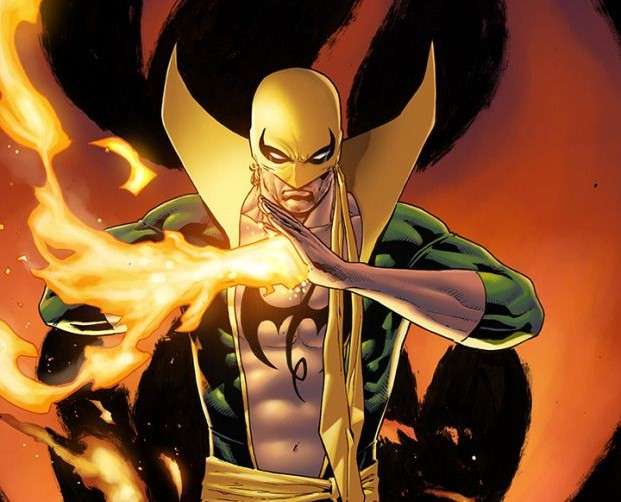
Danny spent the next decade training under Lei Kung the Thunderer, mastering every aspect of martial arts in K’un-Lun. At nineteen, he underwent his coming-of-age ritual: defeating Shou-Lao the Undying, an immortal dragon. His victory left him with a stylized dragon brand across his chest and the title of Iron Fist.
With the power of the Iron Fist, Danny can channel chi (spiritual life-force energy) to enhance his natural abilities. He can focus his own chi alongside the energy of Shou-Lao, manifesting it as glowing energy surrounding his hands and fists.
Instead of staying in K’un-Lun and embracing immortality, Danny returned to New York to avenge his parents. He found Harold Meachum, but chose not to kill him once he saw Harold had become a pathetic, bitter amputee who’d lost his legs to frostbite. A mysterious assassin killed Harold anyway, and his daughter Joy blamed Iron Fist for his death. Danny cleared his name and the experience inspired him to use the power of the Iron Fist to fight for justice.
Is Danny Rand an Example of Cultural Appropriation?
For years, Danny’s existence has been a source of controversy. He is a white American man who becomes the greatest warrior of a culture that doesn’t belong to him, then returns to the Western world as its representative.
Everything about the mythology surrounding Iron Fist draws from Chinese culture. The city of K’un-Lun is based on the concept of axis mundi, or “pillar of the sky”. It’s the belief that the Kunlun Mountain range is the center of the world, a bridge connecting Heaven, Earth, and the Underworld. The idea of using chi as a power source is drawn from the concept of qi, a vital energy or life force central to Traditional Chinese Medicine. There are also parallels between Danny’s origins and those of Kwai Chang Caine, a half-Chinese, half-American orphan raised in a Shaolin monastery in the 1972 television series Kung Fu. Even the dragon Danny defeats shares its name with Shou-Lao the God of Longevity, a revered figure in Chinese and Taoist tradition who symbolizes long life and health.
Many have criticized Danny Rand for reinforcing a white savior narrative and promoting orientalism, a stereotypical and sometimes offensive portrayal of Asian cultures. Co-creator Roy Thomas has been defensive of the character, stating that he wasn’t ashamed of making Danny white.
When Marvel and Netflix announced they were developing a television series on Iron Fist, an online movement formed advocating for an Asian-American actor to take the role. Prominent figures including writer Gail Simone, director Lexi Alexander, and journalist Marc Bernardino voiced their support for an Asian Iron Fist. Not everyone was on board with the idea. Writer Albert Ching argued in an article for Comic Book Resources that changing Iron Fist’s race would reinforce a different stereotype of Asians being inherently proficient in martial arts. White English actor Finn Jones was cast as Danny, but the series only fueled existing accusations of cultural appropriation.
Regardless of how you feel about Danny Rand as a character, the criticism he’s faced is valid. He’s another example of how the Western world can embrace certain aspects of Asian culture while refusing to center Asian characters (particularly Asian men) in their own stories. I’m not saying this was the intention of his creators, but it doesn’t change the reality of the situation.
Marvel has addressed the controversy in its own way. The Immortal Iron Fist run (2006–2009) by Ed Brubaker, Matt Fraction, and artist David Aja redefined Danny’s role as the Iron Fist. We learn that he’s one of dozens of people to have held the title throughout history, including warriors from diverse backgrounds. Danny is not the chosen one, he’s merely the current one. Or at least he was until Marvel passed the title to Lin Lie, a Chinese character and descendant of Chinese legend Fuxi. Lin Lie is even a playable character in the third-person shooter Marvel Rivals, which has given some fans hope that Marvel is listening to them.
Becoming the Ghost Fist
The Iron Fist 50th Anniversary Special (August 2024) ended with Danny Rand’s death.
The Ch’i-Lin, a longtime enemy of every Iron Fist across the centuries, was destined to hunt each bearer of the title. Danny had defeated the creature years earlier, but only postponed his fate. The blade-handed assassin Razor Fist, possessed by the Ch’i-Lin, cut off Danny’s right hand and left leg before killing him on his thirty-fourth birthday. To make it clear that Danny wouldn’t stay dead for long, the issue ended with a QR code directing readers to a secret page of a glowing skeletal hand bursting from a grave.
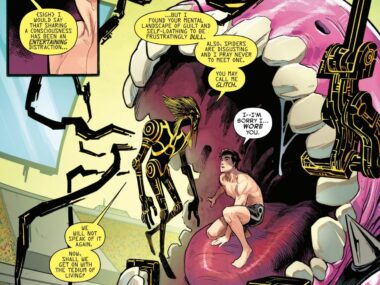
Danny’s spirit was sent to the Duat, the Egyptian underworld, where he encountered his predecessor Orson Randall. Orson revealed that everything the Book of the Iron Fist taught them was a lie. Quan Yaozu, who’d lied about being the first Iron Fist, had orchestrated the deaths of previous Iron Fists throughout history, siphoning their chi to extend his own life and power. Orson brought Danny before Osiris, the Egyptian god of the dead, who judged his soul to be pure and offered him a bargain: return to the living as the Ghost Fist, complete a trial to destroy Quan Yaozu, and earn his resurrection.
The catch was that Osiris created a tapestry representing Danny’s soul. Once Danny returned to the living world, the tapestry would begin to burn. If it burned away entirely before he completed his mission, he would be permanently bound to the underworld. Osiris trained Danny for months before tattooing his divine mark on Danny’s chest, replacing the old Heart of the Dragon brand.
Danny returned to the living world in The Undead Iron Fist (September 2025), a four-issue limited series written by Jason Loo with art by Fran Galán. He came back with a new costume: armor covering his right arm to replace the severed limb, arnis sticks, and a full cowl mask. He also returned with new powers. As Ghost Fist, Danny can channel a mystical purple aura similar to the chi of Shou-Lao, empowering his strikes and projecting destructive energy blasts. He can also sense and see supernatural and demonic forces invisible to ordinary humans. The caveat is that using these abilities too aggressively shortens the time he has left.
Danny made his way through New York toward the Rand Building, where Quan had established a portal to the Eighth City. On the way there, Danny fought through an army of Wraithlins or demonic entities possessing ordinary civilians. He briefly crossed paths with Spider-Man, who couldn’t see the Wraithlins and assumed Ghost Fist was a criminal attacking civilians. He also ran into Daredevil, who deduced his identity and offered help that Danny declined. Quan had also dispatched the possessed Immortal Weapons, but Danny defeated and freed each of them.
When Danny reached the Rand Building, he found his best friend Luke Cage waiting for him, possessed by a Wraithlin. Unable to bring himself to attack Luke, Danny allowed himself to be knocked out and brought before Quan in the penthouse. Quan confirmed he was responsible for the deaths of the previous Iron Fists and that Danny’s attempts to redeem him were futile.
Danny broke free and summoned the spirit of T’an-Long, a heavenly dragon he had encountered in the underworld before Quan killed her centuries earlier. Together, Ghost Fist and T’an-Long freed Luke from possession and threw Quan from the building to his death. T’an-Long dragged his soul to the underworld.
With the mission complete and the tapestry barely intact, Danny was summoned back. Osiris declared the bargain fulfilled but kept Danny in the underworld until he was needed in the realm of the living again. Days later, Luke had Danny’s grave taken down.
The Long Way Home
Danny Rand arrived in K’un-Lun as a traumatized nine-year-old with no family or claim to the city. He returned to New York as a young man shaped by a place you couldn’t find on a map, wielding power rooted in a tradition that was never his. He reclaimed his father’s company from the family of the man who killed said father. At every turn, the world reminded him that he didn’t quite fit but that never stopped him from showing up and doing his best.
The Ghost Fist arc is the end of that story, and also something stranger. In death, Danny comes to grips with the corruption he was unknowingly a part of, the lie at the center of the Iron Fist mythology. His resurrection doesn’t bring him back as the Iron Fist. He comes back as something new, with borrowed time so he can avenge his predecessors.
Whether Danny Rand returns to the world of the living or is forced to stay in the underworld as Osiris’s instrument remains to be seen. What the last fifty years have made clear is that you’ll never know what the universe has in store for Danny Rand.
Comics Reading List
- The Immortal Iron Fist #1–27 by Ed Brubaker, Matt Fraction & David Aja (the definitive run and one of Marvel’s best series of the 2000s)
- Power Man and Iron Fist #50–125 by Chris Claremont, John Byrne and various writers and illustrators (features Danny’s friendship with Luke Cage that defines both characters)
- Iron Fist vol. 1 #1–15 — Chris Claremont & John Byrne (the original solo run)
- Iron Fist 50th Anniversary Special #1 by Chris Claremont, Justina Ireland, Jason Loo, Frank Tieri & Alyssa Wong (Danny’s death; essential for understanding what comes next)
- The Undead Iron Fist #1–4 by Jason Loo & Fran Galán (the Ghost Fist era; the most recent chapter)
- Power Man and Iron Fist vol. 3 by David Walker (the best take on Luke and Danny’s friendship)
- Iron Fist: The Living Weapon by Kaare Andrews (a modern retelling of Danny’s origin story)